Contextual-value approach to the generalized measurement of observables
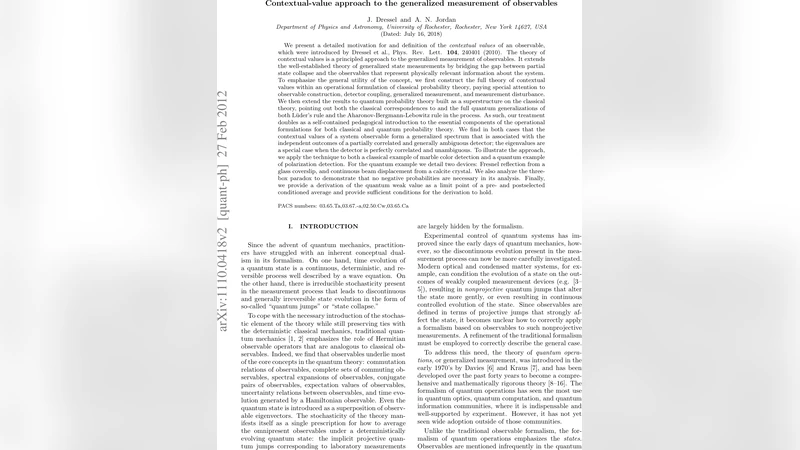
We present a detailed motivation for and definition of the contextual values of an observable, which were introduced by Dressel et al. [Phys. Rev. Lett. 104 240401 (2010)]. The theory of contextual values extends the well-established theory of generalized state measurements by bridging the gap between partial state collapse and the observables that represent physically relevant information about the system. To emphasize the general utility of the concept, we first construct the full theory of contextual values within an operational formulation of classical probability theory, paying special attention to observable construction, detector coupling, generalized measurement, and measurement disturbance. We then extend the results to quantum probability theory built as a superstructure on the classical theory, pointing out both the classical correspondences to and the full quantum generalizations of both L"uder’s rule and the Aharonov-Bergmann-Lebowitz rule in the process. We find in both cases that the contextual values of a system observable form a generalized spectrum that is associated with the independent outcomes of a partially correlated and generally ambiguous detector; the eigenvalues are a special case when the detector is perfectly correlated and unambiguous. To illustrate the approach, we apply the technique to both a classical example of marble color detection and a quantum example of polarization detection. For the quantum example we detail two devices: Fresnel reflection from a glass coverslip, and continuous beam displacement from a calcite crystal. We also analyze the three-box paradox to demonstrate that no negative probabilities are necessary in its analysis. Finally, we provide a derivation of the quantum weak value as a limit point of a pre- and postselected conditioned average and provide sufficient conditions for the derivation to hold.
💡 Research Summary
The paper develops a comprehensive framework called “contextual values” for describing generalized measurements of observables, both in classical and quantum settings. Starting from an operational formulation of classical probability, the authors define a sample space of mutually exclusive propositions, its Boolean algebra, and an algebra of observables. A measurement device is modeled by a conditional probability matrix that maps system states to detector outcomes. The key idea is to assign to each detector outcome a numerical weight—called a contextual value—such that the observable can be reconstructed as a weighted sum of the detector’s POVM elements. These contextual values reduce to the eigenvalues of the observable only when the detector is perfectly correlated and unambiguous; otherwise they form a generalized spectrum that compensates for detector noise, bias, or ambiguity.
A concrete classical example involving a color‑blind observer illustrates how the contextual values (e.g., a = 25, b = −25) are derived from the detector’s confusion matrix and used to recover the true average color of a marble ensemble. The authors then lift the construction to quantum theory by treating each measurement context as a separate “framework” built on the same underlying probability space. Quantum states are represented by density operators, measurements by POVM elements Eₖ and Kraus operators Mₖ. The observable A is expressed as A = ∑ₖcₖEₖ, defining the quantum contextual values cₖ. This formulation simultaneously generalizes Lüders’ rule for state update and the Aharonov‑Bergmann‑Lebowitz (ABL) rule for pre‑ and post‑selected ensembles.
Two quantum optical implementations are presented: (1) Fresnel reflection from a glass coverslip and (2) continuous beam displacement in a calcite crystal, both used to measure photon polarization. In each case the detector’s imperfect correlation with the polarization is quantified, and the appropriate contextual values are calculated, demonstrating that different physical devices can yield the same observable when properly calibrated.
The paper also treats weak measurements. By taking the limit of vanishing interaction strength, the authors show that the conditioned average of a pre‑ and post‑selected ensemble converges to the familiar weak value, provided certain regularity conditions on the measurement operators are satisfied. This connects the contextual‑value formalism to the broader weak‑measurement literature.
Finally, the three‑box paradox is revisited. Using contextual values, the paradox is resolved without invoking negative probabilities; the apparent contradictions arise solely from neglecting the measurement context.
Overall, the work bridges the gap between traditional observable‑centric quantum mechanics and the modern theory of quantum operations, offering a unified, operationally transparent method to handle imperfect, weak, and post‑selected measurements across both classical and quantum domains.
Comments & Academic Discussion
Loading comments...
Leave a Comment