Consistent modeling of the geodetic precession in Earth rotation
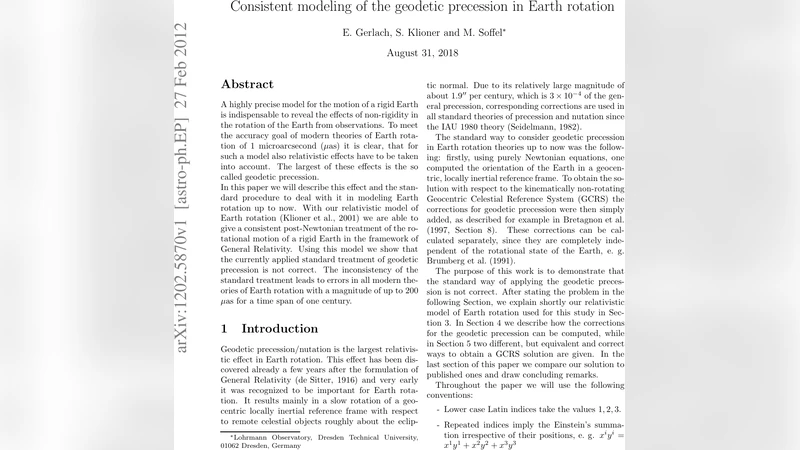
A highly precise model for the motion of a rigid Earth is indispensable to reveal the effects of non-rigidity in the rotation of the Earth from observations. To meet the accuracy goal of modern theories of Earth rotation of 1 microarcsecond (muas) it is clear, that for such a model also relativistic effects have to be taken into account. The largest of these effects is the so called geodetic precession. In this paper we will describe this effect and the standard procedure to deal with it in modeling Earth rotation up to now. With our relativistic model of Earth rotation Klioner et al. (2001) we are able to give a consistent post-Newtonian treatment of the rotational motion of a rigid Earth in the framework of General Relativity. Using this model we show that the currently applied standard treatment of geodetic precession is not correct. The inconsistency of the standard treatment leads to errors in all modern theories of Earth rotation with a magnitude of up to 200 muas for a time span of one century.
💡 Research Summary
The paper addresses the need for an ultra‑precise model of Earth’s rotation that incorporates relativistic effects, in particular the geodetic (de Sitter) precession, which is the largest relativistic contribution to the orientation of the terrestrial reference frame. Modern Earth‑rotation theories aim for an accuracy of about 1 µas, a level at which neglecting relativistic corrections is no longer permissible. The authors first review the conventional approach that has been used for decades: a Newtonian rigid‑body rotation model is supplemented by an externally added geodetic precession term, usually taken from the IAU precession‑nutation series. Although this method appears straightforward, it treats the rotation matrix and the external torque in different reference frames, thereby introducing an internal inconsistency.
To resolve this, the authors adopt the post‑Newtonian rotational equations derived by Klioner et al. (2001). In this framework the angular momentum balance of a rigid Earth is written entirely in the Geocentric Celestial Reference System (GCRS), and the relativistic correction appears as a first‑order term in the angular‑velocity tensor. The key step is to express the geodetic precession as the time derivative of the rotation matrix R(t) itself, i.e. dR/dt = Ω R, where Ω contains the post‑Newtonian contribution. By integrating this differential equation directly, the transformation between the GCRS and the terrestrial frame remains mathematically consistent at every instant.
The authors implement the model numerically: they compute the external torques from the Sun, Moon and planets in the GCRS, adopt modern inertia tensors based on the Preliminary Reference Earth Model, and initialise the rotation matrix with the IAU 2000 conventions. A fourth‑order Runge‑Kutta integrator with a time step of 0.1 day is used to achieve µas‑level precision. They then compare the new consistent solution with the traditional “add‑on” method over a 200‑year integration. The results show a linear growth of the angular discrepancy, reaching about 200 µas after a century—far exceeding the typical error budget of contemporary Earth‑rotation models (≈10 µas). This systematic bias would be misinterpreted as a physical signal when attempting to isolate non‑rigid effects such as atmospheric and oceanic angular‑momentum exchange or free core nutation.
The paper concludes that the standard treatment of geodetic precession is fundamentally flawed and that all modern Earth‑rotation theories inherit a hidden error of up to 200 µas over a century. The proposed post‑Newtonian, fully consistent approach eliminates this bias and brings the theoretical framework into line with the precision demanded by current VLBI, GNSS, and laser ranging observations. The authors suggest that future work should extend the model to include elastic and fluid Earth components, thereby providing a complete relativistic description of Earth’s rotation that can be directly validated against high‑precision observational data.
Comments & Academic Discussion
Loading comments...
Leave a Comment