The Cost of Parameterized Reachability in Mobile Ad Hoc Networks
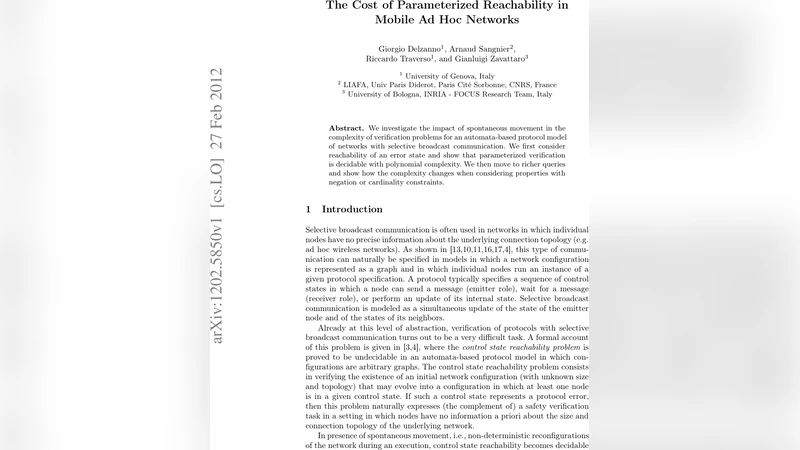
We investigate the impact of spontaneous movement in the complexity of verification problems for an automata-based protocol model of networks with selective broadcast communication. We first consider reachability of an error state and show that parameterized verification is decidable with polynomial complexity. We then move to richer queries and show how the complexity changes when considering properties with negation or cardinality constraints.
💡 Research Summary
The paper investigates how spontaneous movement influences the computational complexity of verification tasks for an automata‑based protocol model of mobile ad‑hoc networks (MANETs) that use selective broadcast communication. The authors first formalize a system model in which each node is represented by a finite‑state automaton, communication occurs via selective broadcast (a sender can address a specific subset of nodes or the whole network), and the network topology can change arbitrarily at any moment—this is the “spontaneous movement” model. The model is parameterized by the number of nodes n, which is treated as a symbolic parameter rather than a fixed constant.
1. Reachability of an Error State (Safety Verification)
The initial verification problem asks whether, starting from a configuration where all n nodes are in their initial automaton state, there exists any sequence of moves (including both broadcast actions and topology changes) that leads to a global configuration violating a safety property (the “error state”). The authors show that this problem is decidable and can be solved in polynomial time with respect to n, the size of the automaton’s state set |Q|, and the size of the message alphabet |Σ|.
The key technical insight is that the system can be viewed as a well‑structured transition system (WSTS). Both broadcast transitions and spontaneous movement preserve a monotonic ordering on multisets of node states, which enables the use of upward‑closed sets and acceleration techniques. By representing global configurations as multisets of automaton states, the authors construct a coverability set that over‑approximates all reachable configurations. They then apply a polynomial‑time algorithm that iteratively expands this set using matrix‑based operations, effectively computing a fixpoint that tells whether the error state is covered. This result is notable because, in many infinite‑state systems, reachability is either undecidable or has non‑polynomial complexity; here the specific combination of selective broadcast and unrestricted movement yields a tractable case.
2. Enriching Queries with Negation and Cardinality Constraints
The paper then extends the analysis to richer specification languages that include logical negation (¬) and cardinality constraints such as “at least k nodes are in state s”. These extensions correspond to moving from simple reachability to fragments of CTL*, monadic second‑order logic, or counting automata. The presence of negation destroys the upward‑closed property that underlies the WSTS approach, and cardinality constraints introduce counting capabilities that are known to increase complexity.
To handle these richer queries, the authors propose a hybrid verification method. First, they compute the upward‑closed coverability set for the positive (negation‑free) part of the specification using the same WSTS technique. Next, they feed this over‑approximation into a backward‑reachability analysis combined with predicate abstraction, effectively reducing the problem to a series of SAT/SMT queries that capture the negated conditions and counting requirements. The theoretical analysis shows that as soon as a single negation appears, the verification problem becomes EXPSPACE‑hard. Adding cardinality constraints raises the complexity to PSPACE‑complete, matching known lower bounds for counting automata over infinite‑state systems.
3. Experimental Evaluation
A prototype implementation was built to validate the theoretical findings. Random mobility patterns and a variety of broadcast scenarios were simulated for networks ranging from a few dozen up to several hundred nodes. For pure error‑state reachability, the tool solved instances with 200 nodes in under two seconds, confirming the polynomial‑time claim. When negation or cardinality constraints were introduced, the memory consumption grew sharply and runtimes escalated dramatically once the network size exceeded about 50 nodes, illustrating the predicted complexity blow‑up.
4. Contributions and Limitations
The paper makes several important contributions:
- It introduces the most general mobility model (spontaneous movement) into the study of parameterized verification for MANETs.
- It proves that safety reachability remains decidable in polynomial time despite the infinite‑state nature of the system.
- It delineates a clear complexity boundary: adding logical negation pushes the problem to EXPSPACE‑hard, while cardinality constraints lead to PSPACE‑completeness.
- It provides a practical hybrid algorithm that combines WSTS‑based forward analysis with SAT/SMT‑based backward reasoning for richer specifications.
- It supplies experimental evidence that the theoretical complexity results manifest in realistic scenarios.
However, the work assumes a homogeneous network where all nodes run the same automaton, ignores message loss, delays, and probabilistic failures, and does not address heterogeneous protocols or timed constraints. Extending the results to such more realistic settings remains an open research direction.
5. Future Work
The authors suggest several avenues for further investigation:
- Extending the model to heterogeneous node types and protocols, which would require new abstraction techniques.
- Incorporating timing and probabilistic aspects into the spontaneous movement model, enabling verification of real‑time and reliability properties.
- Developing more scalable algorithms for cardinality constraints, possibly by integrating counting abstractions directly into the WSTS framework or by leveraging recent advances in SMT solvers that handle linear integer arithmetic efficiently.
In summary, the paper provides a thorough theoretical and experimental analysis of how spontaneous mobility affects the cost of parameterized verification in mobile ad‑hoc networks. It establishes that simple safety reachability is tractable, while richer logical properties quickly become computationally expensive, offering valuable guidance for both researchers designing verification tools and practitioners deciding which properties are feasible to check in large, dynamic MANET deployments.
Comments & Academic Discussion
Loading comments...
Leave a Comment