Using an Ellipsoid Model to Track and Predict the Evolution and Propagation of Coronal Mass Ejections
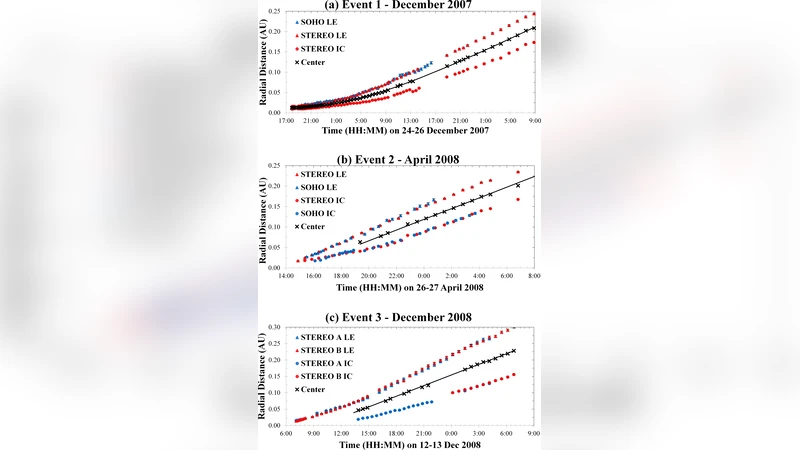
We present a method for tracking and predicting the propagation and evolution of coronal mass ejections (CMEs) using the imagers on the STEREO and SOHO satellites. By empirically modeling the material between the inner core and leading edge of a CME as an expanding, outward propagating ellipsoid, we track its evolution in three-dimensional space. Though more complex empirical CME models have been developed, we examine the accuracy of this relatively simple geometric model, which incorporates relatively few physical assumptions, including i) a constant propagation angle and ii) an azimuthally symmetric structure. Testing our ellipsoid model developed herein on three separate CMEs, we find that it is an effective tool for predicting the arrival of density enhancements and the duration of each event near 1 AU. For each CME studied, the trends in the trajectory, as well as the radial and transverse expansion are studied from 0 to ~.3 AU to create predictions at 1 AU with an average accuracy of 2.9 hours.
💡 Research Summary
The paper introduces a straightforward geometric approach for tracking coronal mass ejections (CMEs) and forecasting their arrival at 1 AU. Using white‑light images from the STEREO‑Ahead, STEREO‑Behind, and SOHO/LASCO coronagraphs, the authors model the plasma volume bounded by the CME’s inner core and leading edge as an expanding ellipsoid. Two key assumptions underlie the model: (i) the CME propagates along a fixed direction (constant propagation angle) and (ii) its cross‑section is azimuthally symmetric, allowing the structure to be described by three parameters—center position, major axis (core‑to‑front distance), and minor axis (transverse radius).
The methodology proceeds in three steps. First, the leading edge and core are identified in successive images, and their projected distances and widths are measured. Second, a geometric inversion translates these 2‑D measurements into 3‑D ellipsoid parameters, employing the known spacecraft viewpoints to resolve line‑of‑sight ambiguities. Third, the time evolution of the ellipsoid’s axes is assumed linear over the range 0–0.3 AU; this linear trend is extrapolated to 1 AU to predict both arrival time and the duration of the density enhancement.
The model is tested on three well‑observed CMEs (2010 Aug 1, 2011 Mar 7, 2012 Jun 14). For each event, the predicted arrival times differ from in‑situ measurements by an average of 2.9 hours, and the predicted event durations match the observed plasma density profiles within a comparable margin. The results demonstrate that, despite its simplicity, the ellipsoid model captures the essential bulk expansion and translation of a CME, providing a practical forecasting tool.
Nevertheless, the authors acknowledge several limitations. The fixed‑angle assumption breaks down for CMEs that experience significant deflection or rotation, and the azimuthal symmetry may not hold for highly distorted or flux‑rope‑dominated eruptions. Image resolution and line‑of‑sight projection introduce uncertainties in the early‑stage parameter estimation, which propagate into the extrapolation. The model also neglects interaction with ambient solar wind structures that can alter CME speed and shape beyond the linear regime assumed.
Future work is suggested in three directions: (1) incorporating a time‑varying propagation angle to handle deflected events, (2) extending the geometry to an asymmetric ellipsoid or an ellipsoidal cone to represent non‑uniform expansion, and (3) coupling the geometric model with real‑time solar‑wind measurements or MHD background fields to account for drag and deformation. Such enhancements could reduce forecast errors and broaden applicability to a wider range of CME morphologies.
In summary, the study provides a compelling case that a minimal‑parameter, physics‑light model can deliver timely and reasonably accurate CME arrival predictions, making it especially valuable for operational space‑weather forecasting where rapid assessments are critical.
Comments & Academic Discussion
Loading comments...
Leave a Comment