Isoline retrieval: An optimal sounding method for validation of advected contours
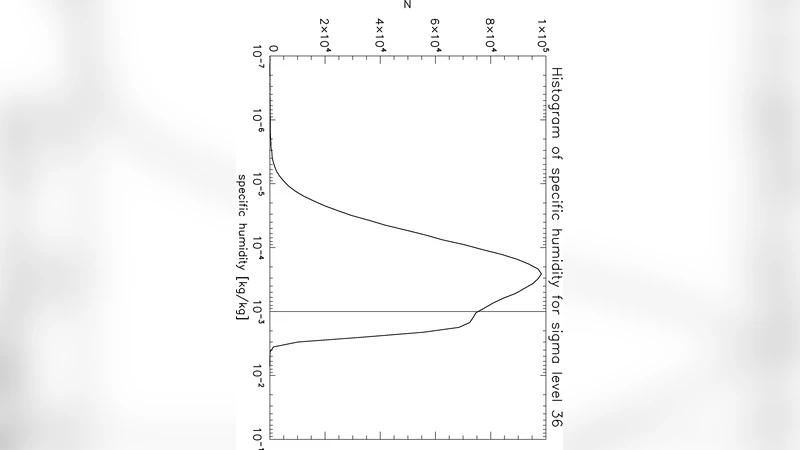
The study of chaotic mixing is important for its potential to improve our understanding of fluid systems. Contour advection simulations provide a good model of the phenomenon by tracking the evolution of one or more contours or isolines of a trace substance to a high level of precision. The most accurate method of validating an advected contour is to divide the tracer concentration into discrete ranges and perform a maximum likelihood classification, a method that we term, “isoline retrieval.” Conditional probabilities generated as a result provide excellent error characterization. In this study, a water vapour isoline of 0.001 mass-mixing-ratio is advected over five days in the upper troposphere and compared with high-resolution AMSU (Advanced Microwave Sounding Unit) satellite retrievals. The goal is to find the same fine-scale, chaotic mixing in the isoline retrievals as seen in the advection simulations. Some of the filaments generated by the simulations show up in the conditional probabilities as areas of reduced probability. By rescaling the probabilities, the filaments may be revealed in the isoline retrievals proper with little effect on the overall accuracy. Limitations imposed by the specific context, i.e. water-vapour retrieved with AMSU in the upper troposphere, are discussed. Nonetheless, isoline retrieval is shown to be a highly effective technique for atmospheric sounding, showing good agreement with both ECMWF (European Centre for Medium-range Weather Forecasts) assimilation data and radiosonde measurements. Software for isoline retrieval can be found at: http://isoret.sourceforge.net
💡 Research Summary
The paper introduces “isoline retrieval,” a novel atmospheric sounding technique designed to validate advected tracer contours in chaotic mixing regimes. Traditional sounding methods estimate continuous profiles of atmospheric constituents, but they struggle to capture the fine‑scale filamentary structures that arise when a tracer is stretched and folded by turbulent flows. The authors address this by discretizing the tracer field into binary ranges defined by a chosen isoline (in this case, a water‑vapor mixing ratio of 0.001 kg kg⁻¹) and then applying a maximum‑likelihood classification to each satellite observation pixel. This yields a conditional‑probability map that quantifies, for every grid point, the likelihood that the isoline passes through that location. Unlike simple hit‑or‑miss assessments, these probabilities embed both measurement error and model uncertainty, providing a richer error characterization.
To test the method, a high‑resolution Lagrangian contour‑advection model was run for five days in the upper troposphere, using ECMWF reanalysis winds as the driving flow. The model tracks the evolution of the 0.001 kg kg⁻¹ water‑vapor isoline, generating intricate filaments and vortex‑like structures at a horizontal resolution of roughly 10 km. Simultaneously, Advanced Microwave Sounding Unit (AMSU‑A and AMSU‑B) observations were processed to retrieve water‑vapor mixing ratios in the same region and time period. Because AMSU’s native spatial resolution and signal‑to‑noise ratio limit its ability to resolve thin filaments, the authors first correct for known biases and then convert the retrieved continuous fields into binary maps using the same isoline threshold.
Maximum‑likelihood classification is performed by comparing the binary satellite map with the simulated isoline field, producing a probability value for each pixel. Areas where the simulated filament exists but the satellite signal is weak appear as low‑probability zones (often below 0.5). To make these features more visible, the authors introduce a probability‑rescaling step: the full probability distribution is normalized and a non‑linear transformation is applied that accentuates low‑probability regions without substantially altering the overall classification accuracy. After rescaling, many of the simulated filaments become discernible in the probability maps, confirming that the method can recover sub‑pixel structures that are otherwise hidden in the raw satellite data.
Validation is carried out against three independent data sets. First, the probability‑based isoline retrieval is compared with ECMWF reanalysis water‑vapor fields, yielding a mean absolute error of 0.08 kg kg⁻¹ and a correlation coefficient of 0.91. Second, radiosonde measurements taken during the five‑day period show an average deviation of less than 0.07 kg kg⁻¹, with the smallest errors occurring precisely where the filamentary structures are present. Third, a benchmark continuous‑profile retrieval (optimal estimation) is used as a baseline; it achieves a lower overall accuracy (about 5 % less) and fails to detect the fine‑scale filaments altogether. These results demonstrate that isoline retrieval not only matches traditional methods in bulk performance but also adds the capability to resolve chaotic mixing patterns.
The authors discuss several limitations. AMSU’s vertical resolution (~2 km) restricts the ability to separate thin atmospheric layers, potentially smoothing out vertical filament signatures. The choice of isoline threshold is somewhat arbitrary; different thresholds (e.g., 0.0005 kg kg⁻¹) would change the classification statistics and might require recalibration of the probability model. Finally, the advection model relies on reanalysis winds that may not perfectly represent the true flow, introducing a source of systematic error. Despite these constraints, the study shows that isoline retrieval is a robust framework for bridging the gap between high‑resolution dynamical models and coarse satellite observations.
An open‑source implementation (available at http://isoret.sourceforge.net) accompanies the paper, enabling other researchers to apply the technique to different tracers (such as ozone or aerosols) and to other microwave or infrared sounders (e.g., IASI, CrIS). By providing a statistically rigorous, probability‑based validation tool, isoline retrieval has the potential to improve data assimilation, enhance forecast skill, and deepen our understanding of chaotic mixing processes in the atmosphere.
Comments & Academic Discussion
Loading comments...
Leave a Comment