Remembering Erich Lehmann
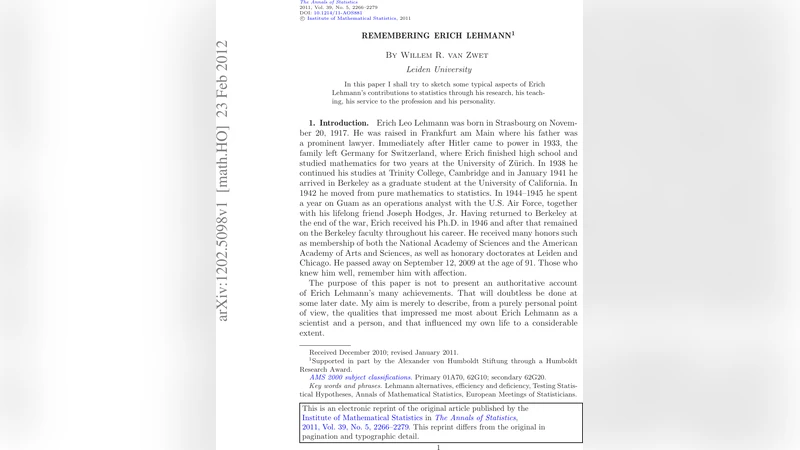
In this paper I shall try to sketch some typical aspects of Erich Lehmann’s contributions to statistics through his research, his teaching, his service to the profession and his personality.
💡 Research Summary
Erich Lehmann (1917‑2009) stands as one of the most influential architects of modern statistical theory, and this paper offers a comprehensive portrait of his contributions across four interrelated dimensions: research, teaching, professional service, and personal character.
In the research domain, Lehmann’s seminal work “Testing Statistical Hypotheses” reshaped the foundations of hypothesis testing. By rigorously distinguishing Type I and Type II errors, formalizing the relationship between power and significance level, and introducing the Lehmann–Scheffé theorem, he provided a unifying framework for minimum‑variance unbiased estimation (MVUE). The theorem’s reliance on sufficient and complete statistics not only clarified the existence and uniqueness of optimal estimators but also bridged frequentist and Bayesian perspectives, influencing a broad spectrum of experimental designs and data‑analytic strategies.
Lehmann’s contributions to non‑parametric statistics are equally pivotal. In his chapter on distribution‑free tests, he generalized rank‑based procedures, showing how test statistics constructed from order information remain valid without any specific distributional assumptions. This insight laid the groundwork for modern resampling techniques such as the bootstrap and permutation tests, and it continues to inform robust methods in contemporary machine learning and high‑dimensional data analysis.
On the teaching front, Lehmann authored two textbooks that have become global standards: “Theory of Point Estimation” and “Testing Statistical Hypotheses.” The former systematically develops bias, variance, and efficiency concepts, culminating in the Lehmann–Scheffé result; the latter walks readers through the entire testing pipeline, coupling rigorous proofs with intuitive examples. Lehmann’s pedagogical philosophy emphasized deep understanding over rote memorization, encouraging students to reconstruct core ideas and apply them to real‑world problems. His lecture style—linking abstract mathematics to everyday scenarios—helped generations of statisticians internalize complex theory.
Lehmann’s professional service shaped the statistical community’s infrastructure. As an editor for “The Annals of Mathematical Statistics” and later “The Annals of Statistics,” he instituted stricter peer‑review standards, transparent editorial policies, and mechanisms to promote early‑career researchers. His leadership roles within the American Statistical Association (ASA) and the International Statistical Institute (ISI) included organizing major conferences, delivering keynote addresses, and fostering international collaborations that broadened the discipline’s reach.
Beyond his scholarly output, Lehmann’s personal qualities left an indelible mark on colleagues and students. Known for humility, generosity, and a steadfast commitment to intellectual honesty, he offered unwavering mentorship, avoided personal attacks in scholarly debates, and consistently focused on logical argumentation. This demeanor cultivated deep trust within his academic circle and helped embed a culture of collegiality and ethical conduct that persists in today’s statistical societies.
In sum, Erich Lehmann’s legacy is multidimensional: his theoretical breakthroughs provided the mathematical backbone of modern inference; his textbooks educated countless practitioners; his editorial and organizational work elevated the quality and inclusiveness of the field; and his character modeled the ideal of a scholar‑citizen. The paper concludes that Lehmann’s influence continues to inspire both current research directions and the professional ethos of statisticians worldwide.
Comments & Academic Discussion
Loading comments...
Leave a Comment