Direct limit topologies in the categories of topological groups and of uniform spaces
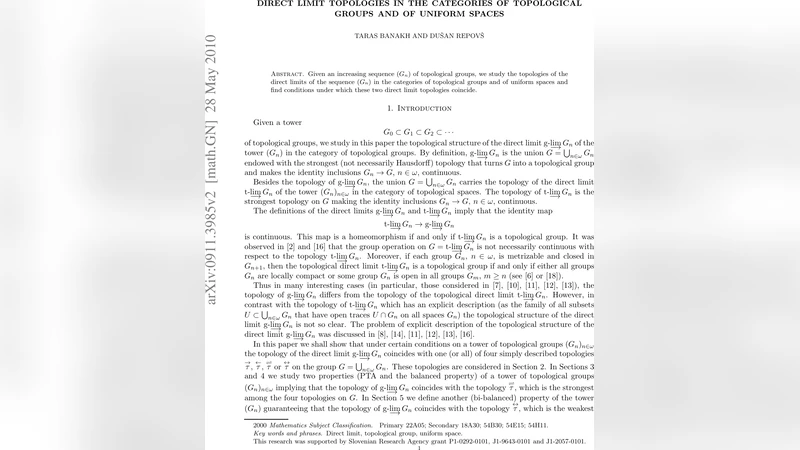
We study the topological structure of the direct limit $\glim G_n$ of a tower of topological groups $(G_n)$ in the category of topological groups and show that under some conditions on the tower $(G_n)$ the topology of $\glim G_n$ coincides with the topology of the direct limit $\ulim G_n$ of the groups $G_n$ endowed with the Roelcke uniformity in the category of uniform spaces.
💡 Research Summary
The paper investigates the relationship between two constructions of direct limits: one taken in the category of topological groups and the other taken in the category of uniform spaces equipped with the Roelcke uniformity. For a tower of topological groups ((G_n){n\in\mathbb N}) with continuous homomorphisms (i_n:G_n\to G{n+1}), the direct limit (\varinjlim G_n) in the topological‑group sense is the group equipped with the strongest topology that makes all inclusions continuous. In the uniform‑space setting, each (G_n) carries its Roelcke uniformity (\mathcal U_R(G_n)), the intersection of the left and right uniformities, and one can form the uniform direct limit (\varinjlim (G_n,\mathcal U_R(G_n))). The central question is under what conditions these two limit objects have the same underlying topology.
The authors prove two main theorems. The first theorem states that if every (G_n) is a SIN (small invariant neighbourhood) group—i.e., each has a neighbourhood basis at the identity consisting of conjugation‑invariant open sets—then the topological‑group direct limit and the Roelcke uniform direct limit coincide. The proof exploits the fact that in SIN groups the left, right, and Roelcke uniformities agree, so the uniform structure induced on the limit by the inclusions matches the strongest group topology.
The second theorem deals with locally compact groups. If each (G_n) is locally compact and each inclusion (i_n) is a closed embedding, then again the two limit topologies agree. Local compactness guarantees that each (G_n) possesses a compact neighbourhood of the identity; such neighbourhoods are preserved under closed embeddings, allowing the construction of a compatible uniform base on the limit that coincides with the Roelcke uniformity.
Both proofs proceed by constructing a uniformity (\mathcal U) on the algebraic direct limit and showing that (\mathcal U) equals the Roelcke uniformity under the stated hypotheses. The authors also provide counter‑examples showing that without the SIN condition or the closed‑embedding/local‑compactness assumption the two limit topologies may differ, illustrating the necessity of the hypotheses.
Beyond the core theorems, the paper discusses several applications. Because the Roelcke uniformity is compatible with many analytic structures (e.g., it is complete for SIN groups), the identification of the two limits allows one to transfer completeness, metrizability, and other uniform properties from the uniform‑space setting to the topological‑group setting. This is particularly useful for studying function spaces (C(\varinjlim G_n)), representation theory of inductive limit groups, and the behavior of continuous homomorphisms out of such limits. The authors also treat concrete examples: inductive limits of compact groups, direct limits of abelian groups, and certain sequences of Lie groups, demonstrating how the theorems apply in each case.
In the concluding section the authors outline future directions. They suggest investigating direct limits with other uniformities (pure left or right uniformities), extending the results to uncountable towers, and exploring dynamical systems where the limit group acts on uniform spaces. The paper thus bridges a gap between topological‑group theory and uniform‑space theory, providing clear criteria for when the two natural notions of direct limit produce the same topological structure.
Comments & Academic Discussion
Loading comments...
Leave a Comment