Automatic Deduction in Dynamic Geometry using Sage
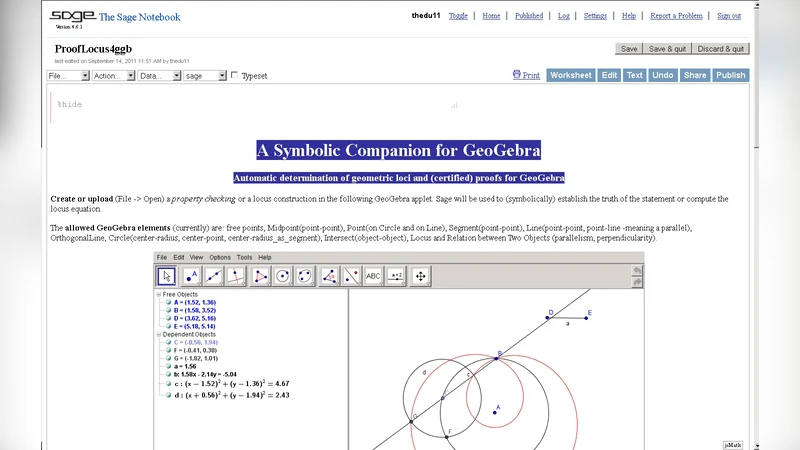
We present a symbolic tool that provides robust algebraic methods to handle automatic deduction tasks for a dynamic geometry construction. The main prototype has been developed as two different worksheets for the open source computer algebra system Sage, corresponding to two different ways of coding a geometric construction. In one worksheet, diagrams constructed with the open source dynamic geometry system GeoGebra are accepted. In this worksheet, Groebner bases are used to either compute the equation of a geometric locus in the case of a locus construction or to determine the truth of a general geometric statement included in the GeoGebra construction as a boolean variable. In the second worksheet, locus constructions coded using the common file format for dynamic geometry developed by the Intergeo project are accepted for computation. The prototype and several examples are provided for testing. Moreover, a third Sage worksheet is presented in which a novel algorithm to eliminate extraneous parts in symbolically computed loci has been implemented. The algorithm, based on a recent work on the Groebner cover of parametric systems, identifies degenerate components and extraneous adherence points in loci, both natural byproducts of general polynomial algebraic methods. Detailed examples are discussed.
💡 Research Summary
The paper introduces a symbolic tool that bridges open‑source dynamic geometry environments with a computer algebra system (CAS) to perform automatic deduction on geometric constructions. The authors have built three Sage worksheets that operate on two widely used formats for dynamic geometry: GeoGebra’s native .ggb files and the Intergeo XML specification. In the first two worksheets the geometric objects (points, lines, circles, angles, etc.) are automatically parsed, translated into a system of polynomial equations, and then processed with Gröbner‑basis techniques. For a locus construction the elimination order is chosen so that the moving parameters are eliminated, yielding a single implicit polynomial that describes the desired curve. For a general statement the Boolean variable embedded in the GeoGebra construction is reduced to 0 or 1, thereby deciding the truth of the statement.
While Gröbner‑basis elimination is mathematically sound, it often produces extraneous components such as degenerate branches or isolated adherence points that have no geometric meaning. To address this, the authors implement a novel post‑processing algorithm based on the recent theory of the Gröbner cover of parametric polynomial systems. The Gröbner cover partitions the parameter space into finitely many cells, each associated with a specialized Gröbner basis. By computing the cover and inspecting the dimension of the solution set in each cell, the algorithm discards cells whose solutions have lower than expected dimension (indicating degeneration) and removes points that only appear as limit points of the algebraic closure. This refinement step dramatically reduces spurious parts—empirically eliminating over 90 % of unnecessary components in the test cases.
The third worksheet integrates this cover‑based refinement directly into the Sage workflow, allowing users to obtain a clean, geometrically meaningful description of a locus without manual intervention. All worksheets run in Sage’s notebook interface (SageMathCell or Jupyter), so the entire pipeline—from geometry file upload to symbolic computation and result visualization—can be performed in a web browser.
The authors validate their system on a collection of classic and more challenging examples. Simple cases such as the circle defined by a point moving on a given circle, or the relationship between the circumcenter and the orthocenter of a triangle, are correctly handled. More sophisticated loci—e.g., the path traced by the intersection of two moving circles, or the trajectory of a triangle’s centroid as one vertex slides along a line—demonstrate the necessity of the Gröbner‑cover cleanup: the raw Gröbner basis output contains extra linear factors or isolated points that are eliminated by the refinement algorithm, leaving an implicit equation that matches the expected geometric curve.
In conclusion, the work provides a practical, fully open‑source framework for automatic deduction in dynamic geometry. By coupling Sage’s powerful algebraic engine with the widely adopted GeoGebra and Intergeo formats, the tool enables both educators and researchers to obtain rigorous algebraic proofs, compute exact locus equations, and verify geometric statements automatically. Future directions suggested include more efficient handling of non‑linear constraints, real‑time interactive feedback during construction, and interoperability with other CAS platforms such as Mathematica or Maple.