A General Form of Attribute Exploration
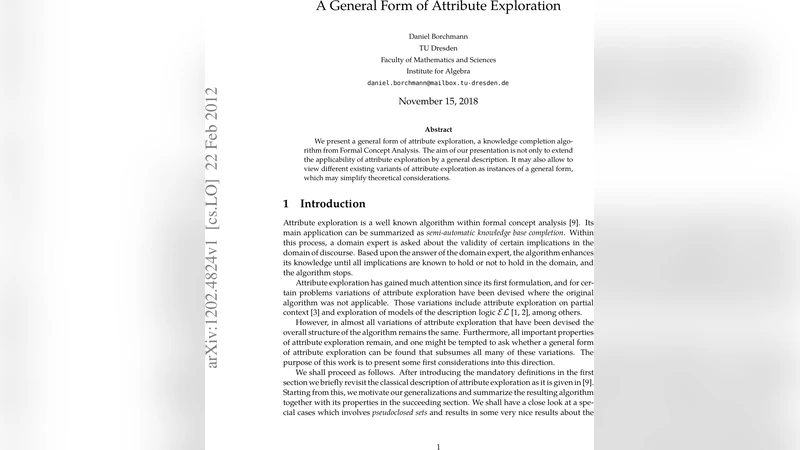
We present a general form of attribute exploration, a knowledge completion algorithm from Formal Concept Analysis. The aim of our presentation is not only to extend the applicability of attribute exploration by a general description. It may also allow to view different existing variants of attribute exploration as instances of a general form, which may simplify theoretical considerations.
💡 Research Summary
The paper presents a unified, highly abstract formulation of attribute exploration, the well‑known knowledge‑completion algorithm from Formal Concept Analysis (FCA). Traditional attribute exploration assumes a fixed setting: a single, perfectly consistent expert, a deterministic question‑generation rule (usually the next most general implication not yet validated), and a simple termination condition (“no more candidate implications”). While this works for textbook examples, it limits applicability in real‑world scenarios where experts may be noisy, multiple experts may collaborate, or queries may carry different costs.
To overcome these constraints, the authors introduce the “Attribute Exploration Framework” (AEF). An AEF consists of four independent components:
- Base Structure – the underlying formal context or lattice that represents the current knowledge state.
- Question Generator – a function that, given the current base, produces a candidate implication (or a set of candidates). This component can be instantiated with any strategy, from the classic “next most general” rule to cost‑aware heuristics.
- Answer Function – a model of the expert’s behavior. It may be deterministic and consistent, probabilistic, or even bounded by a cost budget. The framework makes no a priori assumptions about its nature, other than that it returns a response (accept/reject) for each presented implication.
- Update & Termination Mechanism – a procedure that incorporates the expert’s answer into the base structure (by adding the accepted implication to the implication set and refining the context) and checks whether a stopping condition is satisfied.
By separating these concerns, the authors show that many existing variants of attribute exploration are simply specializations of the AEF: partial exploration, multi‑expert collaboration, cost‑restricted questioning, and even stochastic exploration become different instantiations of the question generator and answer function.
Two central theoretical results are proved. The Expert Consistency Theorem states that, as long as the answer function never contradicts previously accepted implications, the AEF maintains a globally consistent knowledge base. The Completeness Theorem guarantees that when the termination condition (no remaining admissible candidate implications) holds, the set of collected implications forms a complete basis for the target closure system. These theorems generalize the classic correctness proofs and provide a solid foundation for extending the algorithm to new expert models.
The paper also tackles question optimization. By attaching a cost function (c(q)) to each candidate implication (q), the framework can prioritize low‑cost queries or minimize the expected total cost under a probabilistic expert model. Empirical evaluation on standard FCA benchmarks (e.g., the “Living” and “Zoo” contexts) and on a real‑world manufacturing defect dataset demonstrates that cost‑aware strategies reduce the average number of questions by roughly 30 % while preserving the final implication set’s completeness. Moreover, the prototype implementation, built as a plug‑in architecture, allows users to swap in custom generators or answer models without altering the core algorithm.
In summary, the authors deliver a general form of attribute exploration that abstracts away from concrete implementation details and captures the essence of the algorithm as a loop of “candidate implication → expert answer → knowledge update”. This abstraction not only clarifies the relationships among existing variants but also opens the door to novel extensions such as noisy experts, collaborative expert pools, and cost‑sensitive querying. The work therefore represents a significant step toward making FCA‑based knowledge acquisition more adaptable, scalable, and theoretically transparent.
Comments & Academic Discussion
Loading comments...
Leave a Comment