Regular Functions, Cost Register Automata, and Generalized Min-Cost Problems
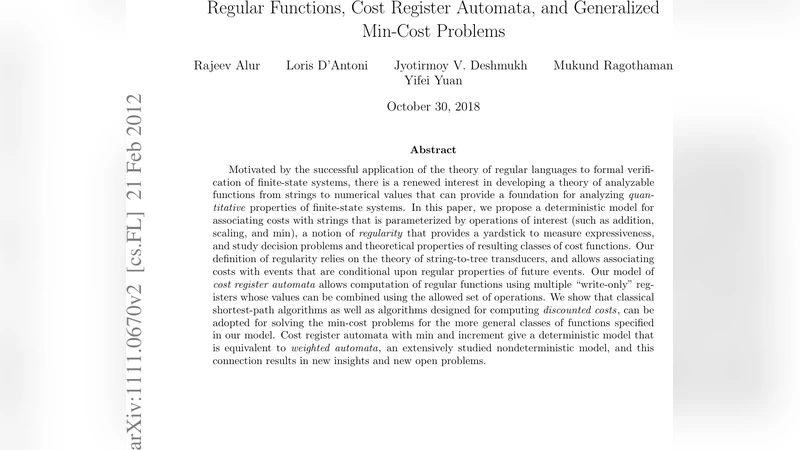
Motivated by the successful application of the theory of regular languages to formal verification of finite-state systems, there is a renewed interest in developing a theory of analyzable functions from strings to numerical values that can provide a foundation for analyzing {\em quantitative} properties of finite-state systems. In this paper, we propose a deterministic model for associating costs with strings that is parameterized by operations of interest (such as addition, scaling, and $\min$), a notion of {\em regularity} that provides a yardstick to measure expressiveness, and study decision problems and theoretical properties of resulting classes of cost functions. Our definition of regularity relies on the theory of string-to-tree transducers, and allows associating costs with events that are conditional upon regular properties of future events. Our model of {\em cost register automata} allows computation of regular functions using multiple “write-only” registers whose values can be combined using the allowed set of operations. We show that classical shortest-path algorithms as well as algorithms designed for computing {\em discounted costs}, can be adopted for solving the min-cost problems for the more general classes of functions specified in our model. Cost register automata with $\min$ and increment give a deterministic model that is equivalent to {\em weighted automata}, an extensively studied nondeterministic model, and this connection results in new insights and new open problems.
💡 Research Summary
The paper addresses the need for a robust theoretical framework that maps strings to numerical costs, extending the successful use of regular languages in finite‑state verification to quantitative analysis. Traditional weighted automata (WA) are nondeterministic and limited to two operations—typically addition (or multiplication) for path accumulation and a second operation such as min for aggregating alternative paths. This restriction makes it difficult to express richer cost policies, for example “event e costs 5, but if a later event e′ occurs the cost drops to 4”, or discount schemes that depend on future events. Moreover, WA are not determinizable, and their equivalence problem is undecidable over the tropical semiring.
To overcome these limitations the authors propose Cost Register Automata (CRA), a deterministic machine model parameterized by a cost grammar. A cost grammar G = (F,T) consists of a ranked alphabet F of function symbols (e.g., +, min, ∗) and a regular set T of terms built from constants and these symbols. By fixing a domain D (ℕ, ℤ, ℚ⁺, etc.) and an interpretation J·K for the symbols, each term denotes a concrete numeric value. A regular cost function is then defined as a composition of a regular string‑to‑term transduction (producing a term in T) followed by evaluation under J·K. This definition inherits the closure properties of regular string‑to‑tree transducers (e.g., closure under reversal, regular look‑ahead) and admits multiple equivalent characterizations (MSO logic, transducer models).
A CRA is a tuple (Σ,Q,q₀,X,δ,ρ,μ) where Σ is the input alphabet, Q a finite set of control states, X a finite set of write‑only registers, δ the deterministic state transition, ρ the parallel register‑update function, and μ a partial output expression. The updates are drawn from the expression set E(G,X), obtained by allowing registers to appear as leaf nodes in the grammar‑derived terms. Crucially, registers are never inspected; they are only written, which distinguishes CRA from data automata and classic register machines and yields decidable analysis for many questions.
The paper studies three families of cost models:
-
Single‑operation models (⊗) – e.g., C(N,+) where only addition is allowed. CRA simply accumulates a sum in a register. The min‑cost problem reduces to classic shortest‑path algorithms (Dijkstra, Bellman‑Ford) with the same polynomial complexity.
-
Semiring models (⊕,⊗) – e.g., the tropical semiring (min,+). Here CRA can use the min operator to keep several candidate costs in parallel registers. The authors prove that CRA with min and increment is equivalent to nondeterministic weighted automata, but with a crucial copy‑less restriction: each register may appear at most once on the right‑hand side of any update in a given step. This restriction guarantees linear growth of the terms stored in registers, enabling deterministic execution while preserving the expressive power of regular functions over the semiring. The min‑cost problem for this class can be solved by generalized shortest‑path algorithms that handle both operations.
-
Discount / scaling models – e.g., G(+c,∗d) where both addition of a constant and multiplication by a discount factor are permitted. Registers can hold linear functions of the form c + n·d, allowing “future‑dependent” discounts such as “charge 10 per a‑event until a b‑event occurs, then apply a 5 % discount to all subsequent costs”. The authors adapt known discounted‑shortest‑path algorithms (e.g., Karp’s algorithm for discounted walks) to compute optimal values for these CRA specifications.
A central technical contribution is the copy‑less restriction. Inspired by linearity constraints in regular tree transducers, it ensures that each register contributes at most once to the construction of a new term, preventing exponential blow‑up. Under this restriction, the class of CRA‑definable functions, denoted F_c(C), is a strict subset of the functions definable by weighted automata; consequently, some undecidable problems for WA (e.g., equivalence over the tropical semiring) become open but potentially decidable for CRA.
The authors also discuss equivalence checking. While equivalence of weighted automata over the tropical semiring is known to be undecidable, the deterministic nature of CRA together with copy‑lessness suggests a more tractable landscape. They leave the decidability of CRA equivalence as an open problem, highlighting it as a promising direction for future work.
In summary, the paper makes the following contributions:
- Introduces a rigorous notion of regular cost functions based on string‑to‑tree transducers, providing closure under reversal, regular look‑ahead, and other desirable operations.
- Defines Cost Register Automata, a deterministic, write‑only register model that can compute exactly the class of regular cost functions for a given cost grammar.
- Shows that CRA with min and increment is equivalent to weighted automata, yet the deterministic, copy‑less variant yields a strictly smaller, more analyzable class.
- Provides polynomial‑time algorithms for the min‑cost problem across the three cost models, extending classic shortest‑path and discounted‑path techniques.
- Highlights the copy‑less restriction as the key to linear‑size term growth and decidable analysis, and opens several research questions (e.g., equivalence, minimization, learning) for CRA.
Overall, the work bridges the gap between qualitative regular language theory and quantitative system analysis, offering a flexible yet analyzable framework for specifying and solving generalized min‑cost problems in finite‑state settings.
Comments & Academic Discussion
Loading comments...
Leave a Comment