Processes, Roles and Their Interactions
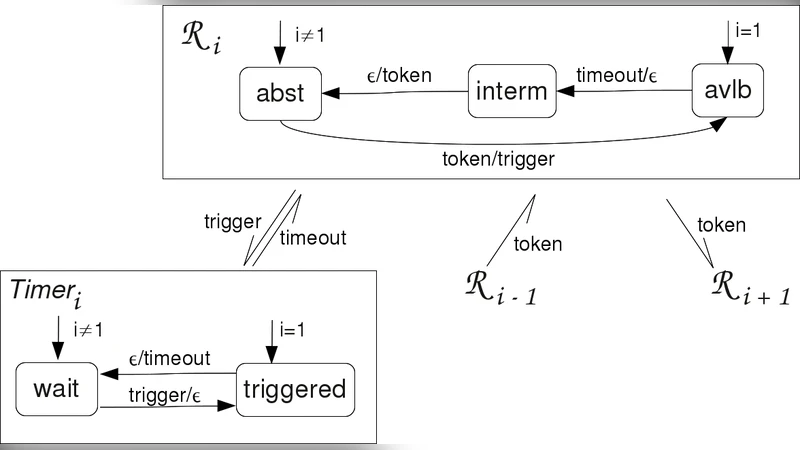
Taking an interaction network oriented perspective in informatics raises the challenge to describe deterministic finite systems which take part in networks of nondeterministic interactions. The traditional approach to describe processes as stepwise executable activities which are not based on the ordinarily nondeterministic interaction shows strong centralization tendencies. As suggested in this article, viewing processes and their interactions as complementary can circumvent these centralization tendencies. The description of both, processes and their interactions is based on the same building blocks, namely finite input output automata (or transducers). Processes are viewed as finite systems that take part in multiple, ordinarily nondeterministic interactions. The interactions between processes are described as protocols. The effects of communication between processes as well as the necessary coordination of different interactions within a processes are both based on the restriction of the transition relation of product automata. The channel based outer coupling represents the causal relation between the output and the input of different systems. The coordination condition based inner coupling represents the causal relation between the input and output of a single system. All steps are illustrated with the example of a network of resource administration processes which is supposed to provide requesting user processes exclusive access to a single resource.
💡 Research Summary
The paper tackles the problem of describing deterministic finite systems that participate in networks of nondeterministic interactions. Traditional process models treat processes as step‑by‑step executable activities and tend to centralize control, which makes it difficult to capture the inherently nondeterministic nature of many distributed interactions. To overcome this limitation the authors propose a unified modeling framework in which both processes and their interactions are expressed using the same elementary building block: finite input‑output automata (also called transducers).
An input‑output automaton consists of a finite set of states, an input alphabet, an output alphabet, a transition relation that maps a state together with an input to a new state and an output, and an initial state. The transition relation is deterministic: for a given state and input there is at most one possible output and successor state.
In the proposed view a process is a deterministic automaton that may be connected to several other automata through communication channels. Each channel links the output of one automaton to the input of another, establishing an “outer coupling”. The channel itself can be nondeterministic in the sense that the order in which messages are delivered is not fixed, but the behavior of each individual automaton remains deterministic. The overall system behavior is obtained by forming the product automaton of all participating automata and then restricting its transition relation according to the coupling constraints.
Inside a single automaton, the authors introduce an “inner coupling” mechanism. This is expressed as a coordination condition that restricts the transition relation so that multiple input‑output events that must occur together are treated as a single atomic transition. In this way the internal coordination of a process – for example, the need to read a request, update an internal flag, and emit a response in one logical step – is captured without breaking the deterministic nature of the automaton.
The theoretical construction is illustrated with a concrete example: a network of resource‑administration processes that grant exclusive access to a single resource. User processes request the resource, the administration process queues the requests, grants access to one user at a time, and finally releases the resource. Each request, grant, and release is modeled as a transition of the corresponding automaton. The outer coupling is realized by channels that carry request and grant messages between user and administration automata. The inner coupling inside the administration automaton ensures that the actions of checking a request, allocating the resource, and sending a grant happen atomically. Even though the order in which user requests arrive is nondeterministic, the protocol guarantees that at any moment only one user holds the resource, thereby demonstrating safety and liveness properties derived from the transition‑restriction approach.
Key contributions of the paper are:
- A unified formalism that treats processes and interaction protocols as instances of the same finite input‑output automaton model, eliminating the conceptual gap between process‑centric and interaction‑centric descriptions.
- The introduction of two orthogonal coupling mechanisms – outer coupling via channels and inner coupling via coordination conditions – that together enable deterministic specification of systems embedded in nondeterministic environments.
- A concrete case study showing how the abstract construction can be instantiated to model real‑world resource‑allocation scenarios, providing a template for applying the method to other distributed systems such as service‑oriented architectures or multi‑agent simulations.
By grounding both process behavior and protocol specifications in a single, well‑understood automaton framework, the paper offers a path toward more modular, verifiable, and scalable designs for distributed systems where nondeterministic interactions are the norm rather than the exception.
Comments & Academic Discussion
Loading comments...
Leave a Comment