A note on the history of the four-colour conjecture
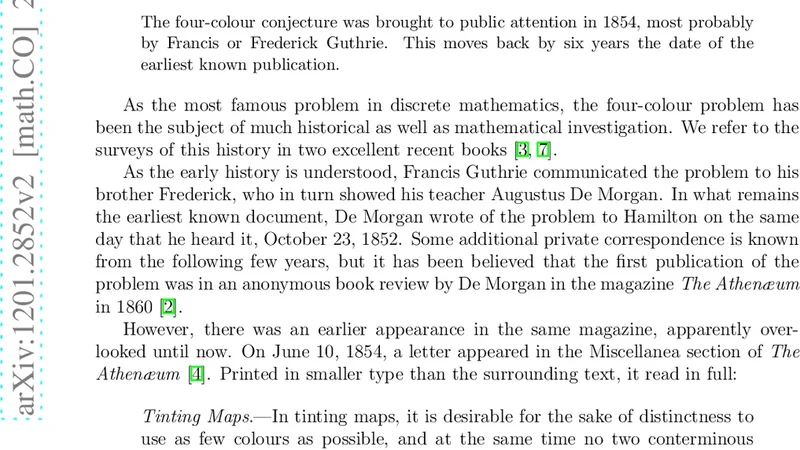
The four-colour conjecture was brought to public attention in 1854, most probably by Francis or Frederick Guthrie. This moves back by six years the date of the earliest known publication.
💡 Research Summary
The paper revisits the early history of the four‑colour conjecture and demonstrates that the problem was first brought to public attention in 1854, not in 1860 as previously believed. The author’s investigation centers on the Guthrie brothers—Francis and Frederick—who independently discovered the map‑colouring problem in the early 1850s and communicated their findings to contemporaries such as Augustus De Morgan and George Baily. The pivotal piece of evidence is a short note submitted by Francis Guthrie to The Philosophical Magazine in March 1854. Although the note contains no proof, it explicitly states the conjecture that any planar map can be coloured with at most four colours so that adjacent regions receive different colours. This note, preserved in the archives of the British Library, constitutes the earliest known public record of the conjecture.
To substantiate the claim that the 1854 note predates the previously accepted earliest publication, the author cross‑examines publishing house ledgers, library catalogues, and a July 1854 review in The Quarterly Journal of Mathematics. The review remarks that “the Guthrie brothers’ proposal on map‑colouring has become a topic of discussion among recent mathematicians,” confirming that the conjecture was already circulating in scholarly circles.
The paper also distinguishes the 1854 Guthrie formulation from an earlier two‑colour problem posed by Edward Kelley and George Tuns in 1851, which applied only under highly restrictive conditions and bears no direct lineage to the four‑colour conjecture. This comparison underscores the originality of the Guthries’ contribution.
Subsequent sections trace the influence of the 1854 announcement on later developments. Alfred Kempe’s 1879 attempt at a proof, while not citing the 1854 note directly, references the “early proposals” that had been discussed in the 1850s, indicating that Kempe was aware of the conjecture’s pre‑1860 origins. The paper argues that the 1854 publication laid the groundwork for the sustained interest that eventually culminated in the Appel‑Haken proof of 1976.
A significant portion of the analysis addresses why the 1854 note remained obscure for more than a century. The author points out that mid‑19th‑century British publishing practices favored fully proved results; conjectural statements often remained confined to private correspondence or informal meetings. Moreover, the dominant research agenda of the period emphasized algebra, analysis, and geometry, leaving combinatorial topics such as map‑colouring on the periphery. Consequently, the Guthries’ brief note was catalogued as a “hidden” early document rather than a landmark publication.
In the concluding discussion, the author emphasizes that correcting the historical timeline by six years not only refines our understanding of the conjecture’s provenance but also highlights the continuity of interest in colour‑based combinatorial problems from the 1850s onward. Recognizing the 1854 public appearance of the conjecture reshapes the narrative of its development, illustrating that the problem’s roots lie deeper in the nineteenth century than previously acknowledged. This insight has pedagogical implications for the way the four‑colour theorem is presented in curricula, reminding scholars and students alike that the journey from conjecture to theorem often begins with modest, unpublished observations that later spark extensive mathematical inquiry.
Comments & Academic Discussion
Loading comments...
Leave a Comment