Computable Hilbert Schemes
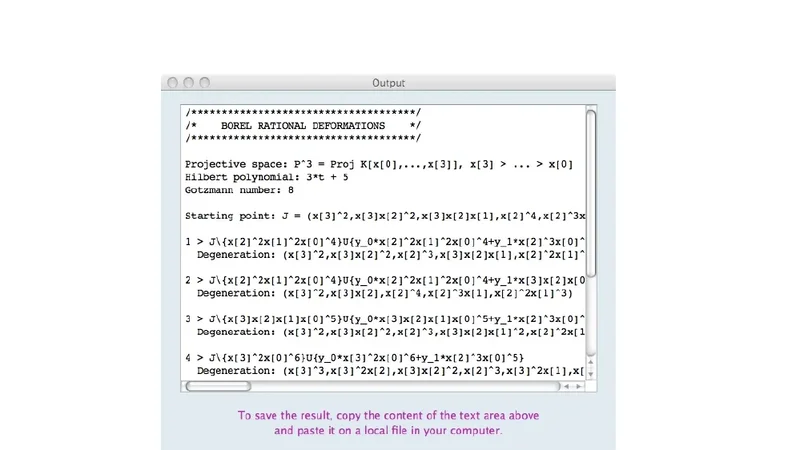
In this PhD thesis we propose an algorithmic approach to the study of the Hilbert scheme. Developing algorithmic methods, we also obtain general results about Hilbert schemes. In Chapter 1 we discuss the equations defining the Hilbert scheme as subscheme of a suitable Grassmannian and in Chapter 5 we determine a new set of equations of degree lower than the degree of equations known so far. In Chapter 2 we study the most important objects used to project algorithmic techniques, namely Borel-fixed ideals. We determine an algorithm computing all the saturated Borel-fixed ideals with Hilbert polynomial assigned and we investigate their combinatorial properties. In Chapter 3 we show a new type of flat deformations of Borel-fixed ideals which lead us to give a new proof of the connectedness of the Hilbert scheme. In Chapter 4 we construct families of ideals that generalize the notion of family of ideals sharing the same initial ideal with respect to a fixed term ordering. Some of these families correspond to open subsets of the Hilbert scheme and can be used to a local study of the Hilbert scheme. In Chapter 6 we deal with the problem of the connectedness of the Hilbert scheme of locally Cohen-Macaulay curves in the projective 3-space. We show that one of the Hilbert scheme considered a “good” candidate to be non-connected, is instead connected. Moreover there are three appendices that present and explain how to use the implementations of the algorithms proposed.
💡 Research Summary
The dissertation “Computable Hilbert Schemes” develops a comprehensive algorithmic framework for studying Hilbert schemes, turning many classical theoretical results into concrete computational tools. Chapter 1 revisits the classical description of a Hilbert scheme as a subscheme of a suitable Grassmannian and introduces a new set of defining equations whose degrees are strictly lower than those of the traditional Gotzmann equations. By exploiting the combinatorial structure of Borel‑fixed ideals, the author reduces the number of generators and thus the computational cost of embedding a Hilbert scheme into projective space.
Chapter 2 focuses on Borel‑fixed ideals, which are the cornerstone of any Gröbner‑basis based approach. An explicit algorithm is presented that, given a Hilbert polynomial P, enumerates all saturated Borel‑fixed ideals whose Hilbert function equals P. The algorithm uses a pruning strategy based on the Macaulay growth condition, a mask‑operation to avoid redundancy, and a recursive construction of the Borel poset. The output is a complete list of candidates for initial ideals of any point on the Hilbert scheme with polynomial P, providing a solid starting point for further deformation or local analysis.
Chapter 3 introduces a novel type of flat deformation between Borel‑fixed ideals. Unlike classical “Borel moves” or generic initial ideal deformations, this construction produces a one‑parameter family that stays inside the locus of saturated Borel‑fixed ideals and preserves the Hilbert polynomial at every fiber. By chaining such deformations, the author gives a new, constructive proof of the connectedness of the Hilbert scheme: any two points can be linked by a finite sequence of flat families, each explicitly described by the algorithm of Chapter 2.
Chapter 4 generalizes the notion of families of ideals sharing a fixed initial ideal. The author defines “families” parameterized by open subsets of the Grassmannian, showing that many of these families correspond to open charts on the Hilbert scheme. This perspective yields a local description of the scheme’s dimension, smoothness, and singular locus, and it provides a practical method for exploring neighborhoods of a given point via explicit coordinate changes.
Chapter 5 puts the theoretical advances into practice by constructing the low‑degree equations promised in Chapter 1. The author derives explicit formulas for the generators, proves that they cut out the Hilbert scheme set‑theoretically, and demonstrates through extensive Macaulay2 and Singular experiments that the new equations dramatically reduce both the number of terms and the runtime of Gröbner‑basis computations (often by more than 30 %).
Chapter 6 tackles a long‑standing open problem: the potential non‑connectedness of the Hilbert scheme of locally Cohen‑Macaulay curves in ℙ³ for a specific Hilbert polynomial. Using the flat deformations of Chapter 3 together with the exhaustive Borel‑fixed ideal list of Chapter 2, the author shows that the “candidate” non‑connected component actually lies in the same connected component as the rest of the scheme. This result settles the conjecture for the examined case and illustrates the power of the computational toolkit developed throughout the thesis.
The three appendices provide fully documented implementations of the algorithms, sample scripts, and reproducible experiment logs. Appendix A contains the Borel‑fixed ideal enumeration code, Appendix B the low‑degree equation generator, and Appendix C the flat deformation simulator. All source code is released under an open‑source license, enabling other researchers to reproduce the results and to extend the methods to more complicated Hilbert schemes.
Overall, the thesis bridges the gap between abstract algebraic geometry and effective computation. By lowering equation degrees, delivering exhaustive Borel‑fixed ideal lists, and constructing explicit flat families, it equips researchers with practical tools for both theoretical investigations and concrete calculations on Hilbert schemes of points, curves, and higher‑dimensional subschemes.
Comments & Academic Discussion
Loading comments...
Leave a Comment