A numerical retro-action model relates rocky coast erosion to percolation theory
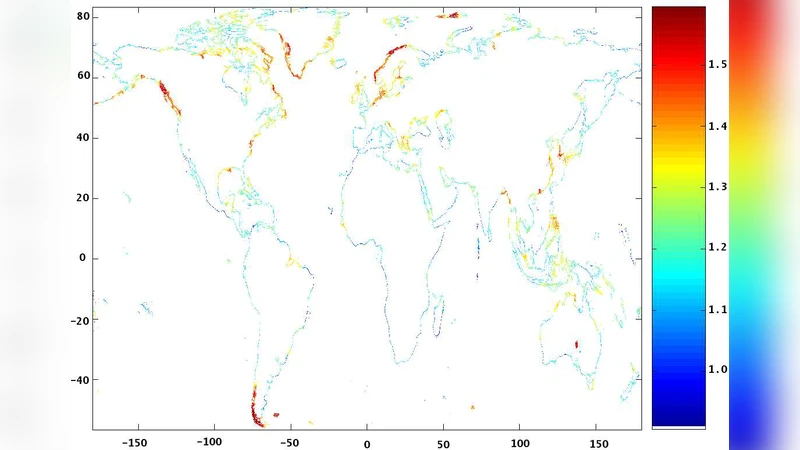
We discuss various situations where the formation of rocky coast morphology can be attributed to the retro-action of the coast morphology itself on the erosive power of the sea. Destroying the weaker elements of the coast, erosion can creates irregular seashores. In turn, the geometrical irregularity participates in the damping of sea-waves, decreasing their erosive power. There may then exist a mutual self-stabilization of the wave amplitude together with the irregular morphology of the coast. A simple model of this type of stabilization is discussed. The resulting coastline morphologies are diverse, depending mainly on the morphology/damping coupling. In the limit case of weak coupling, the process spontaneously builds fractal morphologies with a dimension close to 4/3. This provides a direct connection between the coastal erosion problem and the theory of percolation. For strong coupling, rugged but non-fractal coasts may emerge during the erosion process, and we investigate a geometrical characterization in these cases. The model is minimal, but can be extended to take into account heterogeneity in the rock lithology and various initial conditions. This allows to mimic coastline complexity, well beyond simple fractality. Our results suggest that the irregular morphology of coastlines as well as the stochastic nature of erosion are deeply connected with the critical aspects of percolation phenomena.
💡 Research Summary
The paper proposes a minimal yet powerful numerical model that captures a feedback loop between coastal morphology and wave‑driven erosion. Traditional erosion models treat wave energy as an external driver that removes material from a static coastline. In contrast, the authors argue that the evolving shape of the coast itself modifies wave propagation: irregularities act as scatterers and dissipators, reducing the effective erosive power of incoming waves. This “retro‑action” creates a self‑stabilizing system in which erosion and morphology co‑evolve.
The model is implemented on a two‑dimensional lattice of cells, each representing a small patch of rock with a prescribed resistance (lithology) and a wave‑damping coefficient. A wave front is launched from the sea side; as it encounters the coastline it loses energy proportionally to the local geometry. Only cells whose resistance falls below the locally attenuated wave energy are eroded, turning sea cells into land cells and exposing new shoreline segments. The erosion of a cell instantly changes the boundary conditions for subsequent wave propagation, thereby increasing local damping. This iterative process continues until the wave energy is insufficient to erode any further cells.
A single control parameter, the morphology‑damping coupling strength, governs the overall behavior. When the coupling is weak, wave attenuation is modest, so erosion proceeds aggressively. The coastline self‑organizes into a critical configuration that displays the statistical signatures of two‑dimensional percolation: cluster‑size distributions follow a power law with exponent τ≈2.05, and the resulting coastline has a fractal dimension D≈4/3, remarkably close to the theoretical percolation hull dimension. This establishes a direct quantitative link between coastal erosion and percolation theory, suggesting that many observed fractal coastlines may be the product of a percolation‑like self‑organized critical process.
In the opposite limit of strong coupling, each erosion event dramatically increases local damping, quickly quenching further wave penetration. The coastline still becomes irregular, but the geometry no longer exhibits true fractality. Instead, the surface roughness can be described by conventional scaling exponents (roughness exponent ζ≈0.5–0.7), akin to those found in Kardar‑Parisi‑Zhang or Edwards‑Wilkinson surface growth models. The authors term these configurations “rugged but non‑fractal” and provide a geometric characterization based on RMS height and correlation length.
The model is readily extended to incorporate heterogeneity in rock strength. By sampling resistance values from normal or log‑normal distributions, weak zones erode first, creating channel‑like patterns that resemble real‑world fault‑controlled coastlines. Different initial shoreline shapes (straight, sinusoidal, random) converge to the same statistical regimes dictated by the coupling strength and lithological variance, demonstrating the robustness of the framework.
Numerical experiments confirm the theoretical expectations. In the weak‑coupling regime, the simulated coastlines reproduce the percolation hull dimension within statistical error, and the hull length scales with system size as L∝N^D/2. In the strong‑coupling regime, the height‑height correlation function follows a power law with exponent 2ζ, and the power spectral density decays as k^−(2ζ+1), consistent with self‑affine rough surfaces.
The authors discuss several avenues for future work. Adding a third spatial dimension would allow the study of cliff retreat and vertical erosion. Incorporating tidal cycles, wind‑driven sediment transport, or anthropogenic interventions (breakwaters, quarrying) could make the model applicable to coastal management scenarios. Moreover, the identified percolation connection suggests that similar retro‑action mechanisms may underlie other geomorphological processes such as riverbank erosion, dune migration, or even fracture networks in rocks.
In summary, the paper demonstrates that the irregular morphology of rocky coastlines can arise naturally from a feedback loop between erosion and wave damping. Depending on the strength of this feedback, the system either self‑organizes into a percolation‑type fractal coastline (dimension ≈4/3) or stabilizes into a rugged, non‑fractal shape characterized by conventional roughness scaling. This work bridges coastal geomorphology with statistical physics, providing a unified framework to interpret the diversity of observed shoreline geometries and their stochastic evolution.
Comments & Academic Discussion
Loading comments...
Leave a Comment