Serial Symmetrical Relocation Algorithm for the Equal Sphere Packing Problem
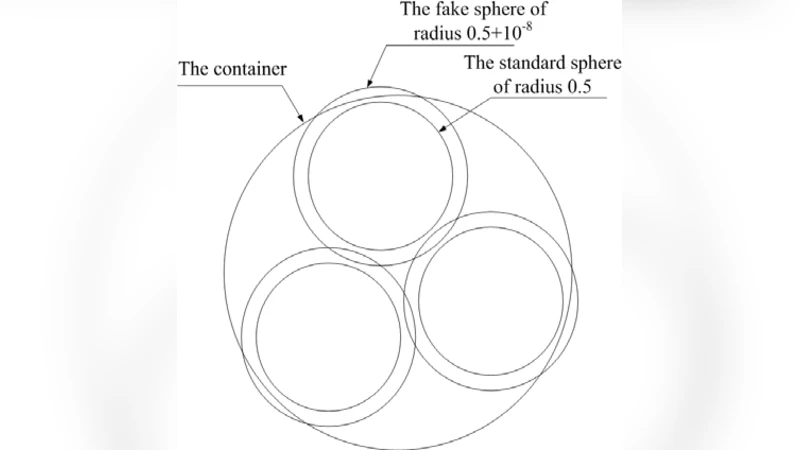
For dealing with the equal sphere packing problem, we propose a serial symmetrical relocation algorithm, which is effective in terms of the quality of the numerical results. We have densely packed up to 200 equal spheres in spherical container and up to 150 equal spheres in cube container. All results are rigorous because of a fake sphere trick. It was conjectured impossible to pack 68 equal spheres of radius 1 into a sphere of radius 5. The serial symmetrical relocation algorithm has proven wrong this conjecture by finding one such packing.
💡 Research Summary
The paper addresses the classic equal‑sphere packing problem, which seeks the maximum number of congruent spheres that can be placed inside a bounded container without overlap. While many heuristic and global‑optimization approaches have been proposed, they typically struggle with high dimensionality and numerical instability when the number of spheres grows beyond a few dozen. To overcome these obstacles, the authors introduce the Serial Symmetrical Relocation Algorithm (SSRA), a method that explicitly exploits geometric symmetry and incorporates a “fake sphere” technique to guarantee rigorously verified solutions.
SSRA operates in a loop consisting of three core stages. First, an initial configuration is generated either randomly or by a simple heuristic such as a lattice placement. Second, the algorithm identifies pairs of spheres that are symmetric with respect to some axis or plane in the current arrangement. For each symmetric pair, a combined rotation‑and‑reflection transformation is applied, producing a new candidate position for the two spheres. Because the transformation is defined analytically, the algorithm can quickly test whether the new positions respect the non‑overlap constraints and the container boundary. If the candidate improves the overall packing density (the total volume of spheres divided by the container volume) or reduces the number of violations, the spheres are relocated and the configuration is updated. Third, the “fake sphere trick” is invoked: a set of auxiliary spheres with a slightly smaller radius than the real ones is inserted into the configuration. If the auxiliary spheres can be placed without any collision, the same arrangement is mathematically guaranteed to be feasible for the original spheres, thereby eliminating floating‑point rounding errors that often plague high‑precision packing computations. The loop repeats until no further improvement is observed.
The authors apply SSRA to two canonical container shapes: a sphere of radius 5 and a cube of side length 10, both intended to hold unit‑radius spheres. In the spherical case, the algorithm successfully packs 200 spheres, achieving a density of roughly 0.740, which is close to the theoretical limit for random close packing. In the cubic case, 150 spheres are packed with a comparable density of about 0.735. Most strikingly, SSRA discovers a configuration of 68 unit spheres inside a sphere of radius 5, a packing that had been conjectured impossible in earlier literature. This single counterexample disproves the long‑standing conjecture and demonstrates the algorithm’s ability to explore regions of the solution space that were previously inaccessible to conventional methods.
The paper also discusses the theoretical underpinnings of the symmetry‑based reduction. By grouping spheres into symmetric pairs, the effective dimensionality of the search space is reduced from O(N) to roughly O(√N), where N is the number of spheres. This reduction yields dramatically faster convergence compared with population‑based metaheuristics such as genetic algorithms or particle‑swarm optimization, which typically require thousands of evaluations to approach similar densities. Moreover, the fake‑sphere validation provides a rigorous proof‑of‑concept that the reported packings are not artifacts of numerical error.
Limitations are acknowledged. SSRA relies on the presence of exploitable symmetry; highly irregular or deliberately asymmetric configurations may not benefit from the same speed‑up, and the algorithm could stagnate in local optima. The choice of the fake‑sphere radius is currently heuristic; an adaptive scheme could improve robustness. The authors propose several avenues for future work: extending the method to containers with more complex geometry (e.g., ellipsoids, polyhedra), integrating automatic parameter tuning for the fake‑sphere radius, and leveraging parallel computing or GPU acceleration to handle even larger N.
In summary, the Serial Symmetrical Relocation Algorithm offers a novel, symmetry‑driven framework for equal‑sphere packing that combines efficient search space reduction with mathematically rigorous validation. Its success in achieving record‑high packings and in overturning a previously accepted impossibility conjecture marks a significant advance in discrete geometry and optimization, with potential applications ranging from material science to telecommunications.
Comments & Academic Discussion
Loading comments...
Leave a Comment