Mass conserved elementary kinetics is sufficient for the existence of a non-equilibrium steady state concentration
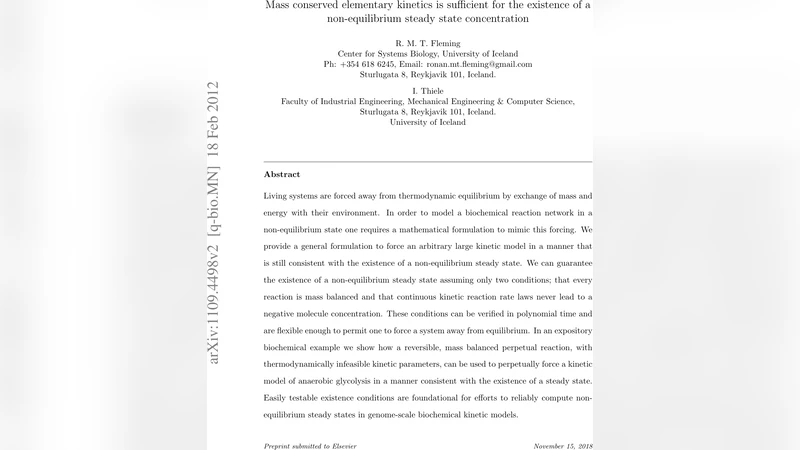
Living systems are forced away from thermodynamic equilibrium by exchange of mass and energy with their environment. In order to model a biochemical reaction network in a non-equilibrium state one requires a mathematical formulation to mimic this forcing. We provide a general formulation to force an arbitrary large kinetic model in a manner that is still consistent with the existence of a non-equilibrium steady state. We can guarantee the existence of a non-equilibrium steady state assuming only two conditions; that every reaction is mass balanced and that continuous kinetic reaction rate laws never lead to a negative molecule concentration. These conditions can be verified in polynomial time and are flexible enough to permit one to force a system away from equilibrium. In an expository biochemical example we show how a reversible, mass balanced perpetual reaction, with thermodynamically infeasible kinetic parameters, can be used to perpetually force a kinetic model of anaerobic glycolysis in a manner consistent with the existence of a steady state. Easily testable existence conditions are foundational for efforts to reliably compute non-equilibrium steady states in genome-scale biochemical kinetic models.
💡 Research Summary
The paper addresses a fundamental question in systems biology: under what minimal conditions does a large biochemical reaction network admit a non‑equilibrium steady‑state (NESS) concentration vector? While flux balance analysis (FBA) guarantees the existence of a mass‑balanced flux distribution, it does not incorporate kinetic laws or thermodynamic constraints, and kinetic models often suffer from the lack of a priori guarantees that a steady state exists. Fleming and Thiele propose a concise mathematical framework that establishes sufficient conditions for the existence of at least one non‑negative steady‑state concentration vector in any kinetic model that satisfies two very basic requirements.
First, every elementary reaction must be mass‑balanced. In matrix terms this means that the stoichiometric matrix S (size m × n, where m is the number of metabolites and n the number of reactions) is “consistent”: there exists a strictly positive mass vector m > 0 such that Sᵀ m = 0. This condition can be verified by solving a linear feasibility problem, which is polynomial‑time solvable and is already standard practice in metabolic network reconstruction.
Second, the kinetic rate laws must be of elementary (mass‑action) form with non‑negative kinetic parameters. Specifically, forward and reverse rates are expressed as
v_f = diag(k_f) · exp(Fᵀ ln x) and v_r = diag(k_r) · exp(Rᵀ ln x),
where F and R are the forward and reverse stoichiometric matrices (S = –F + R), x ≥ 0 is the concentration vector, and k_f, k_r ≥ 0 are the kinetic constants. The crucial property of these rate laws is that if any component of x is zero, the corresponding consumption terms vanish, guaranteeing that concentrations cannot become negative during the dynamics.
Under these two assumptions, the authors prove Theorem 1: starting from any strictly positive initial concentration x₀, there exists at least one concentration vector x* ≥ 0 such that the time derivative ẋ = 0. The proof constructs a continuous mapping f(x) = x + τ ẋ (with τ > 0) and defines a closed, bounded, convex set Ω = { x ≥ 0 | mᵀx = mᵀx₀ }. Because S is mass‑balanced, mᵀẋ = 0, so Ω is invariant under f. Continuity of f together with Brouwer’s fixed‑point theorem guarantees a point x* ∈ Ω with f(x*) = x*, which is precisely a steady state. Notably, the theorem does not require detailed balance or any thermodynamic feasibility of the kinetic constants; even “thermodynamically infeasible” parameters are allowed, as long as they remain non‑negative.
The paper then demonstrates the practical utility of this result with an example from anaerobic glycolysis in Trypanosoma brucei. By adding a reversible “perpetual” reaction that is mass‑balanced but assigned kinetic constants that violate the usual thermodynamic relationship (i.e., the forward constant is much larger than the reverse), the authors create an external driving force that pushes the system away from equilibrium. Simulations show that the network settles into a non‑equilibrium steady state, confirming that the existence theorem holds even under such forced conditions. This illustrates how one can embed external mass or energy fluxes into kinetic models without jeopardizing the mathematical guarantee of a steady state.
In the discussion, the authors emphasize several implications. First, the existence test is computationally cheap and can be integrated into automated model‑building pipelines, providing a sanity check before attempting costly numerical integration or optimization. Second, while the theorem relaxes thermodynamic constraints, realistic modeling still demands additional layers of regulation (e.g., enzyme capacity, allosteric effects, Gibbs free‑energy bounds) to ensure physiological relevance. Third, the theorem guarantees existence but not uniqueness or stability; further analysis (e.g., Jacobian eigenvalue assessment or Lyapunov functions) is required to characterize the dynamical behavior around the steady state. Finally, the work bridges a gap between the purely stoichiometric world of FBA and the fully kinetic world of detailed ODE models, offering a rigorous foundation for genome‑scale kinetic modeling where external forcing (e.g., nutrient uptake, waste excretion) must be represented.
In summary, Fleming and Thiele provide a clear, mathematically rigorous set of sufficient conditions—mass‑balanced stoichiometry and non‑negative elementary kinetic laws—that guarantee the existence of a non‑negative steady‑state concentration vector in arbitrary biochemical kinetic networks. Their theorem, proof, and illustrative example lay the groundwork for more reliable computation of non‑equilibrium steady states in large‑scale metabolic models, opening avenues for integrating kinetic detail with the scalability of constraint‑based approaches.
Comments & Academic Discussion
Loading comments...
Leave a Comment