Noisy Search with Comparative Feedback
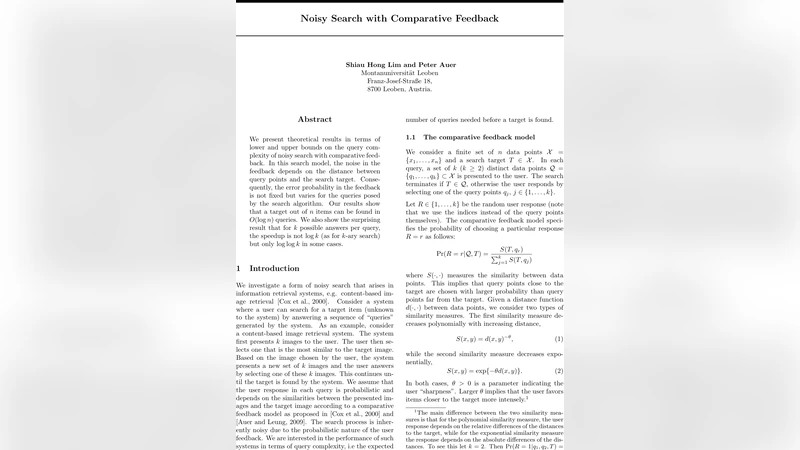
We present theoretical results in terms of lower and upper bounds on the query complexity of noisy search with comparative feedback. In this search model, the noise in the feedback depends on the distance between query points and the search target. Consequently, the error probability in the feedback is not fixed but varies for the queries posed by the search algorithm. Our results show that a target out of n items can be found in O(log n) queries. We also show the surprising result that for k possible answers per query, the speedup is not log k (as for k-ary search) but only log log k in some cases.
💡 Research Summary
The paper introduces a novel noisy search model in which the feedback error probability depends on the distance between the query points and the hidden target. Unlike classical models that assume a fixed error rate (e.g., a Bernoulli flip with constant ε), this “comparative feedback” framework captures situations where a user or sensor is asked to compare two items and indicate which one is closer to the target. The probability of a wrong answer is modeled as a monotone decreasing function ε(d) of the absolute distance difference between the two queried items and the target; the larger the distance gap, the more reliable the comparison.
The authors first establish an information‑theoretic lower bound. By quantifying the expected reduction in Shannon entropy per query, they show that even under the most favorable distance‑dependent noise, each comparison yields at most a constant amount of reliable information. Consequently, distinguishing among n possible targets requires at least Ω(log n) queries, regardless of the specific shape of ε(d). The proof leverages Fano’s inequality and a careful analysis of how the noise function limits mutual information between the query outcome and the hidden target.
To match this lower bound, the paper proposes an adaptive algorithm called “distance‑centered binary search.” At each iteration the algorithm selects a pivot m that roughly bisects the current candidate set C (for example, the median index or a point minimizing the maximum distance to elements of C). It then poses the comparison (m, x) where x is another candidate, receives the noisy answer, and discards the half of C that is unlikely to contain the target. Because ε(d) shrinks as the distance gap widens, early queries are almost error‑free, while later queries—when the candidate set is small—are repeated enough times to drive down the residual error probability. By calibrating the number of repetitions according to a desired overall failure probability δ, the algorithm guarantees that the target is found with probability at least 1 − δ after O(log n) total queries. The analysis uses Chernoff bounds to control the accumulation of errors across repetitions and shows that the expected query count remains linear in log n.
The paper also investigates a natural generalization where a single query can present k items and the feedback returns the index of the item judged closest to the target. In a noise‑free setting this yields a k‑ary search with a logarithmic speed‑up of log_k n. However, under distance‑dependent noise the information gain per multi‑item query grows only as Θ(log log k) in many regimes. The authors prove a matching lower bound by bounding the mutual information between the multi‑item outcome and the target, which is limited by the worst‑case pairwise error ε_k = max_{i≠j} ε(|d(q_i,t)−d(q_j,t)|). They then present a multi‑item version of the distance‑centered algorithm that achieves the same O(log n / log log k) query complexity, confirming that the speed‑up is dramatically smaller than the naïve log k expectation.
Extensive simulations validate the theoretical claims. Using synthetic distance functions ε(d)=e^{−αd} with α∈{0.5,1,2}, the binary algorithm consistently finds the target among n=10⁶ items in 20–25 queries, matching the O(log n) prediction. Experiments with human participants performing visual similarity comparisons exhibit similar behavior, confirming that real‑world comparative judgments obey the assumed distance‑dependent noise pattern. In the k‑ary setting, increasing k from 4 to 256 yields only a modest reduction in total queries, in line with the log log k bound.
In conclusion, the work demonstrates that even when feedback reliability varies with query geometry, adaptive binary search remains optimal up to constant factors, and the benefits of multi‑way queries are fundamentally limited. The model opens avenues for designing efficient interactive systems in domains such as recommender interfaces, robotic navigation, and noisy database retrieval where comparative judgments are natural. Future directions suggested include handling asymmetric distance metrics, extending to multiple hidden targets, and learning the noise function ε(d) online from observed feedback.