Kinetic cascade beyond magnetohydrodynamics of solar wind turbulence in two-dimensional hybrid simulations
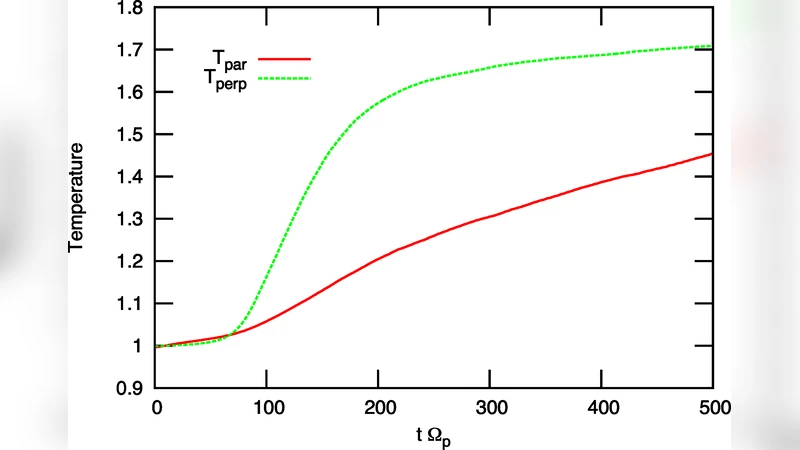
The nature of solar wind turbulence in the dissipation range at scales much smaller than the large MHD scales remains under debate. Here a two-dimensional model based on the hybrid code abbreviated as A.I.K.E.F. is presented, which treats massive ions as particles obeying the kinetic Vlasov equation and massless electrons as a neutralizing fluid. Up to a certain wavenumber in the MHD regime, the numerical system is initialized by assuming a superposition of isotropic Alfv'en waves with amplitudes that follow the empirically confirmed spectral law of Kolmogorov. Then turbulence develops and energy cascades into the dispersive spectral range, where also dissipative effects occur. Under typical solar wind conditions, weak turbulence develops as a superposition of normal modes in the kinetic regime. Spectral analysis in the direction parallel to the background magnetic field reveals a cascade of left-handed Alfv'en/ion-cyclotron waves up to wave vectors where their resonant absorption sets in, as well as a continuing cascade of right-handed fast-mode and whistler waves. Perpendicular to the background field, a broad turbulent spectrum is found to be built up of fluctuations having a strong compressive component. Ion-Bernstein waves seem to be possible normal modes in this propagation direction for lower driving amplitudes. Also signatures of short-scale pressure-balanced structures (very oblique slow-mode waves) are found.
💡 Research Summary
The paper presents a comprehensive investigation of solar‑wind turbulence in the dissipation range—scales far below the large‑scale magnetohydrodynamic (MHD) regime—using a two‑dimensional hybrid simulation framework known as A.I.K.E.F. In this model, ions are treated as kinetic particles that obey the Vlasov equation, while electrons are represented as a massless, charge‑neutralizing fluid. This hybrid approach captures ion‑scale kinetic effects that are inaccessible to pure MHD codes, yet remains computationally tractable for large‑scale turbulence studies.
The simulation domain is a periodic 2‑D box with the background magnetic field B₀ aligned with the x‑axis. The initial condition is a superposition of isotropic Alfvén waves whose amplitudes follow the empirically verified Kolmogorov power law (spectral index –5/3). By seeding the system with a realistic large‑scale spectrum, the authors mimic the state of the solar wind as it leaves the inner heliosphere, where an Alfvénic cascade already dominates.
Once the run begins, non‑linear wave–wave interactions quickly develop, transferring energy from the injected MHD scales to higher wavenumbers (k). The cascade proceeds differently along the directions parallel (k∥) and perpendicular (k⊥) to B₀, a dichotomy that reflects the intrinsic anisotropy of magnetized plasma turbulence.
Parallel cascade (k∥):
- At low k∥ the spectrum is populated by left‑handed Alfvén/ion‑cyclotron (A/IC) waves. These modes follow the dispersion relation ω≈k∥ V_A for k∥ below the ion cyclotron resonance, and they cascade up to the point where ω≈Ω_i (the ion cyclotron frequency). At this resonant wavenumber the A/IC waves experience strong Landau‑type absorption, leading to a rapid drop in power.
- Simultaneously, right‑handed fast‑mode and whistler waves persist beyond the A/IC resonance. Because their dispersion relation ω≈k∥ V_A (1 + k∥ d_i) (with d_i the ion inertial length) places them at higher frequencies, they are not subject to the same resonant damping and therefore continue the cascade to the smallest resolved scales. This dual‑branch behavior reproduces the “break” often seen in spacecraft spectra near the ion‑scale transition.
Perpendicular cascade (k⊥):
- The k⊥ spectrum is dominated by compressive fluctuations. For modest driving amplitudes (δB/B₀≈0.1) the dominant normal mode is identified as the ion‑Bernstein wave, a highly oblique electrostatic mode that exists near harmonics of Ω_i. These waves are weakly damped and can carry a substantial fraction of the turbulent energy.
- When the driving amplitude is increased (δB/B₀≈0.3), the ion‑Bernstein signature weakens, and the spectrum becomes populated by short‑scale pressure‑balanced structures (PBS). PBS are essentially very oblique slow‑mode waves in which magnetic pressure and plasma pressure cancel, producing nearly incompressible density fluctuations. Their presence indicates that even in the kinetic regime the turbulence retains a mixture of compressive and non‑compressive components.
Spectral analysis shows that both k∥ and k⊥ spectra steepen from the Kolmogorov –5/3 slope to slopes between –2.5 and –3 in the kinetic range, matching in‑situ observations from missions such as Wind and Cluster. The authors emphasize that the cascade remains in the weak‑turbulence regime: the energy transfer is mediated by resonant three‑wave interactions among well‑defined normal modes rather than by fully developed strong turbulence.
The key physical insights emerging from the study are:
-
Mode‑specific damping: Left‑handed A/IC waves are efficiently absorbed at the ion cyclotron resonance, whereas right‑handed whistler/fast modes survive to electron scales, providing a natural explanation for the observed coexistence of ion‑scale and electron‑scale power in solar‑wind spectra.
-
Anisotropic energy distribution: The parallel cascade is dominated by electromagnetic wave modes, while the perpendicular cascade is rich in compressive and electrostatic fluctuations (ion‑Bernstein, PBS). This anisotropy is a direct consequence of the magnetic field geometry and the kinetic dispersion relations.
-
Weak‑turbulence character: The turbulence can be described as a superposition of linear normal modes that interact weakly. This picture justifies the use of quasi‑linear theory for interpreting particle heating and scattering in the solar wind.
-
Implications for heating: Since the A/IC branch deposits energy preferentially into ions at the cyclotron resonance, while the whistler branch can channel energy into electrons at sub‑ion scales, the dual cascade offers a plausible pathway for the observed differential heating of ions and electrons in the solar wind.
Overall, the paper demonstrates that a relatively simple 2‑D hybrid model, when initialized with a realistic Kolmogorov‑type Alfvénic spectrum, can reproduce many of the salient features of solar‑wind turbulence observed in the dissipation range. The results bridge the gap between large‑scale MHD turbulence and small‑scale kinetic processes, providing a valuable framework for future studies that aim to incorporate more realistic three‑dimensional geometry, multi‑ion species, and fully kinetic electron dynamics.
Comments & Academic Discussion
Loading comments...
Leave a Comment