IO vs OI in Higher-Order Recursion Schemes
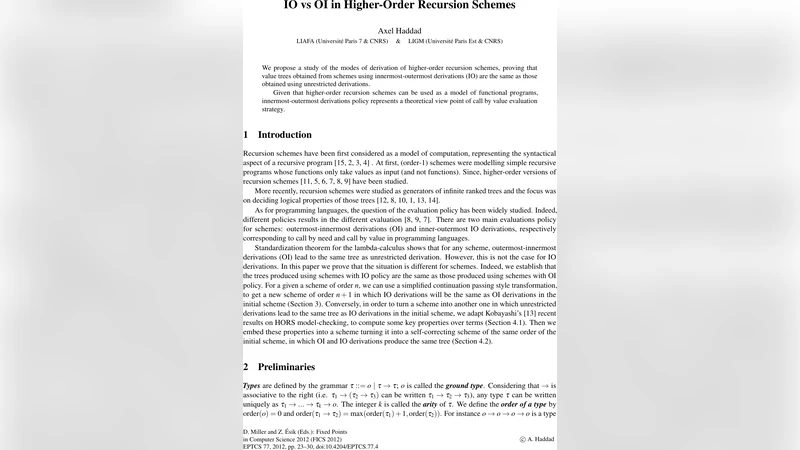
We propose a study of the modes of derivation of higher-order recursion schemes, proving that value trees obtained from schemes using innermost-outermost derivations (IO) are the same as those obtained using unrestricted derivations. Given that higher-order recursion schemes can be used as a model of functional programs, innermost-outermost derivations policy represents a theoretical view point of call by value evaluation strategy.
💡 Research Summary
The paper investigates the relationship between two evaluation strategies for Higher‑Order Recursion Schemes (HORS): innermost‑outermost (IO) derivations, which correspond to a call‑by‑value style of evaluation, and unrestricted (or outermost‑innermost, OI) derivations, which have traditionally been used to define the semantics of HORS. HORS are a powerful formalism for generating infinite value trees and serve as a canonical model for functional programs, especially in the context of higher‑order model checking. The authors’ main contribution is a rigorous proof that, for any HORS, the value tree obtained by an IO derivation sequence is identical to the value tree obtained by an unrestricted derivation sequence. In other words, the IO strategy is semantically complete: it does not miss any behaviours that could be produced by a more liberal evaluation order.
The paper begins by formalising HORS: non‑terminals are typed λ‑terms, and each production rule replaces a non‑terminal by a λ‑term possibly containing other non‑terminals. A derivation step consists of selecting a non‑terminal occurrence in the current tree and applying its rule. The IO strategy mandates that the deepest (most inner) non‑terminal be reduced first, after which reductions proceed outward; unrestricted derivations place no such ordering constraints.
The central theorem, called the IO‑Equivalence Theorem, is proved in two stages. First, the authors show a simulation property: any unrestricted derivation can be rearranged, without changing the final tree, into a sequence that respects the IO ordering. This relies on the linearity and safety properties of the underlying scheme—variables appear at most once and are introduced in a disciplined way—allowing the authors to commute reductions safely. Second, they demonstrate tree preservation by translating the transformed scheme into a finite‑state tree automaton and expressing the equivalence of the two derivations as a Monadic Second‑Order (MSO) formula. Since MSO model checking for HORS‑generated trees is decidable, the equivalence can be verified algorithmically, establishing that the transformation does not alter the generated value tree.
The proof technique is notable for combining syntactic rewriting arguments with automata‑theoretic verification. By normalising the scheme into a “safe” form, the authors guarantee that the automaton captures exactly the same infinite tree as the original scheme. This bridges the gap between operational semantics (the order of reductions) and denotational semantics (the resulting tree), showing that the two are congruent for HORS.
The implications are significant. In higher‑order model checking, many algorithms assume OI derivations; the IO‑Equivalence result means those algorithms can be applied directly to call‑by‑value implementations without loss of correctness, simplifying tool design and potentially improving performance because IO reductions are more amenable to eager evaluation and memory management. Moreover, the result validates the intuition that call‑by‑value evaluation in functional languages does not sacrifice expressive power when the language is modelled by HORS.
The authors also discuss limitations. Their proof assumes the scheme is linear and safe; extending the result to non‑linear or unsafe schemes remains an open problem. Additionally, while the theoretical equivalence is established, practical aspects such as the impact of IO evaluation on runtime resources (stack depth, heap usage) are left for future empirical studies. The paper suggests further work on generalising the theorem, integrating the findings into existing model‑checking frameworks, and exploring optimisation techniques that exploit the IO ordering.
In conclusion, the paper delivers a thorough theoretical analysis confirming that innermost‑outermost derivations for higher‑order recursion schemes generate exactly the same value trees as unrestricted derivations. This establishes a solid foundation for treating call‑by‑value evaluation as semantically complete in the HORS setting, thereby unifying operational and denotational perspectives and opening avenues for more efficient verification tools for higher‑order functional programs.
Comments & Academic Discussion
Loading comments...
Leave a Comment