Magnetic substructure in the northern Fermi Bubble revealed by polarized WMAP emission
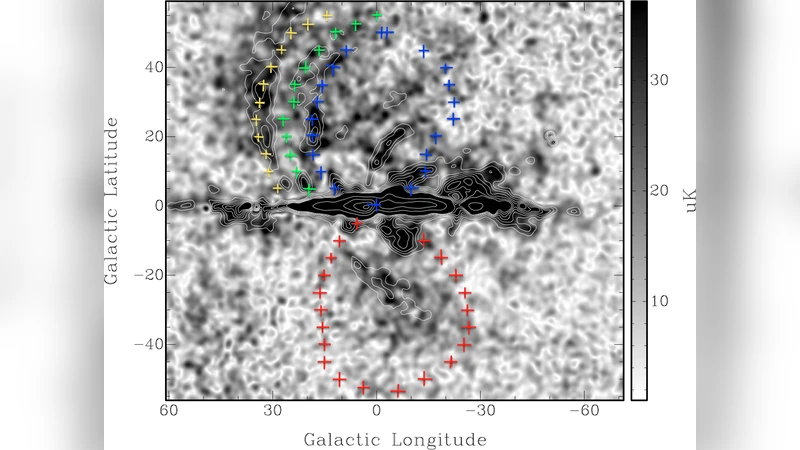
We report a correspondence between giant, polarized microwave structures emerging north from the Galactic plane near the Galactic center and a number of GeV gamma-ray features, including the eastern edge of the recently-discovered northern Fermi Bubble. The polarized microwave features also correspond to structures seen in the all-sky 408 MHz total intensity data, including the Galactic center spur. The magnetic field structure revealed by the polarization data at 23 GHz suggests that neither the emission coincident with the Bubble edge nor the Galactic center spur are likely to be features of the local ISM. On the basis of the observed morphological correspondences, similar inferred spectra, and the similar energetics of all sources, we suggest a direct connection between the Galactic center spur and the northern Fermi Bubble.
💡 Research Summary
The paper presents a multi‑wavelength investigation of large‑scale magnetic structures emerging from the Galactic Center (GC) and their connection to the northern Fermi Bubble (NFB). Using the 23 GHz polarized intensity map from the Wilkinson Microwave Anisotropy Probe (WMAP) together with the all‑sky 408 MHz total intensity survey (Haslam et al.) and the GeV gamma‑ray data from the Fermi Large Area Telescope, the authors identify a prominent, highly polarized microwave filament that rises northward from the Galactic plane. This filament coincides spatially with the well‑known Galactic Center Spur (GCS) seen in the 408 MHz map and, crucially, aligns with the eastern edge of the NFB as defined by the sharp decline in gamma‑ray surface brightness.
The authors perform a detailed morphological comparison, showing that the microwave polarization ridge and the gamma‑ray edge overlap over several degrees in Galactic latitude. The polarization vectors are remarkably uniform along the filament, indicating a coherent magnetic field that is oriented roughly perpendicular to the Galactic plane. This ordered field is inconsistent with the tangled, locally‑generated magnetic structures expected in the nearby interstellar medium (ISM), suggesting instead an origin tied to the GC environment.
Spectral analysis between 23 GHz and 408 MHz yields a synchrotron spectral index of α ≈ −0.7 ± 0.1, typical of relativistic electron populations. The same electron spectrum can account for the GeV gamma‑ray emission via inverse‑Compton scattering of ambient radiation fields, linking the microwave and gamma‑ray components energetically. By integrating the synchrotron brightness and adopting reasonable estimates for the magnetic field strength (tens of µG), the total non‑thermal energy contained in the filament and the adjacent bubble edge is estimated to be on the order of 10⁵⁵ erg, comparable to previous energy budgets assigned to the Fermi Bubbles.
The paper argues that the GCS and the NFB edge are not independent phenomena but rather different manifestations of a single, large‑scale outflow or explosion originating from the GC. Possible drivers include past jet activity from the supermassive black hole Sgr A* or a starburst‑driven wind. In either case, the outflow would carry relativistic electrons and amplify or advect magnetic fields over kiloparsec scales, producing the observed polarized synchrotron ridge and the gamma‑ray bubble.
The authors also discuss the implications for the broader understanding of Galactic feedback. The detection of a coherent magnetic filament that traces the bubble’s boundary provides direct observational evidence that magnetic fields play a significant role in shaping the morphology and confinement of the bubbles. Moreover, the morphological continuity between the GCS and the NFB suggests that the GC has been capable of launching collimated, magnetized outflows that persist for several Myr.
Finally, the paper emphasizes the need for higher‑resolution polarization data (e.g., from Planck, the upcoming LiteBIRD mission, or ground‑based facilities) and for sophisticated magnetohydrodynamic simulations that incorporate cosmic‑ray transport, radiative cooling, and realistic Galactic potential models. Such efforts will be essential to discriminate between jet‑driven and wind‑driven scenarios, to quantify the magnetic field topology, and to assess the impact of these structures on the surrounding halo gas. In summary, the work provides compelling evidence that the Galactic Center Spur and the northern edge of the Fermi Bubble share a common origin, highlighting the importance of magnetic fields in the dynamics of large‑scale Galactic phenomena.