Generalized powerlocales via relation lifting
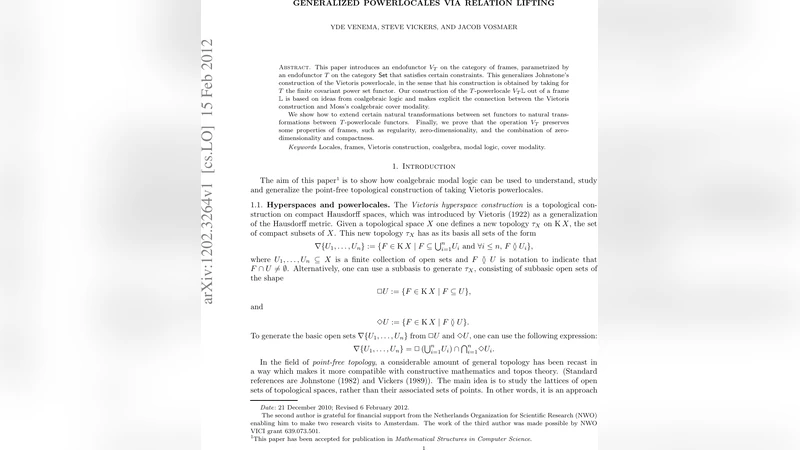
This paper introduces an endofunctor $\VT$ on the category of frames, parametrized by an endofunctor $\T$ on the category $\Set$ that satisfies certain constraints. This generalizes Johnstone’s construction of the Vietoris powerlocale, in the sense that his construction is obtained by taking for $\T$ the finite covariant power set functor. Our construction of the $\T$-powerlocale $\VT \bbL$ out of a frame $\bbL$ is based on ideas from coalgebraic logic and makes explicit the connection between the Vietoris construction and Moss’s coalgebraic cover modality. We show how to extend certain natural transformations between set functors to natural transformations between $\T$-powerlocale functors. Finally, we prove that the operation $\VT$ preserves some properties of frames, such as regularity, zero-dimensionality, and the combination of zero-dimensionality and compactness.
💡 Research Summary
The paper develops a categorical framework that generalizes the classical Vietoris powerlocale construction by parametrizing it with an arbitrary set‑functor 𝕋. After recalling the basic notions of frames (locales) and the Vietoris construction, the authors introduce a set‑endofunctor 𝕋 equipped with four technical conditions: preservation of weak pullbacks, finitariness (𝕋 is determined by its action on finite sets), preservation of monos, and preservation of epimorphisms. These constraints guarantee that the relation‑lifting operation (\overline{R}) can be defined for any binary relation (R\subseteq X\times Y), yielding a relation (\overline{R}\subseteq \mathsf{T}X\times \mathsf{T}Y).
The central definition is the 𝕋‑powerlocale functor (\mathsf{V}{\mathsf{T}}). Given a frame (\mathbb{L}), (\mathsf{V}{\mathsf{T}}(\mathbb{L})) is presented by generators (\langle a\rangle) for each element (a\in\mathbb{L}) together with modal‑style axioms that encode the behaviour of the lifted relation. The key axiom schema mirrors Moss’s coalgebraic cover modality □(_\mathsf{T}): for any lifted relation (\overline{R}) and any finite family ({a_i}\subseteq\mathbb{L}),
\
Comments & Academic Discussion
Loading comments...
Leave a Comment