Tr`es courte enqu^ete sur lextension non-triviale de la logique de propositions `a la logique du premier et deuxi`eme ordre
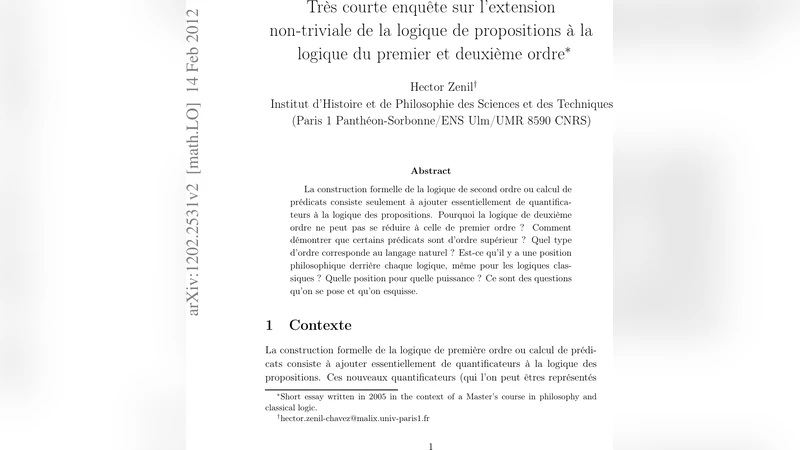
The formal construction of the second-order logic or predicate calculus essentially adds quantifiers to propositional logic. Why second-order logic cannot be reduced to that of the first order? How to demonstrate that certain predicates are of higher-order? What type of order matches the natural language? Is there a philosophical position behind every logic, even for classical ones? What philosophical position for what logic in connection to its expressive power? These are the questions we ask and that we very briefly sketch as a first reflection. (paper in French)
💡 Research Summary
The paper offers a concise yet systematic investigation of the non‑trivial extension from propositional logic to first‑order and then to second‑order predicate logic. It begins by recalling that propositional logic deals only with truth‑functional combinations of atomic sentences, lacking any quantification over objects. The move to first‑order logic introduces variables ranging over individuals and quantifiers that allow statements such as “for every x, …” or “there exists an x …”. This extension brings with it two celebrated meta‑logical properties: completeness (every semantically valid formula is provable) and compactness (any set of formulas is satisfiable iff every finite subset is).
The core of the paper focuses on the jump to second‑order logic, where quantifiers may range over predicates, relations, or sets themselves. Two semantic frameworks are distinguished. Under standard semantics, second‑order variables denote genuine subsets or relations of the domain, which yields powerful expressive capabilities: many mathematical theories become categorical (e.g., the second‑order Peano axioms uniquely characterize the natural numbers). Under Henkin semantics, second‑order variables are treated like first‑order variables ranging over a designated collection of “second‑order objects,” restoring completeness but sacrificing the categorical character of standard models. The authors argue that the standard interpretation is the one that captures the genuine non‑reducibility of second‑order logic to first‑order logic.
The paper then demonstrates why second‑order logic cannot be reduced to first‑order logic. First, Gödel’s incompleteness theorems apply directly: any recursively axiomatizable fragment of second‑order logic cannot capture all its validities, whereas first‑order logic enjoys a complete, recursively enumerable proof system. Second, the Löwenheim‑Skolem theorem, which guarantees countable models for any first‑order theory with an infinite model, fails for standard second‑order theories; thus, second‑order logic can enforce specific cardinalities and categorical structures that first‑order logic cannot. These meta‑logical facts constitute the formal proof of non‑reducibility.
To identify higher‑order predicates, the authors propose a clear criterion: a predicate is of order n > 1 if it is quantified over by a variable that itself ranges over predicates of order n − 1. Concrete examples illustrate the distinction: “All humans die” is first‑order (quantification over individuals), while “Every property is possessed by some human” is second‑order (quantification over properties). The paper also discusses third‑order and beyond, noting that each additional level adds a new layer of abstraction and expressive power.
The relationship between natural language and logical order is examined next. Everyday sentences often embed higher‑order quantification—e.g., “Everyone has some belief” or “There is a reason for every action”—which cannot be faithfully rendered in pure first‑order form without auxiliary constructions. Consequently, a full formal semantics of natural language would at least require second‑order quantification. However, pragmatic factors such as context, implicature, and underspecification limit the feasibility of a strict second‑order formalization, prompting the authors to suggest hybrid approaches that combine dynamic semantics with higher‑order logic.
Finally, the paper explores the philosophical commitments underlying each logical system. First‑order logic aligns with a formalist or empiricist stance that minimizes ontological commitments: only individuals exist, and predicates are merely syntactic devices. In contrast, second‑order logic embodies a realist or Platonist view, treating predicates (properties, relations) as genuine abstract entities. The authors map various philosophical traditions—propositionalism, structuralism, constructivism—to the logical orders they best support, arguing that the choice of logical framework reflects deeper epistemic and metaphysical positions. The conclusion emphasizes that the selection of logical order is not merely a technical decision but a philosophical one, balancing expressive needs, computational tractability, and ontological assumptions. Prospective research directions include integrating standard and Henkin semantics, developing automated reasoning tools for higher‑order logics, and refining the interface between natural‑language semantics and higher‑order formal systems.