An introduction to finite automata and their connection to logic
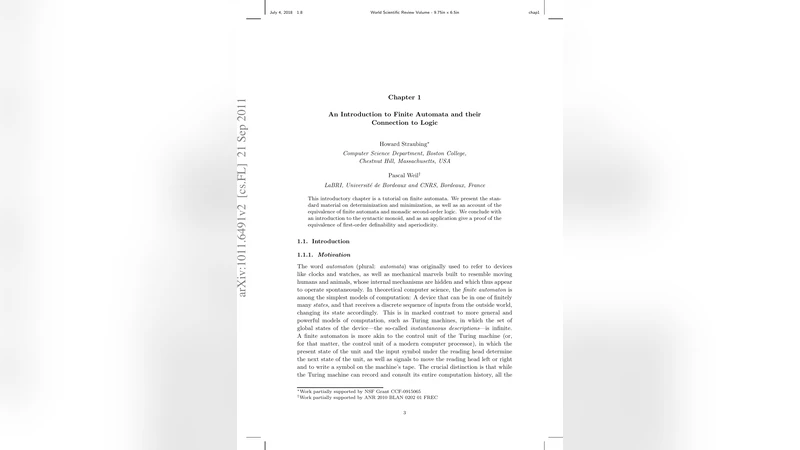
This is a tutorial on finite automata. We present the standard material on determinization and minimization, as well as an account of the equivalence of finite automata and monadic second-order logic. We conclude with an introduction to the syntactic monoid, and as an application give a proof of the equivalence of first-order definability and aperiodicity.
💡 Research Summary
This paper serves as a comprehensive tutorial that bridges the theory of finite automata with formal logic, presenting both classic algorithmic constructions and deeper algebraic‑logical correspondences. It begins by recalling the definition of deterministic and nondeterministic finite automata (DFA and NFA), emphasizing their role as recognizers of regular languages. The authors then detail the subset construction for determinization, explaining how each set of NFA states becomes a DFA state, how ε‑closures are computed, and how the inevitable state‑space explosion can be mitigated through hash‑based representation and on‑the‑fly pruning.
Following determinization, the paper turns to minimization. By introducing the Myhill‑Nerode equivalence relation, the authors prove that two states are indistinguishable precisely when they accept the same set of suffixes. They present Hopcroft’s O(n log n) algorithm, complete with pseudo‑code, and analyse its time and space complexity, highlighting its practical superiority over earlier quadratic‑time methods.
The central logical contribution is the equivalence between finite automata and monadic second‑order logic (MSO). The authors first define MSO over strings, allowing quantification over individual positions and sets of positions. They then construct, by structural induction on MSO formulas, a DFA that accepts exactly the models of a given formula. Conversely, for any DFA they exhibit an MSO sentence that characterizes its language, using state variables to encode the run and transition predicates to capture the automaton’s dynamics. This bidirectional translation establishes the classic result that regular languages are precisely the MSO‑definable languages.
In the final section the paper introduces the syntactic monoid of a language, a finite algebraic structure that captures the combinatorial behavior of concatenation modulo the language’s Myhill‑Nerode congruence. The authors prove Schützenberger’s theorem: a regular language is definable in first‑order logic (FO) if and only if its syntactic monoid is aperiodic (i.e., contains no non‑trivial groups). They provide a constructive proof that an aperiodic monoid yields an FO formula describing the language, and they show the converse by demonstrating that any FO‑definable language must have a syntactic monoid without periodic elements. This result links logical expressiveness to algebraic properties, offering a clean classification of regular languages into the FO‑definable (star‑free) subclass.
Overall, the paper weaves together algorithmic procedures (determinization, minimization), logical characterizations (MSO equivalence), and algebraic insights (syntactic monoids and aperiodicity). It offers a unified perspective that is valuable for students learning the fundamentals of automata theory, as well as for researchers interested in the interplay between automata, logic, and algebraic language theory.
Comments & Academic Discussion
Loading comments...
Leave a Comment