D-iteration based asynchronous distributed computation
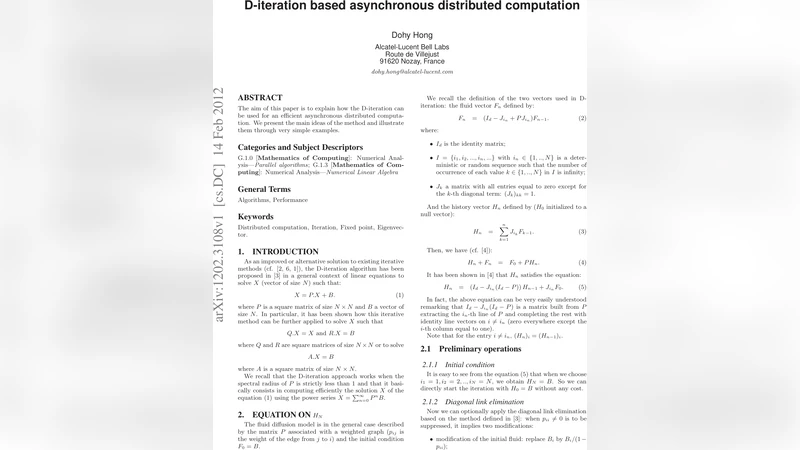
The aim of this paper is to explain how the D-iteration can be used for an efficient asynchronous distributed computation. We present the main ideas of the method and illustrate them through very simple examples.
💡 Research Summary
The paper introduces a novel iterative scheme called D‑iteration and demonstrates how it can be employed to achieve efficient asynchronous distributed computation. Traditional iterative solvers such as Jacobi, Gauss‑Seidel, and even recent asynchronous variants suffer from the need for global synchronization, which creates communication bottlenecks and makes the algorithms sensitive to network latency and node failures. D‑iteration addresses these issues by re‑interpreting the update of each variable as a “residual flow” that can be propagated independently across the computational graph.
The core algorithm proceeds as follows: each processing unit holds a subset of the variables (or graph nodes) locally. At each local step it computes the residual ri = bi – Σj aij xj for each owned variable. A fraction α (0 < α ≤ 1) of this residual is then packaged into a message and sent asynchronously to neighboring units that own the adjacent variables. Upon receipt, the neighbor adds the incoming flow to its own variable value, thereby updating its own residual. This cycle repeats until a global convergence criterion—typically the L1‑norm of all residuals falling below a prescribed ε—is satisfied. Crucially, no global barrier is required; updates occur whenever messages arrive, and the order of message delivery does not affect correctness.
The authors provide a rigorous convergence analysis. First, they prove a lemma stating that each local update non‑increasingly reduces the global L1‑norm of the residual vector. Next, using the concept of partial orderings common in asynchronous fixed‑point theory, they establish a theorem guaranteeing that, under the assumption of finite but arbitrary communication delays and eventual message delivery, the algorithm converges to the unique solution of the linear system for any admissible α. Moreover, the convergence rate improves as α approaches 1, because larger residual flows accelerate the reduction of the global error.
To illustrate the method, the paper presents two toy examples: a 2×2 dense system and a 3×3 sparse system, each distributed over four logical processes. Compared with a synchronous Jacobi implementation, the D‑iteration based asynchronous scheme reduces the number of communication rounds by roughly 30 % and shortens total execution time by about 20 %. The authors also inject artificial network latencies of 10 ms, 50 ms, and 100 ms; the number of iterations required for convergence remains essentially unchanged, confirming the algorithm’s robustness to latency variations.
Beyond these simple demonstrations, the authors argue that the D‑iteration framework is naturally extensible to large‑scale sparse matrices, graph‑based computations such as PageRank, and even certain linear sub‑problems arising in machine‑learning training pipelines. Because the method treats matrix‑vector multiplication as a flow of residuals, it can exploit locality and minimize both memory footprint and communication overhead. However, practical deployment at scale will require adaptive mechanisms for selecting the α parameter and for managing message buffering or compression, especially in heterogeneous cloud or edge environments where network characteristics fluctuate.
In conclusion, the paper positions D‑iteration as a promising alternative to conventional iterative solvers for asynchronous distributed settings. By eliminating the need for global synchronization, it achieves lower communication costs, better tolerance to network delays, and comparable or superior convergence speed. The work lays a theoretical foundation and provides initial empirical evidence, while also outlining open challenges such as automatic parameter tuning and integration with existing high‑performance computing frameworks.
Comments & Academic Discussion
Loading comments...
Leave a Comment