Mandelbrot Law of Evolving Networks
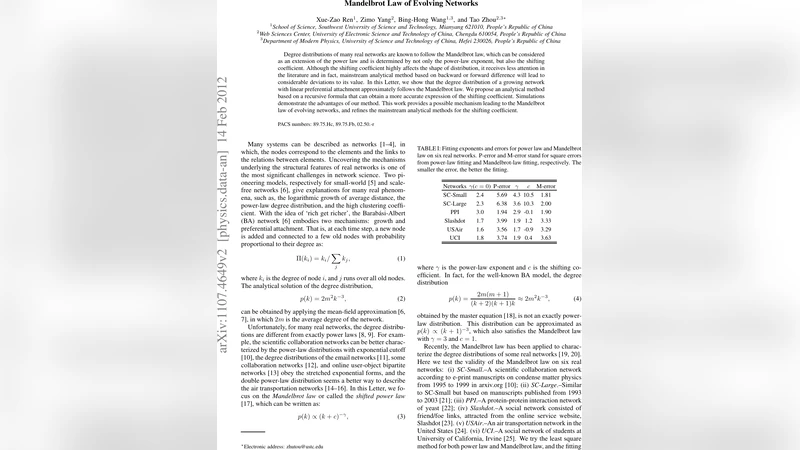
Degree distributions of many real networks are known to follow the Mandelbrot law, which can be considered as an extension of the power law and is determined by not only the power-law exponent, but also the shifting coefficient. Although the shifting coefficient highly affects the shape of distribution, it receives less attention in the literature and in fact, mainstream analytical method based on backward or forward difference will lead to considerable deviations to its value. In this Letter, we show that the degree distribution of a growing network with linear preferential attachment approximately follows the Mandelbrot law. We propose an analytical method based on a recursive formula that can obtain a more accurate expression of the shifting coefficient. Simulations demonstrate the advantages of our method. This work provides a possible mechanism leading to the Mandelbrot law of evolving networks, and refines the mainstream analytical methods for the shifting coefficient.
💡 Research Summary
The paper investigates why many empirical networks deviate from a pure power‑law degree distribution and proposes that the Mandelbrot law, a shifted power‑law of the form p(k) ∝ (k + c)⁻ᵞ, more accurately captures the observed patterns. The authors first demonstrate, using six real‑world networks (two scientific collaboration graphs, a protein‑protein interaction network, the Slashdot social network, the US airline network, and the UCI student network), that fitting a shifted power‑law yields substantially lower squared errors than fitting a simple power‑law whenever the shifting coefficient c is appreciably different from zero. This empirical evidence motivates a theoretical analysis of a growing network model with linear preferential attachment.
The model starts from a fully connected seed of m₀ nodes. At each time step a new node arrives and creates m links to existing nodes. The attachment probability is linear in the degree of the target node:
Π(k) = (α k + β) / N,
where N is the current number of nodes, α and β are parameters, and β = 0 reduces the model to the classic Barabási‑Albert (BA) construction. Enforcing the normalization Σₖ Π(k) p(k) = 1 yields a relation between α and β: α = 1 /
Comments & Academic Discussion
Loading comments...
Leave a Comment