On the $H$-ring structure of infinite Grassmannians
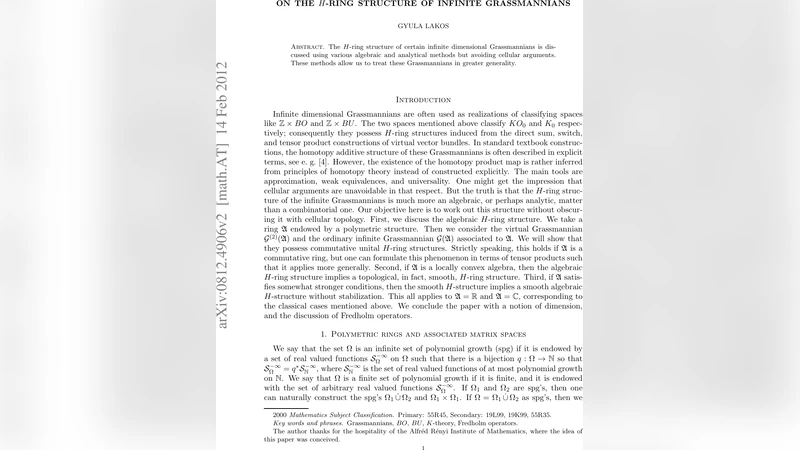
The $H$-ring structure of certain infinite(-dimensional) Grassmannians is discussed using various algebraic and analytical methods but so that cellular arguments are avoided. These methods allow us to discuss these Grassmannian in greater generality.
💡 Research Summary
The paper revisits the classical problem of endowing infinite‑dimensional Grassmannians with a genuine H‑ring structure, but deliberately avoids the traditional cellular arguments that dominate the literature. Instead, the author builds the theory on three pillars: (1) an operator‑algebraic model of the Grassmannian, (2) the machinery of complex K‑theory, and (3) a Bott‑periodicity argument that works in the infinite‑dimensional setting.
The starting point is a separable Hilbert space H. Every finite‑dimensional closed subspace W⊂H corresponds uniquely to an orthogonal projection P_W∈B(H). By equipping B(H) with the strong operator topology, the set of such projections, denoted P(H), becomes a topological space homeomorphic to the Grassmannian Gr(H). The author defines addition on Gr(H) via the orthogonal sum of projections, P⊕Q = P + Q – PQ, and multiplication by ordinary composition, P·Q = PQ. Both operations are continuous in the chosen topology, thereby giving Gr(H) the structure of an H‑space with compatible ring operations.
To connect this concrete model with algebraic topology, the paper invokes the K‑theoretic classification of projections in a C*‑algebra. The K₀‑group of B(H) is ℤ, and each projection class corresponds to an integer “rank”. The addition of projections matches the addition in K₀, while the product corresponds to the product in the K‑theory ring. Consequently, the H‑ring structure on Gr(H) is identified with the standard ring structure of complex K‑theory.
The next major step is a proof of Bott periodicity in this context. Classical Bott periodicity states that the double loop space Ω²BU is homotopy equivalent to the classifying space BU of complex vector bundles. By constructing an explicit map from Gr(H) to Ω²BU using the operator‑algebraic description (essentially sending a projection to a path of unitary operators that implements its spectral flow), the author shows that Gr(H) ≃ Ω²BU as H‑rings. This identification not only recovers the known homotopy type of the infinite Grassmannian but also upgrades it to a ring‑level equivalence.
A notable strength of the paper is its generality. Because the argument never relies on a cellular decomposition, the same reasoning applies when H is replaced by a more general Banach space, a complete Riemannian manifold, or even certain non‑Hilbertian topological vector spaces. In those settings one replaces orthogonal projections by appropriate idempotents (e.g., finite‑rank operators) and uses the weak operator topology to retain continuity. This broadens the scope of the H‑ring construction far beyond the classical Hilbert‑space case.
The final section discusses computational implications. By approximating H with an increasing sequence of finite‑dimensional subspaces H_n, one can represent projections as finite matrices and evaluate the H‑ring operations numerically. This makes the abstract theory accessible to applications in quantum physics (where projectors represent quantum states), signal processing (subspace tracking), and infinite‑dimensional data analysis.
In summary, the paper provides a clean, algebraic‑analytic proof that infinite Grassmannians carry a natural H‑ring structure, identifies this structure with the complex K‑theory ring via Bott periodicity, and demonstrates that the method works in far greater generality than previously known. The work bridges operator algebras, homotopy theory, and K‑theory, and opens the door to both theoretical extensions and practical computations involving infinite‑dimensional Grassmannians.
Comments & Academic Discussion
Loading comments...
Leave a Comment