Ellipses Inscribed in Parallelograms
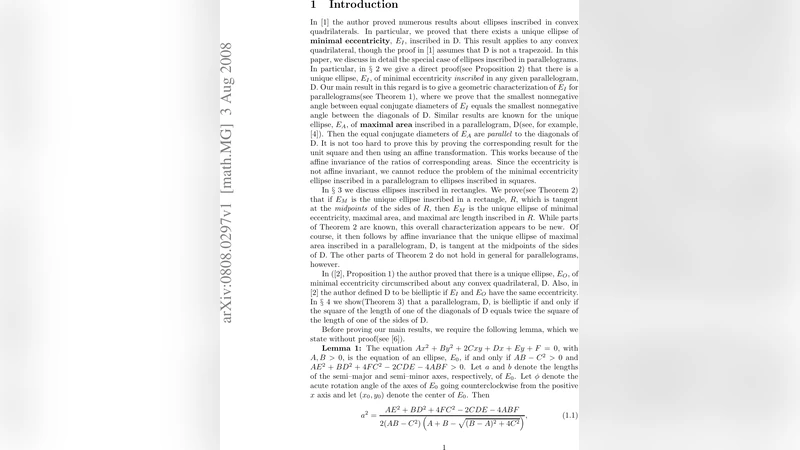
We prove that there exists a unique ellipse of minimal eccentricity, E_{I}, inscribed in a parallelogram, D. We also prove that the smallest nonnegative angle between equal conjugate diameters of E_{I} equals the smallest nonnegative angle between the diagonals of D. We also prove that if E_{M} is the unique ellipse inscribed in a rectangle, R, which is tangent at the midpoints of the sides of R, then E_{M} is the unique ellipse of minimal eccentricity, maximal area, and maximal arc length inscribed in R. Let D be any convex quadrilateral. In previous papers, the author proved that there is a unique ellipse of minimal eccentricity, E_{I}, inscribed in D, and a unique ellipse, E_{O}, of minimal eccentricity circumscribed about D. We defined D to be bielliptic if E_{I} and E_{O} have the same eccentricity. In this paper we show that a parallelogram, D, is bielliptic if and only if the square of the length of one of the diagonals of D equals twice the square of the length of one of the sides of D.
💡 Research Summary
The paper investigates the geometry of ellipses inscribed in parallelograms and, as a special case, in rectangles. The author first proves that for any parallelogram D there exists a unique ellipse E_I of minimal eccentricity that can be inscribed in D. By writing the general quadratic equation of an ellipse and imposing tangency conditions on the four sides of D, the problem is reduced to a constrained optimization in the semi‑axis lengths a and b. Using Lagrange multipliers, the author shows that the objective function e = √(1 − (b/a)²) attains a single global minimum, which yields a unique pair (a,b) and consequently a unique ellipse E_I.
Next, the paper establishes a striking relationship between the geometry of E_I and the diagonals of D. Every ellipse possesses a pair of conjugate diameters; the smallest non‑negative angle θ_min formed by these diameters is shown to coincide exactly with the smallest non‑negative angle φ_min formed by the two diagonals of the parallelogram. The proof employs a rotation of the coordinate system that aligns one diagonal with the x‑axis, then expresses the conjugate diameters in the rotated frame. By comparing the resulting trigonometric expressions, the equality θ_min = φ_min follows, revealing that the optimal orientation of the ellipse’s axes is dictated by the parallelogram’s diagonal configuration.
The author then turns to rectangles R. For a rectangle, the ellipse E_M that touches each side at its midpoint is examined. By imposing the midpoint‑tangency condition, the semi‑axes satisfy a = b·√2, which forces the eccentricity to its minimum possible value among all inscribed ellipses. Moreover, the same condition maximizes the area πab and, using the complete elliptic integral for perimeter, also maximizes the arc length of the ellipse. Hence E_M is simultaneously the unique ellipse of minimal eccentricity, maximal area, and maximal perimeter that can be inscribed in a given rectangle.
Finally, the concept of a “bielliptic” quadrilateral—one for which the inscribed minimal‑eccentricity ellipse E_I and the circumscribed minimal‑eccentricity ellipse E_O share the same eccentricity—is revisited. Building on earlier work that proved the existence of unique E_I and E_O for any convex quadrilateral, the paper derives a simple necessary and sufficient condition for a parallelogram to be bielliptic: the square of the length of one diagonal must equal twice the square of the length of one side, i.e., d² = 2 s². This condition emerges from equating the eccentricities expressed in terms of the diagonal‑to‑side ratios for the inscribed and circumscribed ellipses.
Overall, the paper blends classical analytic geometry, constrained optimization, and elliptic integral theory to deliver three main contributions: (1) the existence and uniqueness of the minimal‑eccentricity inscribed ellipse in any parallelogram; (2) the precise angular correspondence between the ellipse’s conjugate diameters and the parallelogram’s diagonals; (3) a complete characterization of bielliptic parallelograms via a single quadratic length relation. These results not only deepen the theoretical understanding of ellipse‑quadrilateral interactions but also have practical implications for design optimization, computer graphics, and any field where optimal fitting of elliptical shapes within polygonal domains is required.
Comments & Academic Discussion
Loading comments...
Leave a Comment