Sources of GeV Photons and the Fermi Results
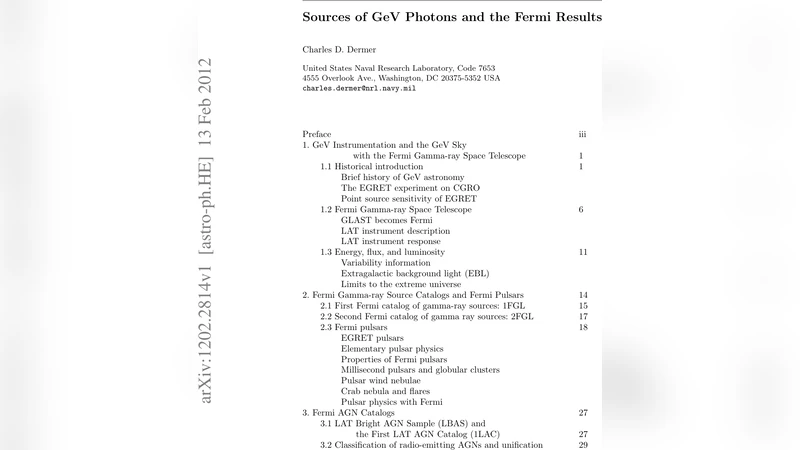
This is a pedagological review of some astrophysical highlights of the Fermi Gamma ray Observatory, including theoretical studies related mainly to extragalactic Fermi science.
💡 Research Summary
The paper provides a pedagogical review of the most significant astrophysical results obtained with the Fermi Gamma‑ray Space Telescope, focusing on the origins of photons in the GeV energy range and the theoretical frameworks that have been developed to interpret them. It begins with an overview of the Fermi mission, emphasizing the capabilities of the Large Area Telescope (LAT) to survey the sky from ~20 MeV to >300 GeV with unprecedented sensitivity and angular resolution. The authors then categorize the principal classes of GeV emitters and discuss how Fermi observations have reshaped our understanding of each class.
Active Galactic Nuclei (AGN), especially blazars with relativistic jets pointed toward Earth, are identified as the dominant extragalactic contributors to the GeV sky. The review contrasts two leading leptonic emission models—external Compton (EC) scattering of ambient photon fields (e.g., broad‑line region, dusty torus) and synchrotron‑self‑Compton (SSC) processes within the jet’s own synchrotron photon bath. By analysing LAT spectra, variability timescales, and multi‑wavelength correlations, the authors argue that both mechanisms operate, with EC typically dominating in powerful flat‑spectrum radio quasars and SSC playing a larger role in high‑frequency‑peaked BL Lac objects.
The paper then turns to star‑forming galaxies and supernova remnants (SNRs) as Galactic sources of GeV photons. In starburst environments, cosmic‑ray protons accelerated by numerous supernova shocks interact with dense interstellar gas, producing neutral pions that decay into gamma rays (the “π⁰‑decay” channel). Fermi’s detection of a characteristic spectral bump in galaxies such as M82 and NGC 253 confirms this hadronic scenario. For individual SNRs, the authors highlight cases (e.g., IC 443, W44) where LAT data reveal the π⁰‑decay signature, providing the first direct evidence that SNRs accelerate protons to at least GeV energies.
A substantial portion of the review is devoted to the search for dark‑matter signatures in the GeV band. The authors summarize the theoretical expectation that weakly interacting massive particles (WIMPs) annihilating or decaying in Galactic halos would produce a line‑like feature or a continuum spectrum peaking at the particle mass. They recount the tentative 130 GeV excess reported in early LAT analyses, explain the statistical limitations, and discuss subsequent null results that have placed stringent limits on the annihilation cross‑section for a wide range of WIMP masses. The paper stresses that future instruments with improved energy resolution (e.g., the proposed AMEGO mission) are essential to resolve this issue.
Gamma‑ray bursts (GRBs) are examined as transient GeV sources. By combining data from the Gamma‑ray Burst Monitor (GBM) and LAT, the authors show that high‑energy photons often arrive with a delay of seconds to minutes relative to the keV‑MeV prompt emission. This temporal behavior, together with the observed spectral hardening, is interpreted within the internal‑shock versus external‑shock frameworks, with the delayed LAT component favoring external‑shock afterglow models in many cases.
Finally, the review addresses the isotropic gamma‑ray background (IGRB) and its small‑scale anisotropies. The LAT’s all‑sky maps enable measurements of angular power spectra that reveal contributions from unresolved blazars, star‑forming galaxies, and possibly exotic processes. By modeling the attenuation of high‑energy photons by the extragalactic background light (EBL), the authors demonstrate how the IGRB can be used to probe the evolution of cosmic star formation and the intergalactic magnetic field.
In conclusion, the paper synthesizes Fermi’s observational breakthroughs with contemporary theoretical models, establishing that GeV photons arise from a diverse set of astrophysical environments—relativistic jets, supernova‑driven shocks, starburst nuclei, and possibly dark‑matter halos. It highlights current uncertainties (e.g., the exact lepton‑to‑hadron ratio in blazar jets, the contribution of faint sources to the IGRB) and outlines future directions, including next‑generation ground‑based Cherenkov arrays (CTA) and space‑based missions with superior energy resolution. The review thus serves both as a comprehensive reference for researchers and as a roadmap for upcoming high‑energy astrophysics investigations.