Weak covering properties and infinite games
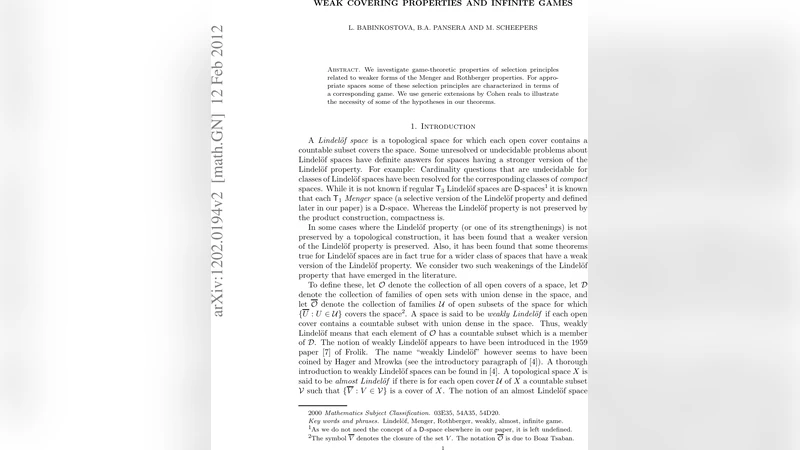
We investigate game-theoretic properties of selection principles related to weaker forms of the Menger and Rothberger properties. For appropriate spaces some of these selection principles are characterized in terms of a corresponding game. We use generic extensions by Cohen reals to illustrate the necessity of some of the hypotheses in our theorems.
💡 Research Summary
The paper investigates the interplay between weakened covering properties—specifically, variants of the classical Menger and Rothberger properties—and infinite two‑player selection games. After recalling the standard definitions of the Menger property (S_fin(𝒪,𝒪)) and the Rothberger property (S₁(𝒪,𝒪)), the authors introduce two new selection principles they call “weakly Menger” and “weakly Rothberger.” In the weakly Menger scheme, for each open cover 𝒰ₙ presented by ONE, TWO may choose a finite subfamily Fₙ, but the union of all chosen families is required only to be dense (or to cover a large subset) rather than the whole space. In the weakly Rothberger scheme, TWO selects a single element Uₙ from each cover, with the requirement that the set of chosen points be “frequently dense” in a precise combinatorial sense.
The central contribution is a game‑theoretic characterization of these weakened principles. The authors define modified games G′_fin(𝒪,𝒟) and G′_1(𝒪,𝒟), where 𝒟 denotes a family of dense open sets. In G′_fin, ONE supplies an open cover at each round, and TWO responds with a finite subfamily; TWO wins if the cumulative union is dense. In G′_1, TWO responds with a single open set, and victory is defined analogously. The paper proves three main theorems:
-
Theorem 1 (Lindelöf case). For any Lindelöf space X, X satisfies the weakly Menger selection principle if and only if TWO has a winning strategy in G′_fin(𝒪,𝒟). The proof adapts diagonalisation techniques and constructs a “dense‑building” strategy that ensures each round’s finite choice expands the dense core.
-
Theorem 2 (σ‑compact, completely regular case). If X is σ‑compact and completely regular, then X satisfies the weakly Rothberger principle exactly when TWO can win G′_1(𝒪,𝒟). The authors develop a progressive selection method that guarantees the chosen singletons avoid previous selections while still achieving frequent density.
-
Theorem 3 (Converse direction). In both contexts, the existence of a winning strategy for TWO automatically yields the corresponding weak covering property; no additional set‑theoretic axioms (such as MA) are required.
To demonstrate that the hypotheses (Lindelöfness, σ‑compactness, complete regularity) are not merely technical, the authors employ forcing. By adding Cohen reals, they construct a generic extension V
Comments & Academic Discussion
Loading comments...
Leave a Comment