A finite Toda representation of the box-ball system with box capacity
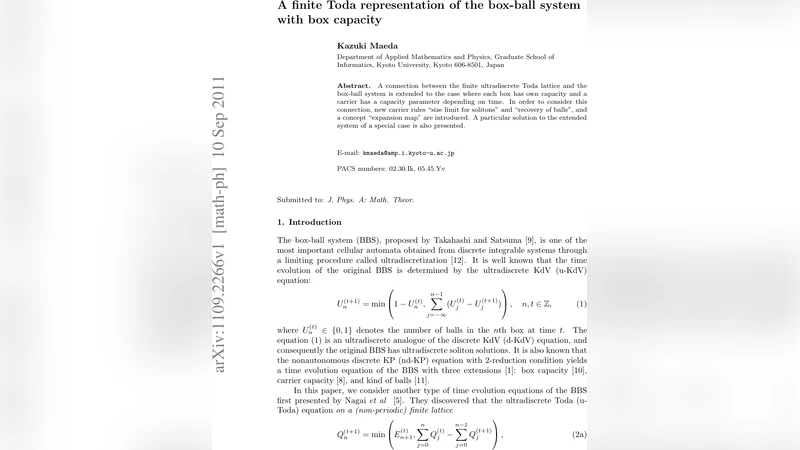
A connection between the finite ultradiscrete Toda lattice and the box-ball system is extended to the case where each box has own capacity and a carrier has a capacity parameter depending on time. In order to consider this connection, new carrier rules “size limit for solitons” and “recovery of balls”, and a concept “expansion map” are introduced. A particular solution to the extended system of a special case is also presented.
💡 Research Summary
The paper investigates a generalized version of the box‑ball system (BBS) in which each box may have its own capacity Δₙ and the carrier’s capacity Mₜ can vary with time. The authors extend the known correspondence between the finite ultradiscrete Toda lattice and the original BBS (which corresponds to the ultradiscrete KdV equation) to accommodate these non‑uniform capacities. To achieve this, they introduce two new carrier rules: “size limit for solitons” and “recovery of balls”. In the size‑limit stage the carrier moves from left to right, picking up all balls from each box; if the number of balls exceeds the current carrier capacity Mₜ₊₁, the excess balls are temporarily removed. In the recovery stage the removed balls are returned to the boxes from which they were taken. These two stages are encoded in equations (8a)–(8c) and combined into a single evolution rule (11), which reduces to the non‑autonomous ultradiscrete KdV equation when Mₜ is infinite.
The derivation starts from the two‑reduced non‑autonomous discrete KP (nd‑KP) equation, introducing parameters δₙ and μₜ (with 0 ≤ δₙ, μₜ ≤ 1) that represent box capacity and carrier capacity, respectively. By applying the standard ultradiscretization limit ε → 0⁺ and using the identity
lim_{ε→0⁺} −ε log(e^{−A/ε}+e^{−B/ε}) = min(A,B),
the authors obtain the ultradiscrete system (8) where U(t)ₙ denotes the number of balls in box n at time t, Z(t)ₙ the number of balls carried into box n during the size‑limit process, and the evolution of U and Z follows a min‑plus algebra.
A crucial conceptual tool is the “expansion map”, which converts a BBS configuration into a binary sequence that respects the individual box capacities. This map allows the definition of soliton size Q(t)ₙ (the number of consecutive occupied cells) and empty‑block size E(t)ₙ (the distance between successive solitons). Using these variables, the authors formulate a finite Toda representation consisting of equations (15a)–(15d). Q(t+1)ₙ is given by the minimum of the adjacent empty‑block size and the carrier content D(t+1)ₙ, while E and D evolve by simple additive updates that reflect the transfer of balls between solitons and the carrier. Boundary conditions E(t)₀ = E(t)ᴺ = +∞ and D(t+1)₀ = Q(t)₀ close the system for a finite number N of solitons.
The paper proves (Theorem 1) that this finite ultradiscrete Toda lattice exactly reproduces the time evolution of the original BBS with the new carrier rules. When the carrier capacity is taken to be infinite, the evolution reduces to the known non‑autonomous ultradiscrete KdV equation, confirming that the new model truly generalizes the classical case.
In addition to the fully general case with arbitrary sequences {Δₙ} and {Mₜ}, the authors present an explicit solution for the special case of constant box capacity Δ (Δₙ = Δ for all n) and fixed carrier capacity. By specifying initial soliton sizes and positions, the solution describes solitons moving at constant speed while respecting the size‑limit and recovery processes during collisions. This construction demonstrates that even with the added complexity of capacity constraints, the system remains integrable and admits closed‑form soliton solutions.
The work also situates the results within the broader context of numerical algorithms. The finite Toda lattice equations (15) are shown to be the subtraction‑free counterpart of the classical q‑d algorithm (Rutishauser’s qd algorithm) and its d‑qd variant, which are used for eigenvalue computations. By recasting these algorithms in a min‑plus ultradiscrete form, the authors bridge integrable cellular automata theory with numerical linear algebra, suggesting potential cross‑fertilization between the two fields.
Overall, the paper delivers a comprehensive extension of the finite Toda representation of the BBS, incorporating heterogeneous box capacities and time‑dependent carrier capacities, introduces novel carrier dynamics, provides a rigorous ultradiscrete derivation from nd‑KP, and supplies explicit soliton solutions for both the general and special cases. This advances the understanding of integrable cellular automata with realistic constraints and opens avenues for further exploration of ultradiscrete integrable systems and their applications in computational mathematics.
Comments & Academic Discussion
Loading comments...
Leave a Comment