Differential K-theory. A survey
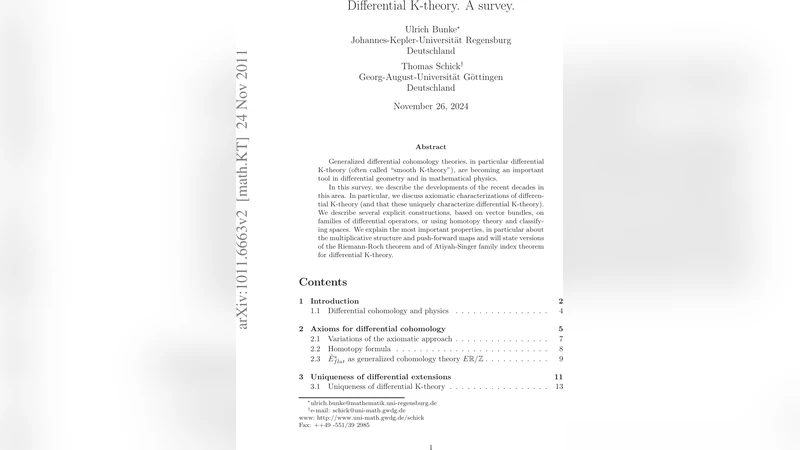
Generalized differential cohomology theories, in particular differential K-theory (often called “smooth K-theory”), are becoming an important tool in differential geometry and in mathematical physics. In this survey, we describe the developments of the recent decades in this area. In particular, we discuss axiomatic characterizations of differential K-theory (and that these uniquely characterize differential K-theory). We describe several explicit constructions, based on vector bundles, on families of differential operators, or using homotopy theory and classifying spaces. We explain the most important properties, in particular about the multiplicative structure and push-forward maps and will state versions of the Riemann-Roch theorem and of Atiyah-Singer family index theorem for differential K-theory.
💡 Research Summary
This survey provides a comprehensive overview of differential K‑theory, often called smooth K‑theory, tracing its development over the past few decades and highlighting its central role at the interface of differential geometry, topology, and mathematical physics. The authors begin by situating differential cohomology as a refinement of ordinary cohomology that simultaneously records topological data and differential‑form information. Within this framework, differential K‑theory is presented as the unique theory satisfying a set of natural axioms: a curvature map to closed differential forms, an underlying topological K‑class map, and a “characteristic class” map to ordinary cohomology, together with compatibility conditions such as functoriality, exactness, and a product structure. The authors prove a uniqueness theorem showing that any functor obeying these axioms is canonically isomorphic to the standard model of differential K‑theory.
Three principal constructions are examined in depth. The first, the “vector‑bundle model,” equips a complex vector bundle with a connection and a differential form representing the Chern‑Simons correction; the resulting data define a differential K‑class via the Chern‑Weil homomorphism. The second, the “family‑operator model,” uses a smooth family of elliptic differential operators parametrized by a base manifold. The associated index bundle together with the Bismut‑Freed connection yields a differential K‑class, linking directly to the Atiyah‑Singer family index theorem. The third, the “homotopy‑theoretic model,” constructs differential K‑theory as a homotopy pullback of the K‑theory spectrum, the de Rham complex, and the ordinary cohomology spectrum; this perspective clarifies the role of classifying spaces and enables a clean treatment of higher‑categorical structures.
The paper then develops the multiplicative structure, showing that the cup product on differential forms lifts to a graded‑commutative product on differential K‑theory, compatible with the curvature map and with the underlying topological product. Push‑forward (integration) maps are defined for proper submersions equipped with a differential K‑orientation (a choice of spin(^c) structure together with a compatible connection). The authors prove a differential Riemann‑Roch theorem: the differential Chern character intertwines the push‑forward in differential K‑theory with the push‑forward in differential cohomology, up to the Todd class expressed as a differential form.
Finally, a differential version of the Atiyah‑Singer family index theorem is presented. The theorem asserts that the differential analytic index of a family of Dirac‑type operators equals the differential topological index obtained via the push‑forward of the differential K‑class of the symbol. This result refines the classical index theorem by retaining curvature information and provides a powerful tool for applications in quantum field theory, where anomaly cancellation and charge quantization naturally live in differential K‑theory.
The survey concludes with a discussion of open problems: explicit models for higher‑dimensional push‑forwards, extensions to twisted and equivariant differential K‑theory, computational techniques for concrete manifolds, and connections to string‑theoretic constructions such as Ramond‑Ramond fields. Overall, the paper serves as both a pedagogical introduction and a reference compendium for researchers interested in the algebraic, geometric, and physical aspects of differential K‑theory.
Comments & Academic Discussion
Loading comments...
Leave a Comment