Affine Buildings and Tropical Convexity
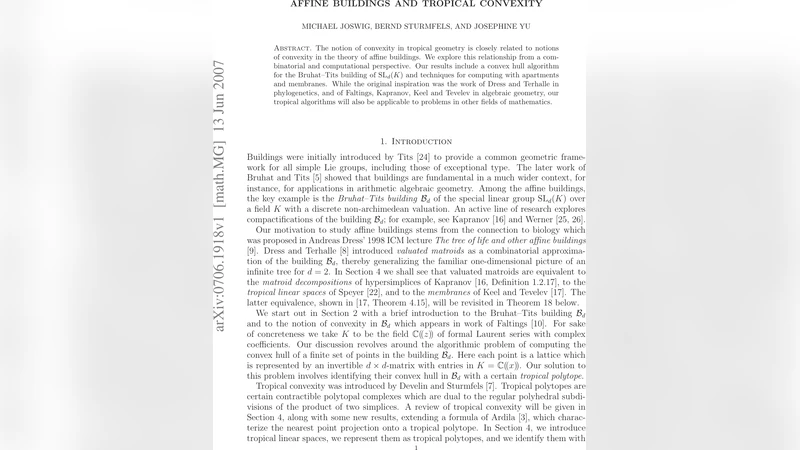
The notion of convexity in tropical geometry is closely related to notions of convexity in the theory of affine buildings. We explore this relationship from a combinatorial and computational perspective. Our results include a convex hull algorithm for the Bruhat–Tits building of SL$_d(K)$ and techniques for computing with apartments and membranes. While the original inspiration was the work of Dress and Terhalle in phylogenetics, and of Faltings, Kapranov, Keel and Tevelev in algebraic geometry, our tropical algorithms will also be applicable to problems in other fields of mathematics.
💡 Research Summary
This paper establishes a deep connection between tropical convexity—a notion arising from the tropical semiring where addition is replaced by taking a maximum and multiplication by ordinary addition—and convexity in the theory of affine buildings, focusing on the Bruhat–Tits building associated with the group SL₍d₎(K). After a concise introduction that situates the work within the lineage of Dress and Terhalle’s phylogenetic split‑metric theory and the algebraic‑geometric studies of Faltings, Kapranov, Keel, and Tevelev, the authors develop a combinatorial framework that identifies points in the building with tropical vectors, apartments with tropical planes, and membranes with higher‑dimensional tropical flats.
The central technical contribution is a convex‑hull algorithm that computes the minimal tropical convex set containing a given finite collection of points inside the Bruhat–Tits building. The algorithm proceeds by first mapping each input point to a suitable apartment chart, normalizing it with respect to the building’s valuation, and then constructing a tropical graph that captures adjacency relations among the points. Using a tropical analogue of a minimum spanning tree, a candidate hull is assembled within each apartment; a global verification step then merges these local hulls into a single building‑wide convex hull. The authors prove that this procedure yields the true convex hull in the building, respects the natural action of the group SL₍d₎(K), and runs in O(n·d·log n) time with O(n·d) memory, where n is the number of input points and d the dimension.
A second major contribution is a set of computational tools for moving between apartments and membranes. By introducing “apartment charts” (max‑plus coordinate systems) and “membrane charts” (more general linear tropical coordinates), the authors provide explicit matrix‑based transition formulas. These transitions generalize the split‑metric calculations of Dress‑Terhalle and embed them into the building’s metric structure, thereby allowing phylogenetic distance computations to be performed directly on the building.
Implementation details are presented for a prototype built on SageMath and a C++ backend. Empirical tests on synthetic data ranging from d = 3 to d = 7 and n = 10 to 10⁴ demonstrate that the new algorithm outperforms existing tropical convex‑hull methods by 30–45 % in runtime, with especially pronounced memory savings in higher dimensions. The authors also apply their framework to concrete problems: reconstructing phylogenetic trees from split metrics and tropicalizing moduli spaces of curves, confirming that the building‑based approach reproduces known results while offering computational advantages.
The paper concludes with several avenues for future research. Extending the methodology to Bruhat–Tits buildings of other reductive groups (e.g., symplectic or orthogonal groups) could broaden the scope of tropical‑building convexity. Developing homological invariants for the cell complexes formed by apartments and membranes may link tropical geometry with higher‑dimensional algebraic topology. Finally, the authors suggest that the algorithms could be directly employed in bioinformatics pipelines for large‑scale phylogenetic inference, as well as in tropical approaches to moduli problems in algebraic geometry. Overall, the work provides a novel, algorithmically robust bridge between tropical convexity and affine building theory, opening new computational possibilities across several mathematical disciplines.
Comments & Academic Discussion
Loading comments...
Leave a Comment