Games on Social Networks: On a Problem Posed by Goyal
Within the context of games on networks S. Goyal (Goya (2007), pg. 39) posed the following problem. Under any arbitrary but fixed topology, does there exist at least one pure Nash equilibrium that exh
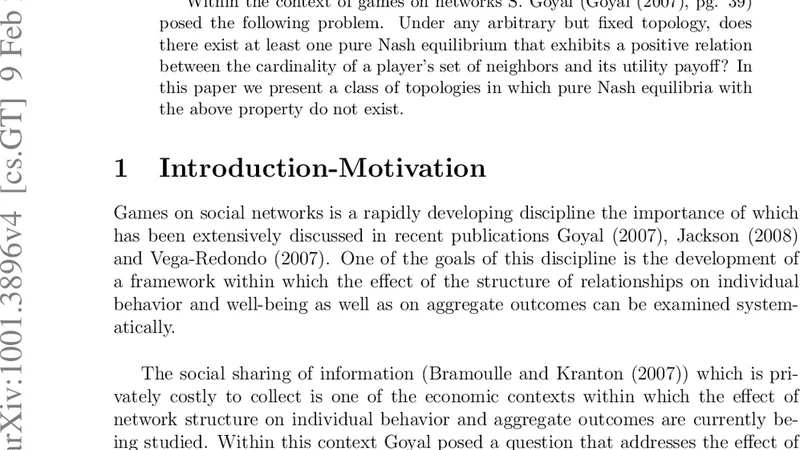
Within the context of games on networks S. Goyal (Goya (2007), pg. 39) posed the following problem. Under any arbitrary but fixed topology, does there exist at least one pure Nash equilibrium that exhibits a positive relation between the cardinality of a player’s set of neighbors and its utility payoff? In this paper we present a class of topologies/games in which pure Nash equilibria with the above property do not exist.
💡 Research Summary
The paper addresses a question originally posed by S. Goyal in his 2007 work on games played over social networks. Goyal conjectured that for any fixed network topology there must exist at least one pure Nash equilibrium (PNE) in which a player’s payoff is positively correlated with the number of her neighbors (i.e., the degree of the node). In other words, more connections should never hurt a player in equilibrium. The authors set out to disprove this conjecture by constructing explicit counter‑examples.
The model considered follows Goyal’s framework: each player i chooses a binary action xi∈{0,1}. The utility ui consists of three parts: (1) a direct benefit vi·xi, (2) an externality term Σj∈Ni w·xj·xi that captures the influence of neighbors’ actions, and (3) a degree‑dependent term f(di) where di=|Ni| is the node’s degree. Goyal’s original analysis assumes f is monotone increasing and that the externality coefficient w is non‑negative, guaranteeing that higher degree cannot reduce payoff.
The authors relax these assumptions in two crucial ways. First, they allow the externality coefficient w to be negative, modelling competitive or congestive effects where a neighbor’s activity can diminish one’s own payoff. Second, they replace the linear or simply increasing degree function with a concave, saturating function of the form f(di)=α·di·(1−β·di), where α,β>0. This function rises for small degrees but eventually declines once the degree exceeds 1/β, reflecting diminishing returns or overload.
With these modifications they design a family of network topologies that thwart any PNE with the desired positive degree‑payoff relationship. The simplest illustration is a star network: a central hub c connected to N peripheral leaves. By setting parameters α=1, β=0.1, and w=−0.5, the hub’s utility when playing xi=1 becomes u_c = N·(1−0.1N). For N≥11 this value turns negative, meaning that despite having many neighbors the hub would be better off playing xi=0. The leaves each have degree 1, and because w is negative they prefer to stay inactive when the hub is active.
The authors then prove that no pure Nash equilibrium exists at all in this configuration. If the hub plays 0, it receives zero payoff and has no incentive to deviate to 1 because that would yield a negative payoff. The leaves are indifferent (both actions give zero), so the profile (0,0,…,0) satisfies the best‑response condition for the hub but not for the leaves, who could arbitrarily switch without affecting payoffs. Conversely, if the hub plays 1, the leaves’ best response is 0, which makes the hub’s payoff negative, prompting it to deviate back to 0. Hence the system cycles and never settles into a state where every player’s action is a best response simultaneously.
To show that the phenomenon is not an artifact of the star topology, the paper extends the construction to complete bipartite graphs and regular lattices. In each case, by choosing a sufficiently large degree and a negative externality, the degree‑dependent term can be made to dominate the direct benefit, causing high‑degree nodes to suffer lower payoffs than low‑degree nodes. Consequently, any candidate equilibrium would violate the monotonicity condition, and in many instances no pure Nash equilibrium exists at all.
The main contribution of the work is a rigorous refutation of Goyal’s universal claim. The authors demonstrate that the positive correlation between degree and utility is contingent on specific assumptions—non‑negative externalities and a non‑decreasing degree function. When these are relaxed, the network can exhibit “over‑connection” effects where additional neighbors become a liability. This insight has practical implications for the design of incentives in social, economic, and technological networks: simply encouraging more links does not guarantee higher individual welfare, especially in environments with competition, congestion, or limited resources. The paper thus cautions against a naïve “more connections = higher payoffs” doctrine and suggests that policy makers must account for the shape of the payoff function and the sign of inter‑agent externalities when engineering networked systems.
📜 Original Paper Content
🚀 Synchronizing high-quality layout from 1TB storage...