A transformation approach for collaboration based requirement models
Distributed software engineering is widely recognized as a complex task. Among the inherent complexities is the process of obtaining a system design from its global requirement specification. This paper deals with such transformation process and suggests an approach to derive the behavior of a given system components, in the form of distributed Finite State Machines, from the global system requirements, in the form of an augmented UML Activity Diagrams notation. The process of the suggested approach is summarized in three steps: the definition of the appropriate source Meta-Model (requirements Meta-Model), the definition of the target Design Meta-Model and the definition of the rules to govern the transformation during the derivation process. The derivation process transforms the global system requirements described as UML diagram activities (extended with collaborations) to system roles behaviors represented as UML finite state machines. The approach is implemented using Atlas Transformation Language (ATL).
💡 Research Summary
The paper addresses a fundamental challenge in distributed software engineering: bridging the gap between a global requirements specification and a concrete system design. The authors propose a model‑to‑model transformation approach that automatically derives the behavior of each system component as a distributed Finite State Machine (FSM) from a global requirements model expressed in an augmented UML Activity Diagram notation. The augmentation consists of a “Collaboration” construct that explicitly captures multi‑role interactions, synchronizations, and conditional flows that are typical in distributed scenarios.
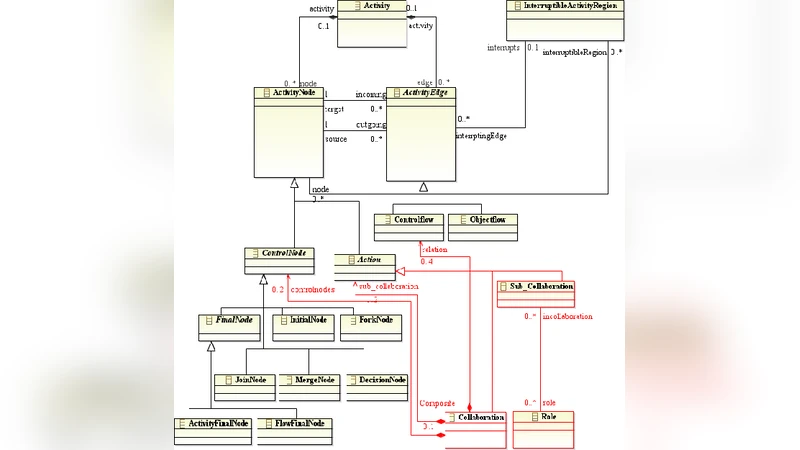
The methodology is organized into three main phases. First, a Requirements Meta‑Model is defined. It extends the standard UML Activity Diagram with the Collaboration meta‑class, participants (roles), messages, and guard conditions. This meta‑model is enriched with OCL constraints to guarantee well‑formedness (e.g., every collaboration must have at least two participants, all control flows must be guarded or unconditional).
Second, a Design Meta‑Model is introduced. Each role is represented by an independent UML State Machine. The state machine includes states, transitions, events, and guards, and it models inter‑role communication through signals or operation calls. Like the requirements meta‑model, the design meta‑model is constrained by OCL to ensure completeness (every state must have an outgoing transition unless it is a final state) and consistency (event signatures must match across communicating roles).
The core contribution lies in the transformation rules, implemented in the Atlas Transformation Language (ATL). The transformation proceeds as follows:
- Parsing and Extraction – The input model (XMI) is parsed; activity nodes, control flows, and collaboration elements are identified.
- Role Identification – For each collaboration, the participating roles are extracted, and the global activity flow is partitioned into role‑specific sequences.
- State‑Machine Construction – Each role‑specific sequence is mapped to a state machine: activity start and end points become states; control‑flow edges become transitions; guard expressions are transferred as transition guards.
- Collaboration Synchronization – Special ATL rules generate “StartCollaboration” and “EndCollaboration” events that are injected into all involved state machines, ensuring that the distributed FSMs remain synchronized exactly as specified in the global model.
- Message Mapping – Messages defined inside collaborations are transformed into signal events that trigger transitions in the target role’s state machine.
The transformation rules combine declarative ATL matched rules (e.g., ActivityNode -> State) with helper functions that handle complex synchronization logic, such as parallel branches within a collaboration. The authors also embed OCL checks both before and after transformation to guarantee that the generated design model respects the original requirements constraints.
To validate the approach, the authors implemented a prototype on top of the Eclipse Modeling Framework (EMF) and applied it to two case studies: an e‑commerce order‑processing scenario and a distributed sensor‑network monitoring scenario. In both cases, the global requirements were modeled using the extended activity diagram, and the ATL transformation automatically produced a set of role‑specific state machines. The generated FSMs were visually inspected in Papyrus and compared against manually crafted designs. The results showed perfect functional equivalence, a dramatic reduction in modeling time (average transformation time ≈ 1.2 seconds), and zero transformation‑induced errors. Moreover, the OCL constraints remained satisfied after transformation, confirming the semantic preservation of the models.
The paper discusses limitations, notably that the current transformation assumes a static set of collaborations defined at design time and does not yet address dynamic role membership or non‑functional properties such as performance or security. Future work is outlined to extend the meta‑models with QoS attributes, to support runtime‑adaptive collaborations, and to integrate the generated FSMs into code‑generation pipelines for end‑to‑end model‑driven development.
In summary, the authors deliver a rigorous, ATL‑based transformation framework that systematically converts collaboration‑enhanced UML activity specifications into distributed finite state machines. This contributes a practical solution for reducing the manual effort and error‑proneness inherent in moving from global requirements to role‑based design in distributed software projects, thereby advancing the state of model‑driven engineering for collaborative systems.