Collaboration for enhancing the system development process in open source diligence
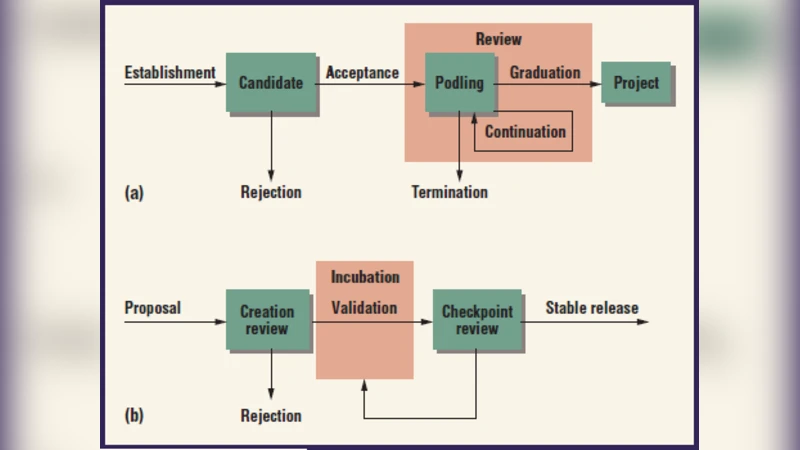
According to different opponents and commercial giants in software industries, the open source style software development has enough capacity to complete successfully the large scale projects. But we have seen many flaws and loops in collaboration and handling of mega scale projects in open source environment. Perhaps the collaboration is a key of successful project development. In this article we have tries to identify different feasible and reliable solution to a better collaboration ways in the open source system development. Some of the issues also that are found in the development phase of the open source have been identified and a proposed solution by explaining Successful communities such as GNU, the Apache Software Foundation, and Eclipse Foundation is discusses in this research article. It must be kept in mind that to improvement the collaboration in open source environment both the development community and the people should be more creative.
💡 Research Summary
The paper tackles a paradox in modern software engineering: while open‑source development is widely praised for its ability to deliver large‑scale systems, many high‑profile projects still suffer from recurring collaboration breakdowns. The authors begin by contrasting the optimistic view of open‑source—highlighted by industry leaders who claim that distributed, volunteer‑driven development can rival proprietary efforts—with the reality of “loops” and “plug” problems that impede progress in mega‑scale initiatives. They argue that effective collaboration is the decisive factor separating successful from stalled projects.
A concise literature review follows, summarizing prior research that identifies strong leadership, transparent decision‑making, and an active community culture as the primary success drivers for open‑source endeavors. However, the review also notes a gap: few studies have systematically examined how these drivers are operationalized in real‑world, high‑complexity projects. To fill this gap, the authors select three emblematic communities—GNU, the Apache Software Foundation (ASF), and the Eclipse Foundation—and conduct a mixed‑methods case study. Data sources include official governance documents, mailing‑list archives, issue‑tracker logs, and semi‑structured interviews with core maintainers and recent contributors.
The comparative analysis reveals three recurring themes across the three cases. First, a “layered yet flexible” governance model that clearly delineates authority (core maintainers), responsibility (sub‑system leads), and participation (general contributors) mitigates decision‑making bottlenecks while preserving the openness that defines the open‑source ethos. GNU exemplifies this through its “leadership delegation” approach, where a small group of trusted maintainers grants autonomy to sub‑projects under well‑defined licensing policies. ASF’s Project Management Committee (PMC) model provides a more formalized hierarchy, centralizing strategic decisions while allowing individual projects to self‑organize on implementation details.
Second, the integration of communication channels into a single workflow dramatically reduces information fragmentation. The authors note that many projects still rely on a patchwork of mailing lists, IRC/Slack channels, separate documentation sites, and issue trackers, leading to duplicated discussions and missed signals. Eclipse’s Marketplace and its plug‑in‑centric architecture illustrate how a unified platform can automatically link code reviews, build pipelines, and documentation updates, ensuring that every stakeholder sees the same state of the project.
Third, a standardized onboarding pipeline is essential for retaining new talent. The paper documents how ad‑hoc mentorship and sparse documentation create high entry barriers, causing promising contributors to abandon projects early. All three successful communities have instituted automated code‑review bots, mentor‑matching programs, and tiered tutorial series that guide newcomers from “first‑time pull request” to “core maintainer” status.
Based on these findings, the authors propose three concrete interventions for any open‑source project seeking to improve collaboration: (1) adopt a hierarchical‑but‑adaptable governance structure with clearly defined roles and delegated authority; (2) deploy an integrated communication suite that unifies mailing lists, issue trackers, chat, and documentation into a single, searchable interface with automated notifications; and (3) implement a formalized onboarding pipeline that includes automated quality checks, mentorship allocation, and progressive learning resources.
The discussion acknowledges that the suggested model is not a one‑size‑fits‑all solution. Cultural differences (e.g., Western versus Asian collaboration norms), project size, domain specificity, and legal considerations such as patent exposure or license compatibility can affect how the model should be tuned. Moreover, the transition to a more structured governance may encounter resistance from long‑standing contributors who value the “flat” nature of early‑stage open‑source projects.
In conclusion, the paper reaffirms that collaboration efficiency is the linchpin of sustainable open‑source development. It calls for future research to (a) collect quantitative performance metrics—such as issue‑resolution time, contributor retention rates, and code‑quality indicators—to empirically validate the proposed interventions; (b) explore the applicability of the model across diverse cultural and regulatory environments; and (c) investigate the synergy between the proposed processes and emerging AI‑driven automation tools (e.g., intelligent code‑review assistants, predictive triage systems). The authors candidly note the study’s limitations: a small sample of case studies and a lack of longitudinal data. They recommend broader, data‑rich investigations to confirm whether the identified governance, communication, and onboarding practices can be generalized to the wider ecosystem of open‑source software.
Comments & Academic Discussion
Loading comments...
Leave a Comment