Some Open Problems in Topological Algebra
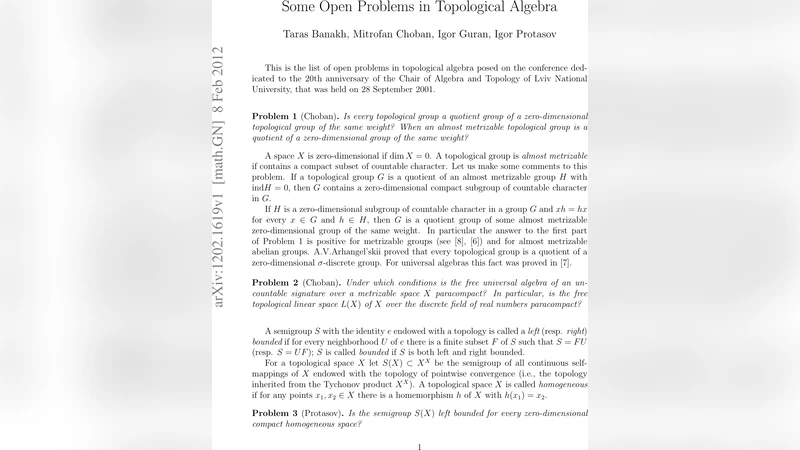
This is the list of open problems in topological algebra posed on the conference dedicated to the 20th anniversary of the Chair of Algebra and Topology of Lviv National University, that was held on 28 September 2001.
💡 Research Summary
**
The paper “Some Open Problems in Topological Algebra” is a curated collection of research questions that were presented at a conference held on September 28, 2001, to celebrate the 20th anniversary of the Chair of Algebra and Topology at Lviv National University. Although the document itself is brief—a list of problems accompanied by short remarks—it serves as a valuable snapshot of the state of topological algebra at the turn of the millennium and highlights directions that have continued to shape the field.
The authors begin with a concise introduction that situates topological algebra at the intersection of algebraic structures (groups, semigroups, rings, modules, vector spaces) and topological considerations (continuity of operations, completeness, compactness, local properties). They stress that many classical algebraic results fail to extend automatically when a topology is imposed, and that the interplay often generates deep, unexpected phenomena.
The body of the paper is organized into four thematic sections.
-
Topological Groups – The first set of problems asks whether certain familiar properties of abstract groups survive under topological constraints. A central question is whether every locally compact, complete topological group admits a compatible continuous algebraic structure that makes it a Lie group or a pro‑Lie group. Related queries concern the existence of continuous homomorphisms onto compact or discrete quotients, the closure of subgroups, and the characterization of groups whose automorphism groups are themselves topologically complete. The authors note partial progress: for example, Gleason–Yamabe theory provides a description for locally compact groups, but the full classification for non‑locally compact or non‑metrizable cases remains open.
-
Topological Semigroups and Semirings – Here the focus shifts to structures where the inverse operation may be absent. The key problem asks for necessary and sufficient conditions under which a topological semigroup possesses a continuous “pseudo‑inverse” or can be embedded into a topological group. The paper also raises the question of when a topological semiring admits a continuous additive identity and a multiplicative identity that are compatible with the given topology. These issues are linked to the study of compactifications (e.g., the Stone–Čech compactification of semigroups) and to the theory of idempotent measures.
-
Topological Modules and Vector Spaces – The third block deals with modules over topological rings and vector spaces equipped with a topology that makes scalar multiplication continuous. A prominent open problem is whether the group of continuous linear operators on a complete topological vector space is itself a complete topological group under the operator topology. Another question concerns the existence of a continuous Hahn–Banach type extension theorem for non‑normable topological vector spaces. The authors point out that while Banach‑space theory provides a rich toolbox, many natural examples (e.g., LF‑spaces, inductive limits of Fréchet spaces) fall outside the classical framework, leaving the continuity of duality maps largely unresolved.
-
Interactions with Other Areas – The final section broadens the perspective, connecting topological algebra to category theory, dynamical systems, and measure theory. One highlighted problem asks whether a dynamical system whose phase space carries a compatible topological algebraic structure necessarily admits an invariant probability measure that respects both the dynamics and the algebraic operations. This question bridges ergodic theory with topological algebra and suggests the use of transfer operators and amenability concepts. Additional problems involve the categorification of topological algebraic structures (e.g., topological monoids as objects in a suitable 2‑category) and the applicability of forcing or model‑theoretic techniques to construct exotic topological algebras.
For each problem the authors provide a brief literature review, indicating which cases have been settled (often under additional hypotheses such as metrizability, separability, or compactness) and which remain completely open. They also suggest methodological avenues: employing transfinite induction on cardinal invariants, using descriptive set‑theoretic tools to analyze Borel complexity of algebraic operations, or adapting recent advances in higher‑category theory to capture continuity constraints more naturally.
In the concluding remarks, the paper proposes a research roadmap. Short‑term goals include completing the classification of locally compact groups with additional continuity constraints and establishing new extension theorems for topological vector spaces. Medium‑term objectives involve developing a unified categorical framework that can simultaneously handle groups, semigroups, and modules with topology, thereby facilitating cross‑fertilization with homotopy theory and non‑commutative geometry. Long‑term aspirations aim at a systematic theory of “topological algebraic invariants” that would parallel classical invariants (cohomology, K‑theory) but be sensitive to the underlying topology of the algebraic operations.
Overall, the paper functions as both a historical record of the open problems circulating in 2001 and a catalyst for ongoing research. Many of the listed questions have inspired substantial work over the past two decades, yet several remain stubbornly unresolved, underscoring the depth and richness of topological algebra as a field that continues to intertwine pure algebraic insight with subtle topological analysis.
Comments & Academic Discussion
Loading comments...
Leave a Comment