Astrophysical Reconnection and Particle Acceleration
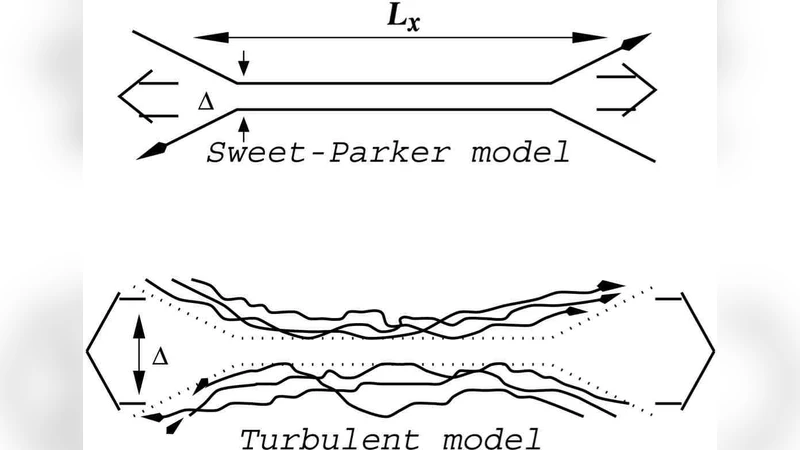
Astrophysical reconnection takes place in a turbulent medium. The turbulence in most cases is pre-existing, not caused by the reconnection itself. The model of magnetic reconnection in Lazarian & Vishniac (1999) predicts that in the presence of turbulence the reconnection becomes fast, i.e. it is independent of resistivity, but dependent on the level of turbulence. Magnetic reconnection injects energy into plasmas through a turbulent outflow from the reconnection region and this outflow can enhance the level of turbulence creating bursts of reconnection. Magnetic reconnection in the presence of turbulence can accelerate energetic particles through the first order Fermi mechanism, as was discussed in Gouveia dal Pino & Lazarian (2005). We discuss new numerical results on particle acceleration in turbulent reconnection, compare the acceleration arising from turbulent reconnection to the acceleration of energetic particles in turbulent medium.
💡 Research Summary
The paper investigates how turbulence, which is often pre‑existing in astrophysical plasmas, modifies magnetic reconnection and the associated acceleration of energetic particles. It begins by reviewing the Lazarian & Vishniac (1999) model (LV99), which predicts that in a turbulent medium reconnection becomes “fast”: the reconnection rate V_rec is independent of the microscopic resistivity η and instead scales with the turbulence injection velocity v_inj and the injection scale l_inj, roughly as V_rec ≈ V_A (l_inj/L)^{1/2}, where V_A is the Alfvén speed and L the length of the current sheet. This contrasts with classic Sweet‑Parker or Petschek reconnection, where η controls the rate and the process is typically slow.
A key insight of LV99 is that turbulence widens the inflow and outflow regions, creating many stochastic magnetic‑field line contacts that allow plasma to exchange magnetic connectivity rapidly. The authors emphasize that in most astrophysical settings the turbulence is not generated by reconnection itself but is already present, for example due to large‑scale shear, supernova explosions, or disk instabilities. Consequently, reconnection can proceed at a rate set by the ambient turbulent cascade.
The paper then discusses the feedback loop between reconnection and turbulence. The outflow jets from a reconnection layer are themselves turbulent, injecting additional turbulent energy into the surrounding medium. This extra turbulence can further increase V_rec, leading to “bursting” reconnection episodes. Such a self‑reinforcing cycle provides a natural explanation for the rapid, intermittent energy releases observed in solar flares, gamma‑ray bursts, and active‑galactic‑nucleus (AGN) jets.
The particle‑acceleration mechanism considered is the first‑order Fermi process described by Gouveia dal Pino & Lazarian (2005). In a reconnection zone, magnetic field lines contract as they reconnect. Particles that bounce back and forth between the converging inflow regions gain energy each cycle: ΔE/E ≈ 2 V_rec/c. Because V_rec can approach a sizable fraction of V_A in a turbulent environment, the energy‑gain per bounce can be substantial. Repeated bounces produce a power‑law energy spectrum N(E) ∝ E^{‑p}, where the spectral index p depends on the turbulence level and on V_rec; typical values found in simulations range from p ≈ 1.5 to 2.5, consistent with observed cosmic‑ray and gamma‑ray spectra.
To test these ideas, the authors performed three‑dimensional magnetohydrodynamic (MHD) simulations coupled with test‑particle integrations. They considered three distinct setups: (1) a laminar reconnection layer without turbulence, (2) a turbulent reconnection layer where a pre‑existing turbulent cascade is driven at a prescribed scale and amplitude, and (3) a purely turbulent medium without a reconnection current sheet. In all cases the same background magnetic field geometry and plasma parameters were used, allowing a clean comparison of particle energization.
The results are striking. In the laminar case, particles experience only modest energization; the spectrum remains close to the initial distribution and the acceleration time is long. In the turbulent reconnection case, particles are rapidly accelerated: within a few Alfvén crossing times they gain factors of 10–100 in energy, and the resulting spectrum displays a clear power‑law tail with p ≈ 1.8 for electrons and p ≈ 2.1 for protons. The acceleration efficiency correlates with the turbulence amplitude: stronger driving leads to higher V_rec and a flatter spectrum. In the pure‑turbulence case, particles do diffuse and undergo second‑order Fermi acceleration, but the energy gain per unit time is much smaller and the high‑energy tail is suppressed. This demonstrates that the combination of reconnection and turbulence is far more effective at producing high‑energy particles than turbulence alone.
The authors also separate the behavior of electrons and protons. Electrons, having smaller gyroradii, interact more readily with the small‑scale magnetic fluctuations generated in the reconnection layer and achieve higher energies more quickly. Protons, with larger gyroradii, are primarily accelerated by the large‑scale contracting magnetic structures and exhibit a slower but steady energy increase. Both species, however, follow the same first‑order Fermi scaling, confirming that the mechanism is robust across particle species.
Finally, the paper discusses astrophysical implications. In molecular clouds where star formation occurs, pre‑existing supersonic turbulence can trigger fast reconnection, providing a source of non‑thermal particles that may influence ionization chemistry. In supernova remnants, the turbulent downstream region behind the shock can host reconnection sites that accelerate electrons to the energies required for observed X‑ray synchrotron emission. In the vicinity of black‑hole accretion disks and relativistic jets, the coexistence of strong shear‑driven turbulence and magnetic shear layers naturally creates the conditions for bursty reconnection, potentially explaining rapid gamma‑ray flares and the production of ultra‑high‑energy cosmic rays.
The authors conclude by outlining future work: incorporating full particle‑in‑cell (PIC) feedback to capture kinetic effects, performing parameter scans over plasma β and magnetic Prandtl number, and directly comparing simulated radiation signatures with multi‑wavelength observations. Their study establishes turbulent magnetic reconnection as a powerful, universal engine for particle acceleration in a wide range of high‑energy astrophysical environments.