Self-similar scaling of density in complex real-world networks
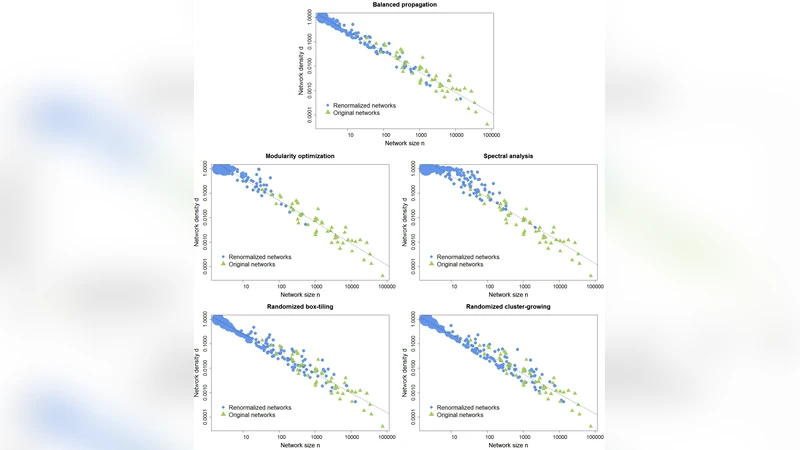
Despite their diverse origin, networks of large real-world systems reveal a number of common properties including small-world phenomena, scale-free degree distributions and modularity. Recently, network self-similarity as a natural outcome of the evolution of real-world systems has also attracted much attention within the physics literature. Here we investigate the scaling of density in complex networks under two classical box-covering renormalizations-network coarse-graining-and also different community-based renormalizations. The analysis on over 50 real-world networks reveals a power-law scaling of network density and size under adequate renormalization technique, yet irrespective of network type and origin. The results thus advance a recent discovery of a universal scaling of density among different real-world networks [Laurienti et al., Physica A 390 (20) (2011) 3608-3613.] and imply an existence of a scale-free density also within-among different self-similar scales of-complex real-world networks. The latter further improves the comprehension of self-similar structure in large real-world networks with several possible applications.
💡 Research Summary
The paper investigates whether the relationship between network size and density follows a universal scaling law across a wide variety of real‑world complex networks, and whether this relationship persists under different renormalization (coarse‑graining) procedures. The authors apply five renormalization techniques: two classic box‑covering methods (random box‑tiling with distance lB = 3 and cluster‑growing with radius rB = 2) and three community‑based coarse‑graining algorithms (balanced propagation, modularity optimization, and spectral partitioning). For each technique the original network is repeatedly reduced to a series of “super‑node” graphs, each representing a different scale of the original structure.
A dataset of 55 real networks spanning social, online, collaboration, citation, biological, technological, and other domains is used. All networks are treated as simple undirected graphs and reduced to their largest connected component. For every renormalization step the number of nodes n and the density d (the ratio of existing links to the maximum possible links) are measured. The authors fit a power‑law model d = c · n^(−γ) and evaluate fit quality with the coefficient of determination (R²) and Spearman’s rank correlation (ρ). Results are averaged over ten independent runs per network.
The empirical analysis shows that both box‑covering methods yield very high R² (≈ 0.94–0.95) and ρ (≈ 0.97–0.98), indicating a strong power‑law relationship between size and density that holds across successive renormalization levels. Balanced propagation, a state‑of‑the‑art community detection algorithm, performs almost as well (R² ≈ 0.96, ρ ≈ 0.985). In contrast, modularity optimization and spectral partitioning produce weaker fits (R² ≈ 0.80 or lower), which the authors attribute to known resolution limits and degeneracy issues of modularity‑based methods.
The estimated scaling exponent γ is consistently around –0.85 for most techniques, slightly different from the theoretical –1 expected for perfectly sparse graphs. This suggests that real networks are not strictly tree‑like but maintain a modest amount of extra connectivity while still scaling roughly linearly with the number of nodes (d ≈ n^(−1)). Importantly, the same exponent is observed in very large networks (≥ 10⁶ edges), confirming that the “scale‑free density” phenomenon is not limited to small or medium‑sized systems.
To test whether the observed scaling is a generic property of any graph, the authors repeat the analysis on Erdős‑Rényi random graphs and on synthetic models such as Barabási‑Albert preferential attachment and Watts‑Strogatz small‑world networks. In these cases the power‑law fit is poor (R² < 0.5), indicating that the universal density scaling is a distinctive feature of real‑world networks that have evolved under specific growth and optimization pressures.
The paper draws two main conclusions. First, appropriate renormalization—either via geometric box‑covering or high‑quality community detection—reveals a robust self‑similar structure in complex networks, manifested as a consistent size‑density scaling across scales. Second, the existence of a scale‑free density law (d ∝ n^(−γ) with γ ≈ 0.85) is universal across network domains, independent of the underlying type (social, biological, technological, etc.). This universality provides a new baseline for network modeling, compression, and sampling, and may inform the design of algorithms that exploit self‑similar density for efficient simulation of dynamical processes such as epidemic spreading or synchronization. Future work suggested includes extending the analysis to directed and weighted networks, exploring the impact of hierarchical modularity on the scaling exponent, and leveraging the scaling law for predictive modeling of network evolution.
Comments & Academic Discussion
Loading comments...
Leave a Comment