Social features of online networks: the strength of intermediary ties in online social media
An increasing fraction of today social interactions occur using online social media as communication channels. Recent worldwide events, such as social movements in Spain or revolts in the Middle East, highlight their capacity to boost people coordination. Online networks display in general a rich internal structure where users can choose among different types and intensity of interactions. Despite of this, there are still open questions regarding the social value of online interactions. For example, the existence of users with millions of online friends sheds doubts on the relevance of these relations. In this work, we focus on Twitter, one of the most popular online social networks, and find that the network formed by the basic type of connections is organized in groups. The activity of the users conforms to the landscape determined by such groups. Furthermore, Twitter’s distinction between different types of interactions allows us to establish a parallelism between online and offline social networks: personal interactions are more likely to occur on internal links to the groups (the weakness of strong ties), events transmitting new information go preferentially through links connecting different groups (the strength of weak ties) or even more through links connecting to users belonging to several groups that act as brokers (the strength of intermediary ties).
💡 Research Summary
The paper investigates whether classic sociological theories about tie strength—Granovetter’s “strength of weak ties” and Burt’s “bridging structural holes”—hold in an online setting, using Twitter as a case study. The authors collected a large-scale dataset from the Twitter API covering November–December 2008, comprising 2,408,534 users, 48,776,888 directed follower links, and all associated mentions (866,264) and retweets.
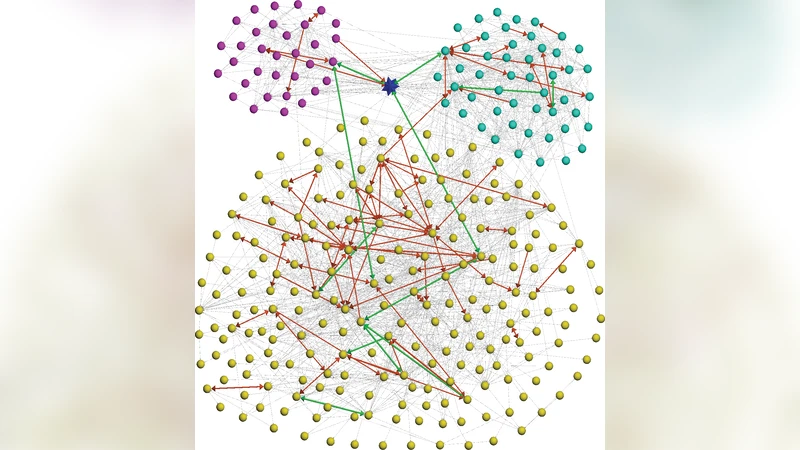
To uncover the underlying community structure, they applied the OSLOM overlapping community detection algorithm, which identified 92,062 groups of varying sizes (the largest around 10,000 members). Users could belong to multiple groups; 37 % of users were not assigned to any group, while some belonged to over 100 groups. Links were categorized based on their position relative to these groups: internal (both endpoints in the same group), between‑group (endpoints in different groups), intermediary (one endpoint belongs to several groups while the other belongs to only one), and no‑group (neither endpoint in any detected group).
Mentions, which usually represent personal conversations, were used as a proxy for tie strength. The analysis showed that mentions are disproportionately concentrated on internal links, especially for groups up to about 150 users—a size reminiscent of Dunbar’s number, suggesting that even in a digital environment cognitive limits on close relationships persist. Moreover, the intensity of a mention relationship (number of exchanged mentions, reciprocity) strongly correlates with the likelihood that the link is internal, confirming Granovetter’s expectation that stronger ties reside within communities.
Retweets, the primary mechanism for viral information diffusion on Twitter, displayed a different pattern. They were more common on between‑group links, particularly when the source and target groups were small (≤200 members). This aligns with the “weak tie” hypothesis: bridges between otherwise separate clusters facilitate the spread of novel information across the network.
The most novel contribution concerns intermediary links. Users who belong to multiple groups act as brokers, and the links involving such users exhibit a higher proportion of retweets than mentions. The probability of a retweet occurring on an intermediary link increases as the similarity between the two groups (measured by shared members) decreases, indicating that these brokers transmit more diverse, less redundant information. The authors term this phenomenon the “strength of intermediary ties,” extending the classic binary strong‑weak tie framework to include a third, highly effective class of connections in online media.
Overall, the study demonstrates that (1) Twitter’s follower network possesses a clear modular structure; (2) internal links are the main venue for personal, high‑strength interactions; (3) between‑group links serve as the backbone for information diffusion; and (4) multi‑group users function as powerful intermediaries, amplifying the reach of novel content. The findings validate offline sociological theories in the digital realm while highlighting the unique role of overlapping community membership in shaping online communication dynamics. Limitations include the lack of ground‑truth offline community data and the focus on a single time window; future work could integrate geographic or demographic information to further elucidate the relationship between online and offline social structures.
Comments & Academic Discussion
Loading comments...
Leave a Comment