De seriebus divergentibus
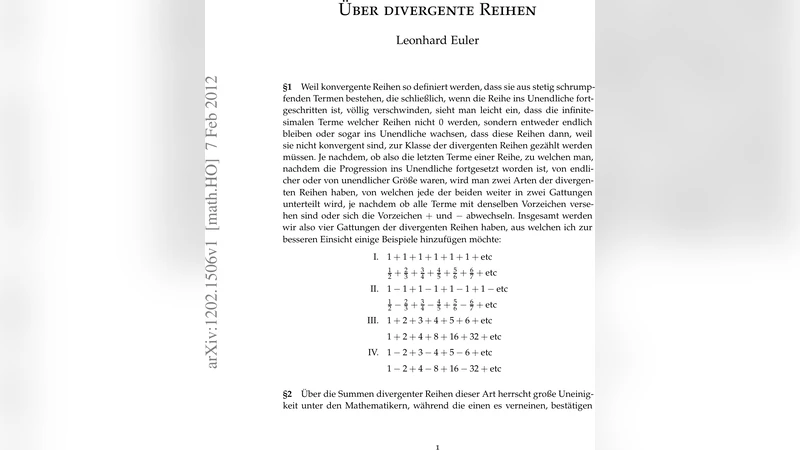
Euler gives a long introduction, giving all the arguments for and against the use of divergent series in calculus and then gives his own definition of the sum of a diverging series. Then in the second half of this paper he evaluates the the 1-1+2-6+24-120+720-… on several ways and gets the sum 0.5963473621372. The paper is translated from Euler’s Latin original into German.
💡 Research Summary
The paper “De seriebus divergentibus,” translated from Euler’s original Latin into German, offers a comprehensive historical and technical treatment of divergent series. In the opening section, Euler surveys the long‑standing debate among mathematicians about whether a series that does not converge in the classical sense can still be assigned a meaningful sum. He lists arguments from both sides, noting that many calculations in analysis, physics, and astronomy routinely employ formally divergent expansions without apparent inconsistency. From this survey he derives a pragmatic stance: the “sum” of a divergent series should be defined not as a limit of partial sums, but as a regularized value obtained after applying a suitable transformation—such as differentiation, integration, Laplace or Borel transforms, or a rearrangement of terms—that yields a finite, well‑defined quantity.
The core of the paper focuses on the alternating factorial series
\