On a coalgebraic view on Logic
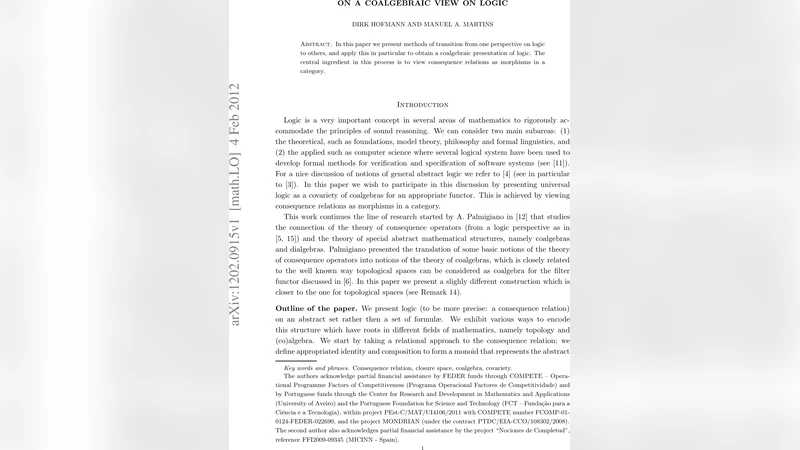
In this paper we present methods of transition from one perspective on logic to others, and apply this in particular to obtain a coalgebraic presentation of logic. The central ingredient in this process is to view consequence relations as morphisms in a category.
💡 Research Summary
The paper “On a coalgebraic view on Logic” proposes a unified categorical framework that reinterprets logical consequence relations as morphisms in a suitable category and then translates these morphisms into coalgebraic structures. The authors begin by recalling that a consequence relation, traditionally written Γ ⊢ φ, can be seen as a binary relation between sets of premises and individual conclusions. By lifting this relation to a monotone map c_R : ℘(X) → ℘(X) (where X is the set of all formulas), they observe that c_R satisfies the three closure operator axioms: extensivity, monotonicity, and idempotence (transitivity). This observation allows them to treat consequence relations as closure operators, which are precisely the algebraic objects of a certain category of algebras over the powerset functor.
Having established the algebraic view, the authors introduce coalgebras as the dual notion suitable for modeling state‑based transition systems. A coalgebra for a functor F is a pair (X, τ) with τ : X → F X. The key insight is that the closure operator c_R can be encoded as a coalgebraic transition function τ_R defined by τ_R(x) = {A ⊆ X | x ∈ c_R(A)}. In this formulation, each formula x is associated with the collection of premise sets that can derive it; the functor F is taken to be ℘(℘(X)), the double powerset, which captures the “set of sets of premises” perspective. Consequently, logical inference becomes a state transition: moving from a premise set to the set of formulas it can produce.
The paper proceeds to instantiate this general construction for several well‑known logics. For modal logic, the authors choose the functor F(W) = ℘(W) on a set of possible worlds W and define τ(w) = {U ⊆ W | ∀v (wRv → v ∈ U)} where R is the accessibility relation. They prove that this coalgebraic representation is equivalent to the standard Kripke semantics, showing that the modal □ operator corresponds exactly to the coalgebraic transition. For intuitionistic logic, they use the same double‑powerset functor but interpret τ as the upward‑closed hull of provable premises, thereby recovering the Heyting algebra structure within the coalgebraic setting. For linear logic, they replace the powerset functor with a multiset functor to model resource consumption, and τ encodes admissible resource transformations.
A central technical contribution is Theorem 4.1, which establishes a categorical equivalence between the category of consequence relations (viewed as closure operators) and the category of coalgebras for the chosen functor. The equivalence is given by two functors: one sending a consequence relation R to its associated coalgebra (X, τ_R), and the other sending a coalgebra (X, τ) back to the closure operator c_τ defined by c_τ(A) = {x ∈ X | τ(x) ⊆ A}. The authors verify that these constructions are inverses up to natural isomorphism, thereby proving that the algebraic and coalgebraic perspectives are fully interchangeable.
The paper concludes by discussing the implications of this duality. By viewing proofs as state transitions, one can apply coalgebraic techniques—such as coinduction, bisimulation, and final coalgebra semantics—to proof theory and automated reasoning. This opens the door to new algorithms for proof search that exploit coalgebraic simulation, as well as to a systematic method for integrating multiple logics within a single coalgebraic model. The authors also outline future work, including extensions to quantum logics, the development of coalgebra‑based model checkers for hybrid systems, and the exploration of enriched categorical settings (e.g., fibrations) to capture more sophisticated logical phenomena. Overall, the paper provides a rigorous and elegant bridge between consequence relations and coalgebra, offering a fresh categorical lens through which to study logic.
Comments & Academic Discussion
Loading comments...
Leave a Comment