The Projection Method for Reaching Consensus and the Regularized Power Limit of a Stochastic Matrix
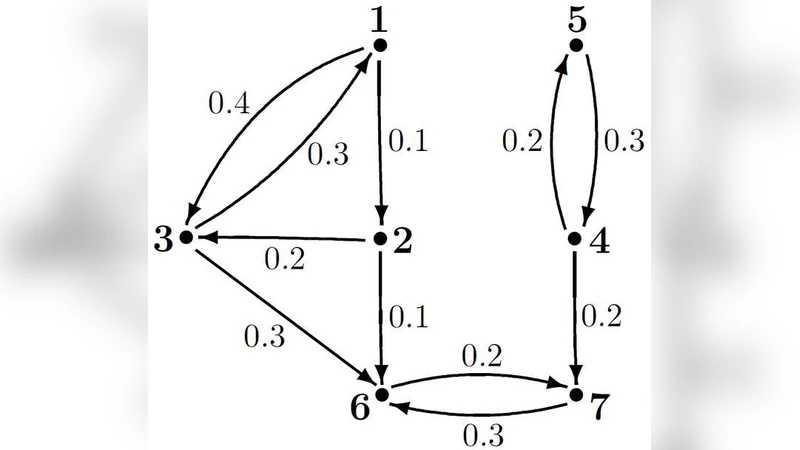
In the coordination/consensus problem for multi-agent systems, a well-known condition of achieving consensus is the presence of a spanning arborescence in the communication digraph. The paper deals with the discrete consensus problem in the case where this condition is not satisfied. A characterization of the subspace $T_P$ of initial opinions (where $P$ is the influence matrix) that \emph{ensure} consensus in the DeGroot model is given. We propose a method of coordination that consists of: (1) the transformation of the vector of initial opinions into a vector belonging to $T_P$ by orthogonal projection and (2) subsequent iterations of the transformation $P.$ The properties of this method are studied. It is shown that for any non-periodic stochastic matrix $P,$ the resulting matrix of the orthogonal projection method can be treated as a regularized power limit of $P.$
💡 Research Summary
The paper addresses the discrete‑time consensus problem for multi‑agent systems modeled by the classic DeGroot iteration (s(k)=P,s(k-1)), where (P) is a row‑stochastic influence matrix. In the standard setting, consensus for arbitrary initial opinions is guaranteed if and only if (P) is regular (SIA), which is equivalent to the communication digraph (\Gamma) containing a spanning arborescence (a spanning out‑tree). However, many practical networks do not satisfy this condition; the powers (P^{k}) may converge to a limit (P_{\infty}) that does not have identical rows, and consequently the DeGroot algorithm fails to produce a common opinion for generic initial states.
The authors first characterize the subspace of initial opinion vectors that still lead to consensus despite the lack of regularity. Let (L=I-P) be the Kirchhoff (Laplacian) matrix associated with (\Gamma). They prove that the “consensus‑compatible” subspace is
\
Comments & Academic Discussion
Loading comments...
Leave a Comment