Localization and Glassy Dynamics Of Many-Body Quantum Systems
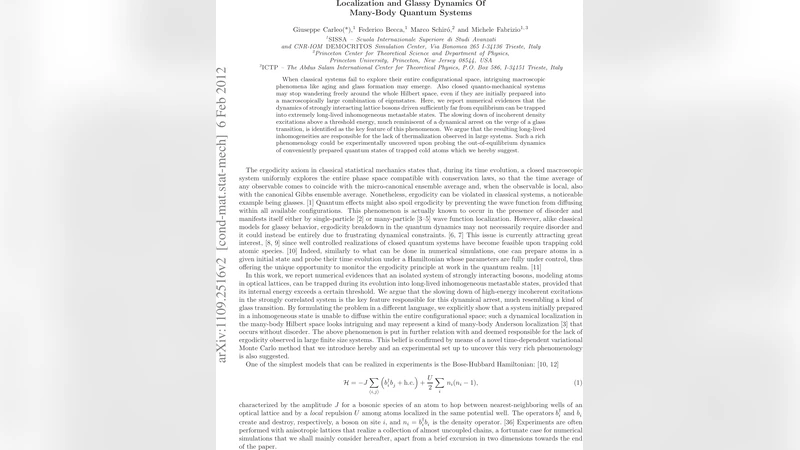
When classical systems fail to explore their entire configurational space, intriguing macroscopic phenomena like aging and glass formation may emerge. Also closed quanto-mechanical systems may stop wandering freely around the whole Hilbert space, even if they are initially prepared into a macroscopically large combination of eigenstates. Here, we report numerical evidences that the dynamics of strongly interacting lattice bosons driven sufficiently far from equilibrium can be trapped into extremely long-lived inhomogeneous metastable states. The slowing down of incoherent density excitations above a threshold energy, much reminiscent of a dynamical arrest on the verge of a glass transition, is identified as the key feature of this phenomenon. We argue that the resulting long-lived inhomogeneities are responsible for the lack of thermalization observed in large systems. Such a rich phenomenology could be experimentally uncovered upon probing the out-of-equilibrium dynamics of conveniently prepared quantum states of trapped cold atoms which we hereby suggest.
💡 Research Summary
The paper investigates the emergence of glass‑like dynamical arrest in a closed many‑body quantum system, specifically a one‑dimensional Bose‑Hubbard lattice of interacting bosons. By preparing highly inhomogeneous initial states—clusters of doubly occupied sites (doublons) interspersed with empty sites—and evolving them under the homogeneous Hamiltonian H = −J∑⟨ij⟩(b†_i b_j + h.c.) + U/2∑_i n_i(n_i − 1), the authors demonstrate that for sufficiently strong on‑site repulsion (U/J above a dynamical threshold (U/J)_dyn≈8–10) the system becomes trapped in long‑lived metastable configurations. In this regime the density profile remains close to its initial non‑uniform pattern for times that grow rapidly with system size, indicating a breakdown of ergodicity.
To rationalize this phenomenon, two complementary theoretical frameworks are employed. First, a strong‑coupling expansion yields an effective spin‑½ XXZ Hamiltonian H_eff ≈ (2J²/U)∑⟨ij⟩(S_i^xS_j^x + S_i^yS_j^y − 8 S_i^zS_j^z). This model describes hard‑axis ferromagnetism where up‑spins correspond to doublons and down‑spins to holons. The large anisotropy (−8) locks the spins into ferromagnetic domains, preventing the motion of doublon clusters and thereby freezing the density inhomogeneity. Second, the many‑body dynamics is mapped, via Lanczos recursion, onto a single‑particle tight‑binding chain whose on‑site energies ε_i and hoppings t_i,i+1 fluctuate quasi‑randomly. This effective Anderson‑type chain exhibits localization for large U: the particle remains near the origin (the initial doublon configuration) and fails to explore the rest of Hilbert space. For small U the particle diffuses across the chain, reproducing rapid thermalization observed in previous experiments.
The authors also explore homogeneous quantum quenches: starting from the ground state at an initial interaction U_i, the interaction is suddenly increased to U_f > U_i. Consistent with the inhomogeneous case, when U_f exceeds (U/J)_dyn the post‑quench dynamics does not thermalize; local observables retain memory of the initial state, violating the Eigenstate Thermalization Hypothesis. By contrast, for U_f below the threshold the system relaxes to the expected thermal values.
Extensive numerical simulations support these conclusions. Exact diagonalization (N = 8–12 with periodic boundaries) and time‑evolving block decimation (TEBD) for larger chains (N ≈ 70–100 with open boundaries) both reveal a sharp increase in the relaxation time τ_R as U/J crosses the dynamical threshold. The inverse relaxation rate 1/τ_R shows a step‑like drop that becomes more pronounced with system size, suggesting that the observed dynamical arrest may survive in the thermodynamic limit.
Experimentally, the paper proposes a concrete protocol using ultracold atoms in optical lattices. By engineering initial states with a high density of doublons (e.g., via controlled lattice loading or Feshbach‑tuned interactions) and tuning the lattice depth to achieve large U/J, one can directly monitor the persistence of density inhomogeneities with quantum‑gas microscopy. Observation of a dramatically slowed relaxation would constitute a clear signature of many‑body localization without disorder—a “quantum glass” transition driven purely by interaction‑induced dynamical constraints.
In summary, the work provides compelling numerical evidence that strong interactions alone can generate a glass‑like dynamical phase in a clean many‑body quantum system. The slowdown of high‑energy incoherent excitations, the formation of long‑lived doublon clusters, and the effective Anderson‑type localization in Hilbert space together explain the breakdown of ergodicity and the lack of thermalization. These findings broaden our understanding of non‑equilibrium quantum dynamics, suggest new avenues for exploring many‑body localization beyond disorder, and have potential implications for quantum information storage where preserving non‑thermal states is desirable.
Comments & Academic Discussion
Loading comments...
Leave a Comment