Ubiquitousness of link-density and link-pattern communities in real-world networks
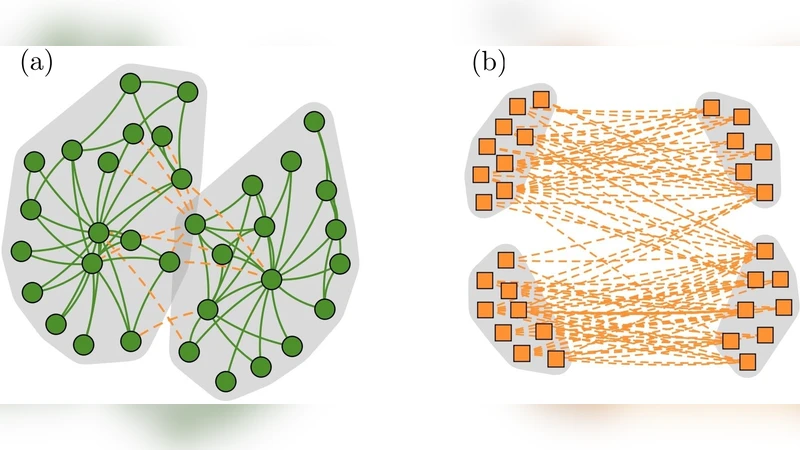
Community structure appears to be an intrinsic property of many complex real-world networks. However, recent work shows that real-world networks reveal even more sophisticated modules than classical cohesive (link-density) communities. In particular, networks can also be naturally partitioned according to similar patterns of connectedness among the nodes, revealing link-pattern communities. We here propose a propagation based algorithm that can extract both link-density and link-pattern communities, without any prior knowledge of the true structure. The algorithm was first validated on different classes of synthetic benchmark networks with community structure, and also on random networks. We have further applied the algorithm to different social, information, technological and biological networks, where it indeed reveals meaningful (composites of) link-density and link-pattern communities. The results thus seem to imply that, similarly as link-density counterparts, link-pattern communities appear ubiquitous in nature and design.
💡 Research Summary
The paper addresses a fundamental limitation of most community‑detection methods, which focus almost exclusively on densely connected (link‑density) clusters, overlooking communities that are defined by similar patterns of connectivity rather than direct ties. The authors propose a novel propagation‑based algorithm capable of uncovering both link‑density and link‑pattern communities without any prior knowledge of the number or nature of the groups.
The core of the method builds on the classic Label Propagation Algorithm (LPA). While LPA is extremely fast, its random update order leads to label oscillations and unstable results. To mitigate this, the authors introduce “balanced propagation”: each node is assigned a balancer bₙ derived from its normalized position iₙ in the random order, using a logistic function with parameters α (fixed to 0) and β (set to 0.25). This counteracts the bias introduced by the update sequence, giving early‑updated nodes stronger influence and later‑updated nodes weaker influence.
A second enhancement, “defensive preservation,” estimates a diffusion value dₙ for each node via random walks confined to its current community. The diffusion values act as additional preferences, reinforcing the community core and preventing a single label from dominating large portions of the network. The combined update rule becomes
cₙ = arg maxₗ ∑_{m∈Nₗ(n)} b_m d_m.
To extend the approach to link‑pattern communities, the authors observe that such groups become cohesive when second‑order neighborhoods (distance‑2 nodes) are considered. Consequently, they modify the propagation rule to incorporate both first‑order (direct neighbor) and second‑order contributions, weighted by a community‑specific parameter δₗ∈
Comments & Academic Discussion
Loading comments...
Leave a Comment