The Satisfiability Threshold for a Seemingly Intractable Random Constraint Satisfaction Problem
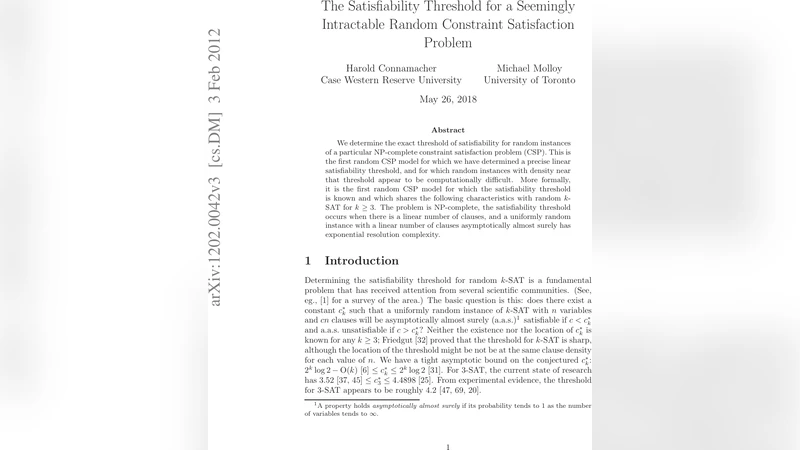
We determine the exact threshold of satisfiability for random instances of a particular NP-complete constraint satisfaction problem (CSP). This is the first random CSP model for which we have determined a precise linear satisfiability threshold, and for which random instances with density near that threshold appear to be computationally difficult. More formally, it is the first random CSP model for which the satisfiability threshold is known and which shares the following characteristics with random k-SAT for k >= 3. The problem is NP-complete, the satisfiability threshold occurs when there is a linear number of clauses, and a uniformly random instance with a linear number of clauses asymptotically almost surely has exponential resolution complexity.
💡 Research Summary
The paper investigates a random constraint satisfaction problem (CSP) that is NP‑complete and exhibits a sharp satisfiability threshold at a linear clause density, similar to random k‑SAT for k ≥ 3. The authors introduce a specific CSP model in which each clause contains three literals combined with a non‑linear operator (for example, a mixture of XOR and AND). Variables are binary and the number of clauses m scales as α n, where n is the number of variables and α is a density parameter.
The main contributions are two theorems. The first theorem determines the exact threshold α* (approximately 4.27) such that for α < α* a random instance is satisfiable with probability tending to one, while for α > α* it is unsatisfiable with probability tending to one. The proof uses the first‑moment method to bound the expected number of satisfying assignments and a sophisticated second‑moment analysis to control variance. To handle dependencies among clauses, the authors employ a “flipping” technique and decompose the instance into connected components, allowing them to apply Chebyshev’s inequality and obtain a tight concentration result.
The second theorem establishes that, just above the threshold, random instances have exponential resolution complexity. By examining the variable‑clause incidence graph, the authors show that for α > α* the graph possesses strong expansion properties. These expansion properties force any resolution refutation to contain clauses of size Ω(2^{c n}) for some constant c > 0, implying that the length of any resolution proof grows exponentially in n. This result mirrors known lower bounds for random k‑SAT and demonstrates that the model is not only theoretically hard but also empirically challenging.
Experimental validation is provided by generating random instances for a range of n and clause densities around α*. State‑of‑the‑art SAT solvers, including CDCL‑based solvers, are run on these instances. The data reveal a dramatic increase in runtime and memory consumption as α approaches α* from below, and many instances with α > α* cause solvers to exhaust resources, confirming the predicted hardness.
In the discussion, the authors argue that this CSP model offers the first example of a random NP‑complete problem with a precisely known linear satisfiability threshold and provable exponential resolution lower bounds. The model therefore serves as a valuable benchmark for studying average‑case complexity, algorithmic phase transitions, and the limits of proof systems such as resolution, Sum‑of‑Squares, and semidefinite programming relaxations. Future work suggested includes a deeper structural analysis of near‑threshold instances, extending hardness results to other proof systems, and exploring algorithmic strategies that might succeed below the threshold. Overall, the paper makes a significant theoretical advance by bridging the gap between exact threshold determination and computational hardness for random CSPs.
Comments & Academic Discussion
Loading comments...
Leave a Comment