Energy spectra of textbf{2D} gravity and capillary waves with narrow frequency band excitation
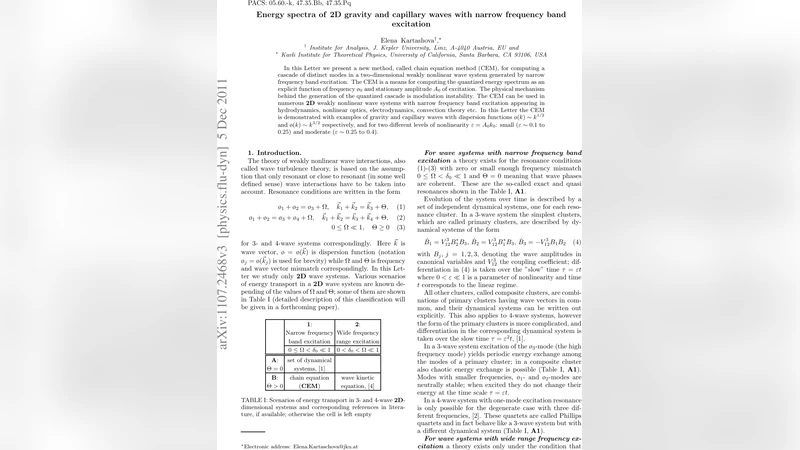
In this Letter we present a new method, called chain equation method (CEM), for computing a cascade of distinct modes in a two-dimensional weakly nonlinear wave system generated by narrow frequency band excitation. The CEM is a means for computing the quantized energy spectrum as an explicit function of frequency $\o_0$ and stationary amplitude $A_0$ of excitation. The physical mechanism behind the generation of the quantized cascade is modulation instability. The CEM can be used in numerous \textbf{2D} weakly nonlinear wave systems with narrow frequency band excitation appearing in hydrodynamics, nonlinear optics, electrodynamics, convection theory etc. In this Letter the CEM is demonstrated with examples of gravity and capillary waves with dispersion functions $\o(k) \sim k^{1/2}$ and $\o(k) \sim k^{3/2}$ respectively, and for two different levels of nonlinearity $\eps=A_0k_0$: small ($\eps\sim 0.1$ to 0.25) and moderate ($\eps\sim 0.25$ to 0.4).
💡 Research Summary
The paper introduces a novel analytical framework called the Chain Equation Method (CEM) for describing quantized energy cascades in two‑dimensional weakly nonlinear wave systems that are driven by narrow‑band frequency excitation. Traditional wave turbulence theory treats only exact or quasi‑resonant interactions, leading to continuous power‑law spectra derived from kinetic equations. However, many laboratory observations—especially under narrow‑band forcing—show discrete energy levels and step‑wise cascades that cannot be captured by kinetic theory.
CEM proceeds in three systematic steps. First, for each cascade step the side‑band (or “daughter”) frequencies are chosen such that the modulation instability (Benjamin‑Feir instability) attains its maximal growth rate. This yields a recurrence relation for the frequencies: ωₙ₊₁ = ωₙ ± ωₙ Aₙ kₙ, where the plus sign corresponds to a direct cascade (toward higher frequencies) and the minus sign to an inverse cascade. Second, the method assumes that a constant fraction p (0 < p < 1) of the energy of mode n is transferred to mode n + 1, which implies Aₙ₊₁ = √p Aₙ. Combining this with the frequency recurrence gives the “chain equation” √p Aₙ = A(ωₙ ± ωₙ Aₙ kₙ). Third, a Taylor expansion of the right‑hand side up to the second order provides a differential relation A′(ω) ≈ ±(√p − 1)/(ω k(ω)). Integration yields an explicit amplitude–frequency law A(ω) ≈ (√p − 1)∫dω/(ω k(ω)) + C, where C is fixed by the initial excitation parameters (ω₀, A₀). The energy spectrum follows as E(ω) ∝ A²(ω).
The authors apply CEM to two canonical wave families: gravity waves (dispersion ω ∝ k¹ᐟ²) and capillary waves (ω ∝ k³ᐟ²). For each family they treat two regimes of nonlinearity: (i) small steepness ε ≈ 0.1–0.25, where the classic Benjamin‑Feir condition Δω/(A k ω) = 1 holds, and (ii) moderate steepness ε ≈ 0.25–0.4, where higher‑order terms modify the instability condition to Δω/√(ωA k) − (3/2)ω²A²k² = 1.
In the small‑ε gravity‑wave case the solution reduces to A(ω) ≈ (1 − √p)² ω⁻² + C, giving a quantized energy spectrum Eₙ ∝ ωₙ⁻⁴ⁿ. The corresponding spectral density S(E) ∝ ω⁻⁵ matches the high‑frequency tail of the empirical JONSWAP spectrum, confirming that the discrete cascade reproduces known continuous statistics in the appropriate limit. For moderate ε the spectrum becomes a mixture of power‑law and exponential terms, e.g. Eₙ ∝ ωₙ⁻³ⁿ × exp
Comments & Academic Discussion
Loading comments...
Leave a Comment