The surprizing complexity of generalized reachability games
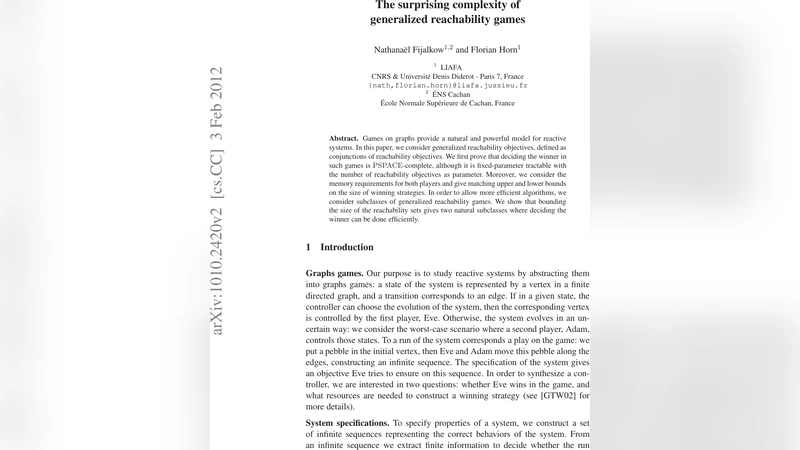
Games on graphs provide a natural and powerful model for reactive systems. In this paper, we consider generalized reachability objectives, defined as conjunctions of reachability objectives. We first prove that deciding the winner in such games is $\PSPACE$-complete, although it is fixed-parameter tractable with the number of reachability objectives as parameter. Moreover, we consider the memory requirements for both players and give matching upper and lower bounds on the size of winning strategies. In order to allow more efficient algorithms, we consider subclasses of generalized reachability games. We show that bounding the size of the reachability sets gives two natural subclasses where deciding the winner can be done efficiently.
💡 Research Summary
The paper investigates a natural extension of reachability games on directed graphs, where the winning condition for one of the players (traditionally called Eve) is a conjunction of several reachability objectives. Formally, given a finite arena G = (V, E) partitioned between Eve and Adam, and a family of target sets T₁,…,T_k ⊆ V, Eve wins a play if for every i she eventually visits some vertex in T_i. This “generalized reachability” objective captures the need to satisfy multiple safety or liveness requirements simultaneously, a situation that frequently arises in the verification of reactive systems.
Complexity classification.
The authors first establish that deciding the winner of a generalized reachability game is PSPACE‑complete. PSPACE‑hardness is proved by a polynomial‑time reduction from Quantified Boolean Formula (QBF) satisfiability. In the construction, each quantified variable is represented by a gadget that forces Eve (existential quantifiers) or Adam (universal quantifiers) to choose a truth value, while each clause of the QBF is encoded as a separate target set T_i. The game is designed so that Eve can force a visit to every clause‑target iff the original QBF is true. Consequently, solving the game is at least as hard as QBF, which is PSPACE‑complete. Membership in PSPACE follows from a standard on‑the‑fly exploration of the game graph: a configuration can be represented by the current vertex together with a bit‑mask indicating which of the k targets have already been visited. Since the mask has size k, the total number of distinct configurations is |V|·2^k, which can be explored using depth‑first search while reusing only polynomial space.
Fixed‑parameter tractability.
Although the problem is intractable in the general case, the authors show that it becomes fixed‑parameter tractable (FPT) when the number of reachability objectives k is taken as a parameter. The algorithm enumerates all 2^k possible subsets of targets, stores each as a bit‑vector, and performs a breadth‑first search on the product of the arena with this subset space. Each transition updates the bit‑vector by setting bits for any newly visited target sets. The overall running time is O(|V|·2^k·poly(|E|)), which is exponential only in k and polynomial in the size of the arena. Thus, for a small number of objectives—common in many verification scenarios—the winner can be decided efficiently.
Memory requirements for strategies.
A central contribution of the paper is a tight analysis of the memory needed by optimal strategies. For Eve, a winning strategy may have to remember exactly which subset of the k targets has already been satisfied, because future moves can depend on the remaining unsatisfied objectives. The authors construct families of games where any winning strategy for Eve indeed requires 2^k distinct memory states, matching the upper bound given by the bit‑mask representation. Conversely, Adam’s optimal counter‑strategy can be implemented with only O(k) memory, since he only needs to know whether a particular target has been visited to block Eve’s progress. The paper provides explicit game constructions that achieve both the lower and upper bounds, thereby proving the bounds are optimal.
Two tractable subclasses.
To obtain polynomial‑time algorithms, the authors identify two natural restrictions on the target sets:
-
Bounded target size. If each T_i contains at most a constant c vertices (e.g., c = 2 or 3), the game can be solved in polynomial time. The key observation is that the set of vertices that can potentially satisfy a given target is tiny, allowing a pre‑computation of all “reach‑to‑T_i” possibilities. By collapsing each target into a single representative node and performing a multi‑source BFS, the problem reduces to checking reachability in a graph of size O(|V|·c), which is polynomial.
-
Pairwise disjoint targets. When the target sets are mutually disjoint, the generalized reachability condition decomposes into independent subgames, each with a single reachability objective. The overall game is then equivalent to the conjunction of the outcomes of these subgames. Since single‑reachability games are solvable in linear time (via standard attractor computation), the conjunction can be decided by solving each subgame separately and intersecting the winning regions. This yields an overall O(k·|V|+|E|) algorithm.
Both subclasses are motivated by practical verification problems where either the individual safety conditions involve a small number of states, or the conditions are naturally orthogonal (e.g., separate hardware modules each requiring its own initialization).
Implications and conclusions.
The paper paints a nuanced picture of generalized reachability games. On the one hand, the PSPACE‑completeness result places the problem among the hardest known graph games, indicating that naïve algorithms will not scale to large instances. On the other hand, the fixed‑parameter tractability result and the polynomial‑time algorithms for the two subclasses provide concrete avenues for efficient analysis in realistic settings where the number of objectives or the structure of the objectives is limited. Moreover, the tight memory bounds clarify the intrinsic asymmetry between the two players: Eve may need exponential memory, while Adam can succeed with linear memory. This asymmetry has practical relevance for the synthesis of controllers (Eve’s strategies) versus the design of adversarial environments (Adam’s strategies).
Overall, the work advances the theoretical understanding of multi‑objective graph games and offers algorithmic tools that can be directly applied to the synthesis and verification of reactive systems with complex, conjunctive specifications.
Comments & Academic Discussion
Loading comments...
Leave a Comment