Improving the Convergence Properties of the Data Augmentation Algorithm with an Application to Bayesian Mixture Modeling
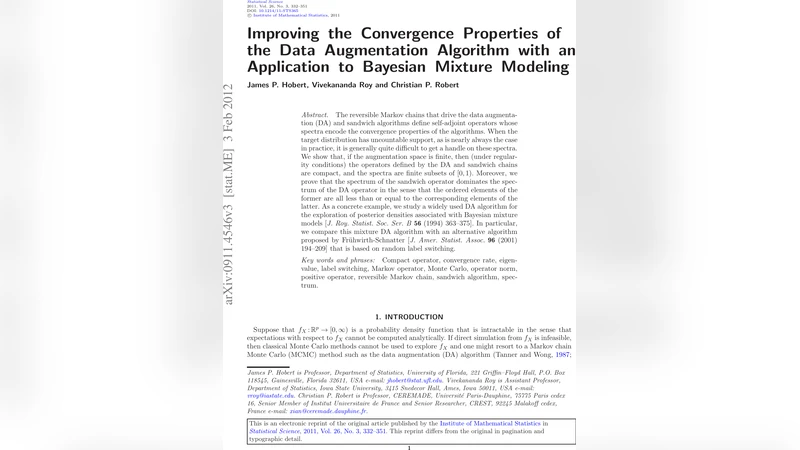
The reversible Markov chains that drive the data augmentation (DA) and sandwich algorithms define self-adjoint operators whose spectra encode the convergence properties of the algorithms. When the target distribution has uncountable support, as is nearly always the case in practice, it is generally quite difficult to get a handle on these spectra. We show that, if the augmentation space is finite, then (under regularity conditions) the operators defined by the DA and sandwich chains are compact, and the spectra are finite subsets of $[0,1)$. Moreover, we prove that the spectrum of the sandwich operator dominates the spectrum of the DA operator in the sense that the ordered elements of the former are all less than or equal to the corresponding elements of the latter. As a concrete example, we study a widely used DA algorithm for the exploration of posterior densities associated with Bayesian mixture models [J. Roy. Statist. Soc. Ser. B 56 (1994) 363–375]. In particular, we compare this mixture DA algorithm with an alternative algorithm proposed by Fr"{u}hwirth-Schnatter [J. Amer. Statist. Assoc. 96 (2001) 194–209] that is based on random label switching.
💡 Research Summary
The paper investigates the convergence behavior of Data Augmentation (DA) algorithms and their “sandwich” variants from the perspective of operator theory. Both algorithms generate reversible Markov chains whose transition kernels can be represented as self‑adjoint operators on an appropriate Hilbert space. The eigenvalues of these operators, especially the second largest eigenvalue (or spectral radius), dictate the geometric rate at which the chain approaches its stationary distribution.
When the augmentation (latent) space is infinite, as is typical for most Bayesian models, the spectrum of the associated operator is extremely hard to characterize. The authors therefore impose a finite‑augmentation‑space condition. Under mild regularity assumptions, they prove that the DA operator and the sandwich operator are compact. Compactness in a Hilbert space implies that the spectrum consists of a finite set of real eigenvalues lying in the interval (
Comments & Academic Discussion
Loading comments...
Leave a Comment