Nucleosynthesis and Gamma-Ray Line Spectroscopy with INTEGRAL
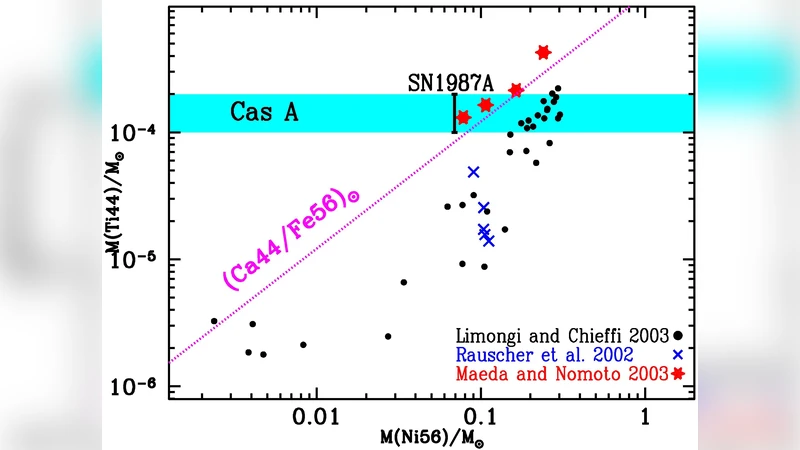
Cosmic nucleosynthesis co-produces unstable isotopes, which emit characteristic gamma-ray emission lines upon their radioactive decay that can be measured with SPI on INTEGRAL. High spectral resolution allows to derive velocity constraints on nucleosynthesis ejecta down to ~100 km/s. Core-collapse supernovae apparently do not always produce significant amounts of 44Ti, as in the Galaxy fewer sources than expected from the supernova rate have been found. INTEGRAL’s 44Ti data on the well-observed Cas A and SN1987A events are evidence that non-spherical explosions and 44Ti production may be correlated. Characteristic gamma-ray lines from radioactive decays of long-lived 26Al and 60Fe isotopes have been exploited to obtain information on the structure and dynamics of massive stars in their late evolution and supernovae, as their yields are sensitive to those details. The extended INTEGRAL mission establishes a database of sufficiently-deep observations of several specific regions of massive star groups, such as Cygnus, Carina, and Sco-Cen. In the inner Galaxy, 26Al nucleosynthesis gamma-rays help to unravel the Galaxy’s structure and the role of a central bar, as the kinematically-shifted 26Al gamma-ray line energy records the longitude-velocity behavior of hot interstellar gas. Thus, INTEGRAL has consolidated the feasibility of constraining cosmic nucleosynthesis through gamma-ray line observations. Due to its extended mission INTEGRAL maintains its chance to also see rare sufficiently-nearby events, such as a nova to provide first nova nucleosynthesis measurements of 7Be and 22Na production.
💡 Research Summary
This paper presents a comprehensive assessment of nucleosynthesis studies carried out with the Spectrometer on INTEGRAL (SPI), emphasizing the unique capability of high‑resolution gamma‑ray line spectroscopy to probe the production and ejection of radioactive isotopes in massive stars, supernovae, and the interstellar medium. The authors first discuss observations of the short‑lived isotope ^44Ti (half‑life ≈ 60 yr) through its characteristic lines at 68 keV, 78 keV, and 1157 keV. Despite the Galactic supernova rate, only a handful of ^44Ti sources have been detected, revealing a “^44Ti deficit” that challenges spherical explosion models. Detailed analysis of the well‑studied remnants Cassiopeia A and SN 1987A shows that the amount of ^44Ti produced is strongly correlated with evidence for asymmetric, jet‑like explosions. This supports three‑dimensional hydrodynamic simulations in which localized high‑temperature, high‑density regions boost ^44Ti synthesis, implying that non‑spherical dynamics are a key factor in the nucleosynthetic output of core‑collapse supernovae.
The paper then turns to the long‑lived isotopes ^26Al (half‑life ≈ 7.2 × 10⁵ yr, 1809 keV line) and ^60Fe (half‑life ≈ 2.6 × 10⁶ yr, lines at 1173 keV and 1333 keV). By accumulating deep exposures (hundreds of Ms) on several massive‑star complexes—Cygnus, Carina, and Sco‑Cen—the authors derive regional ^26Al/^60Fe flux ratios and compare them with predictions from state‑of‑the‑art stellar evolution models that include rotation, mass loss, and metallicity effects. The observed ratios provide stringent constraints on the late‑stage burning phases (C/Ne burning, s‑process neutron capture) and on the mixing of supernova ejecta into the surrounding interstellar medium. Moreover, the Galactic‑wide ^26Al map reveals a systematic Doppler shift of the 1809 keV line as a function of longitude, corresponding to velocity offsets of up to ±200 km s⁻¹. This kinematic signature traces the motion of hot, freshly‑ejected gas and offers an independent probe of the Milky Way’s large‑scale dynamics, including the presence and rotation speed of the central bar, which appears to drive non‑circular flows in the inner Galaxy.
A major strength of the INTEGRAL mission is its longevity; more than fifteen years of continuous operation have built a deep, homogeneous database that enables statistically robust studies of rare events. The authors highlight the prospect of detecting nearby novae, which are expected to emit gamma‑ray lines from ^7Be (477 keV) and ^22Na (1275 keV). Such a detection would constitute the first direct measurement of nova nucleosynthesis, testing models of thermonuclear runaway on white dwarfs. To maximize this opportunity, the paper discusses flexible scheduling, real‑time trigger algorithms, and optimized data pipelines that can respond rapidly to transient alerts.
In summary, the work demonstrates that gamma‑ray line spectroscopy with INTEGRAL provides a uniquely direct window onto the life cycles of massive stars: from core hydrogen and helium burning, through advanced stages that produce ^26Al and ^60Fe, to the explosive synthesis of ^44Ti in core‑collapse supernovae, and potentially to the thermonuclear processes in classical novae. The combination of precise line energies (allowing velocity measurements down to ~100 km s⁻¹), deep exposure maps of star‑forming regions, and the ability to monitor the Galactic plane over many years establishes INTEGRAL as a cornerstone facility for cosmic nucleosynthesis. The authors conclude that the accumulated data not only validate existing theoretical frameworks but also expose deficiencies—particularly in the treatment of explosion asymmetries—and set the stage for next‑generation gamma‑ray missions (e.g., AMEGO, e‑ASTROGAM) to build upon these foundations.