High Energy Neutrinos and Cosmic Rays
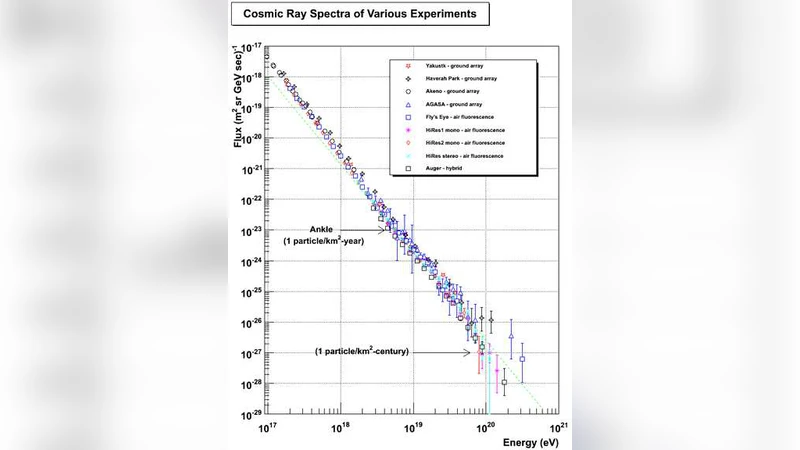
This is a summary of a series of lectures on the current experimental and theoretical status of our understanding of origin and nature of cosmic radiation. Specific focus is put on ultra-high energy cosmic radiation above ~10^17 eV, including secondary neutral particles and in particular neutrinos. The most important open questions are related to the mass composition and sky distributions of these particles as well as on the location and nature of their sources. High energy neutrinos at GeV energies and above from extra-terrestrial sources have not yet been detected and experimental upper limits start to put strong contraints on the sources and the acceleration mechanism of very high energy cosmic rays.
💡 Research Summary
The paper presents a comprehensive overview of the current experimental and theoretical status of ultra‑high‑energy cosmic rays (UHECRs) and their associated neutral secondaries, with a particular focus on high‑energy neutrinos. It begins by outlining why the energy range above ~10¹⁷ eV is of special interest: the cosmic‑ray spectrum exhibits a pronounced “ankle” and a subsequent suppression, indicating a transition from Galactic to extragalactic origins and challenging conventional supernova‑remnant acceleration models.
Recent measurements from the Pierre Auger Observatory and the Telescope Array are examined in detail. Both experiments use the depth of shower maximum (Xmax) to infer mass composition, and the data suggest a trend toward heavier nuclei at the highest energies, although systematic uncertainties arising from hadronic interaction models (e.g., EPOS‑LHC, QGSJet‑II‑04) remain large. The paper emphasizes that a reliable composition determination is essential for discriminating among candidate acceleration mechanisms.
The sky distribution of UHECRs is discussed next. Both Auger (Southern Hemisphere) and TA (Northern Hemisphere) have reported localized excesses—so‑called “hot spots”—that appear to correlate with nearby active galactic nuclei, radio galaxies, or other powerful extragalactic objects. However, the deflection of charged particles by Galactic and intergalactic magnetic fields complicates source identification, and the paper reviews current magnetic‑field models and their impact on back‑tracking analyses.
High‑energy neutrinos are presented as a clean probe of the acceleration sites because they travel undeflected and unabsorbed. The IceCube, ANTARES, and Baikal‑GVD detectors have conducted extensive searches for point‑like and diffuse astrophysical neutrino signals in the GeV–PeV range, yet no statistically significant detection associated with UHECR sources has been confirmed. Instead, the derived upper limits place strong constraints on the photon and matter densities surrounding candidate accelerators. In particular, the non‑observation of the expected neutrino flux from photohadronic (pγ) interactions implies that either the target photon fields are weaker than some models assume, or that the acceleration efficiency is lower.
Theoretical models of particle acceleration are compared, including first‑order Fermi acceleration at relativistic shocks, second‑order stochastic acceleration in turbulent regions, magnetic reconnection, and newer concepts such as magnetoluminescence. Each scenario predicts a characteristic spectral index, maximum energy (Emax), and associated neutrino and gamma‑ray fluxes. Current gamma‑ray background measurements and neutrino limits favor softer spectra (α≈2.3–2.5) over the harder α≈2.0 spectra often invoked in extreme‑acceleration models, prompting a re‑evaluation of the most viable mechanisms.
Future prospects are outlined in detail. Upgrades such as AugerPrime (adding scintillator detectors to improve charge discrimination) and TA×4 (quadrupling the surface area) will sharpen composition measurements and increase exposure. In the neutrino sector, IceCube‑Gen2 aims to enlarge the instrumented volume by an order of magnitude, lowering the flux sensitivity by 1–2 decades. Complementary Mediterranean (KM3NeT) and Siberian (Baikal‑GVD) arrays will provide full‑sky coverage. These next‑generation facilities are expected to simultaneously address two central goals: pinpointing the astrophysical sources of UHECRs and testing the underlying acceleration physics.
In conclusion, while many fundamental questions about the mass composition, source distribution, and acceleration processes of ultra‑high‑energy cosmic rays remain open, the current experimental upper limits on high‑energy neutrinos already impose stringent constraints on source environments. The forthcoming generation of cosmic‑ray and neutrino observatories promises to break existing degeneracies, potentially delivering the first definitive identification of the origins of the most energetic particles in the Universe.